Lessons Library
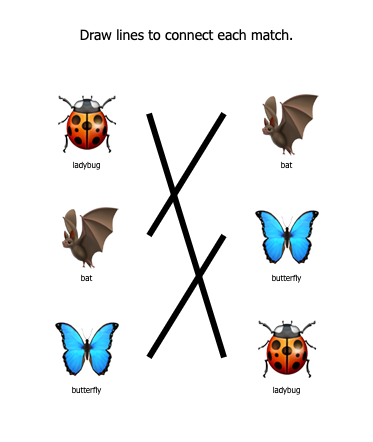
Comparing is a key aspect of learning. Given 2 columns of pictures, match each picture on the left with the same picture on the right. Explore what makes 2 pictures the same and what makes other pictures different. Matching activities introduce the concept of 1-to-1 correspondence. They help prepare students for counting.
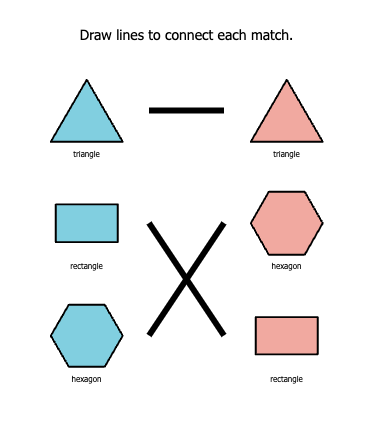
Introduce 2D shapes. Which shape on the left matches the same shape on the right? Matching sides and corners helps with one-to-one correspondence. Does a shape have an extra side or corner? Does it have more? If one shape has more, does the other shape have fewer? Match shapes to objects in the room.
Prerequisites: K-1
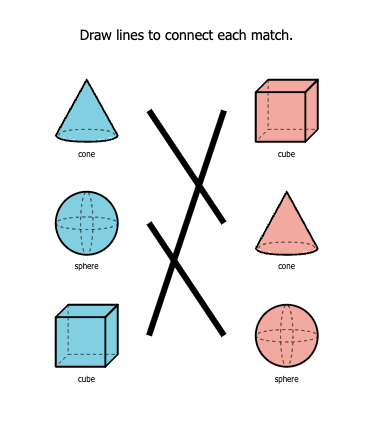
Introduce 3D solids. When possible, use real solids as well as pictures of solids. Recognize and learn their geometric names by making connections to common and familiar objects. Which solid looks like a can of soup? Which solid looks like an ice cream cone? Which looks like an ice cube? A box? A ball?
Prerequisites: K-2
K-001: Match Objects
Comparing is a key aspect of learning. Given 2 columns of pictures, match each picture on the left with the same picture on the right. Explore what makes 2 pictures the same and what makes other pictures different. Matching activities introduce the concept of 1-to-1 correspondence. They help prepare students for counting.
K-002: Match Shapes
Introduce 2D shapes. Which shape on the left matches the same shape on the right? Matching sides and corners helps with one-to-one correspondence. Does a shape have an extra side or corner? Does it have more? If one shape has more, does the other shape have fewer? Match shapes to objects in the room.
Prerequisites: K-1
K-003: Match Solids
Introduce 3D solids. When possible, use real solids as well as pictures of solids. Recognize and learn their geometric names by making connections to common and familiar objects. Which solid looks like a can of soup? Which solid looks like an ice cream cone? Which looks like an ice cube? A box? A ball?
Prerequisites: K-2
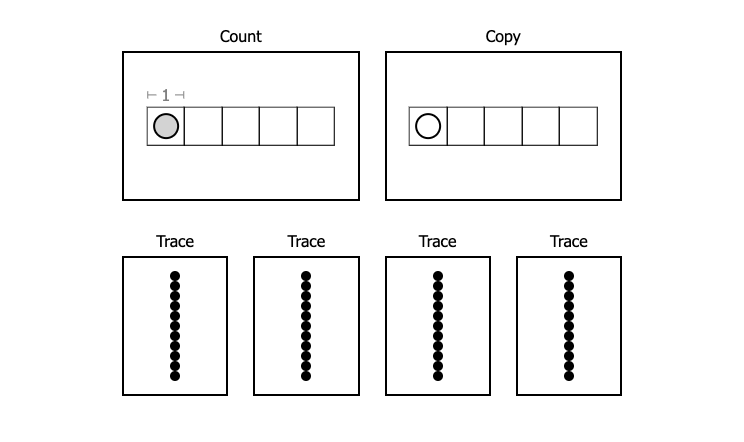
Introduce numbers to describe how many objects in a group or set. Use 1-to-1 correspondence to count and quantify the number of counters on a five frame. Emphasize that the last number counted represents the whole group of objects, not the last object. Count and draw counters on five frames. Learn digits by tracing.
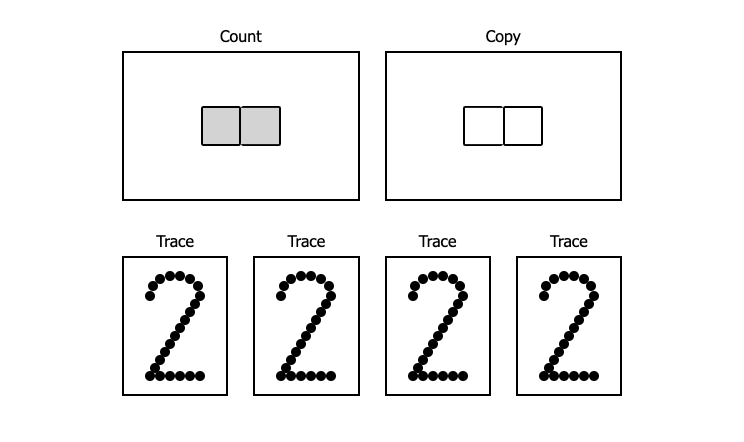
Use snap cubes as the go-to manipulative for modeling numbers concretely. They can be unsnapped or broken apart to find smaller parts. They can be snapped together or unitized to make the total or whole. Count, quantify, draw, and trace numbers to 5 using snap cubes.
Prerequisites: K-12
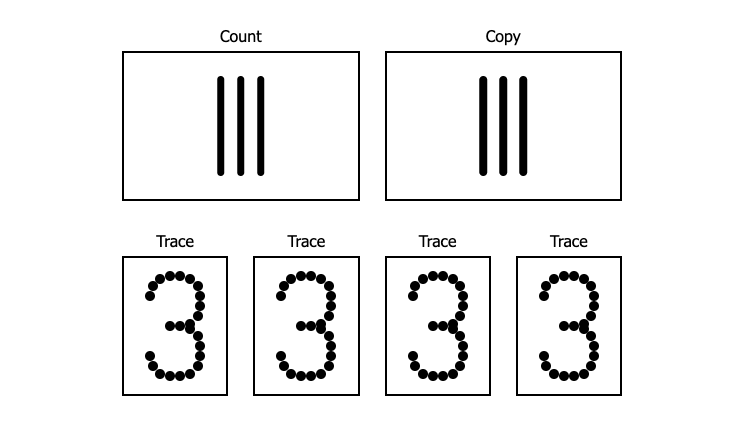
Draw tally marks to model numbers pictorially. Use straws, stirrers, and toothpicks to model concretely, and continue tracing digits to represent numbers abstractly. Why is the 5th tally drawn horizontally or diagonally instead of vertically like the other 4? Want to unitize and show 1 group of 5, instead of 5 groups of 1.
Prerequisites: K-13
K-012: Model and Trace Numbers to 5 using Five Frames
Introduce numbers to describe how many objects in a group or set. Use 1-to-1 correspondence to count and quantify the number of counters on a five frame. Emphasize that the last number counted represents the whole group of objects, not the last object. Count and draw counters on five frames. Learn digits by tracing.
K-013: Model and Trace Numbers to 5 using Snap Cubes
Use snap cubes as the go-to manipulative for modeling numbers concretely. They can be unsnapped or broken apart to find smaller parts. They can be snapped together or unitized to make the total or whole. Count, quantify, draw, and trace numbers to 5 using snap cubes.
Prerequisites: K-12
K-014: Model and Trace Numbers to 5 using Tally Marks
Draw tally marks to model numbers pictorially. Use straws, stirrers, and toothpicks to model concretely, and continue tracing digits to represent numbers abstractly. Why is the 5th tally drawn horizontally or diagonally instead of vertically like the other 4? Want to unitize and show 1 group of 5, instead of 5 groups of 1.
Prerequisites: K-13
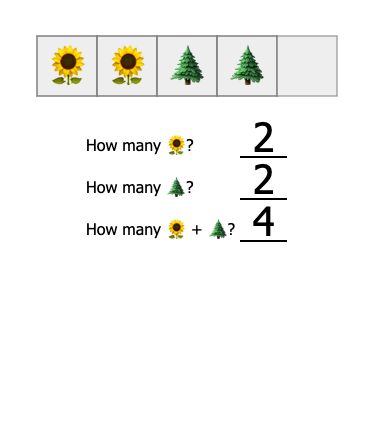
Use five frames to break a larger group – the total – into 2 smaller groups – the parts. Quantify how many are in each group, first by counting, and then by recognizing how many without counting. How many are in the first part? How many are in the second part? How many frames are empty? How many objects in all?
Prerequisites: K-26
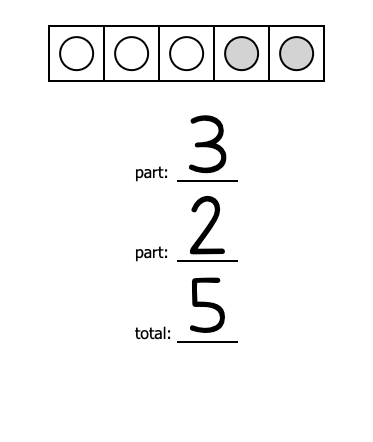
Use five frames to visually break a set of up to 5 counters into parts. Start by outlining each part. Count or subitize to know how many are in each group, and how many altogether. Recognize and read the words "part" and "total." Make sense of both by connecting the objects in the five frame with each digit being traced.
Prerequisites: K-27
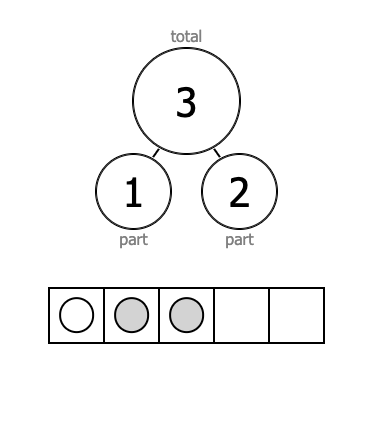
Introduce the number-bond symbol as a way to visualize the relationship between 2 parts and their total. Given 2 parts shown pictorially on a number-bond and concretely on a five frame, figure out the total – how many in all – by adding, grouping, subitizing, and counting, if needed.
Prerequisites: K-28
K-027: Quantify & Add to 5 using Five Frames
Use five frames to break a larger group – the total – into 2 smaller groups – the parts. Quantify how many are in each group, first by counting, and then by recognizing how many without counting. How many are in the first part? How many are in the second part? How many frames are empty? How many objects in all?
Prerequisites: K-26
K-028: Add Concretely by Identifying the Parts & Total
Use five frames to visually break a set of up to 5 counters into parts. Start by outlining each part. Count or subitize to know how many are in each group, and how many altogether. Recognize and read the words "part" and "total." Make sense of both by connecting the objects in the five frame with each digit being traced.
Prerequisites: K-27
K-029: Add Concretely using Number Bonds
Introduce the number-bond symbol as a way to visualize the relationship between 2 parts and their total. Given 2 parts shown pictorially on a number-bond and concretely on a five frame, figure out the total – how many in all – by adding, grouping, subitizing, and counting, if needed.
Prerequisites: K-28
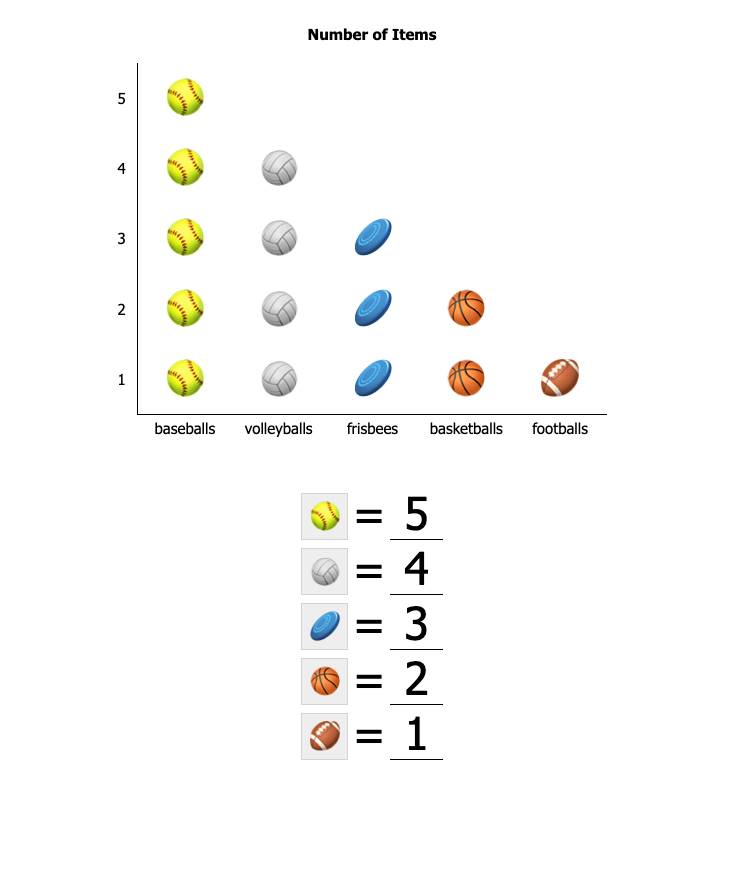
Use picture graphs to count backward and build number sense. Visually compare the number of items in each category to the number of items in the next category. Since it has 1 fewer item, the number is 1 less. Count backward to learn the number that comes before each number – a foundational skill for subtraction.
Prerequisites: K-21 ○ K-23
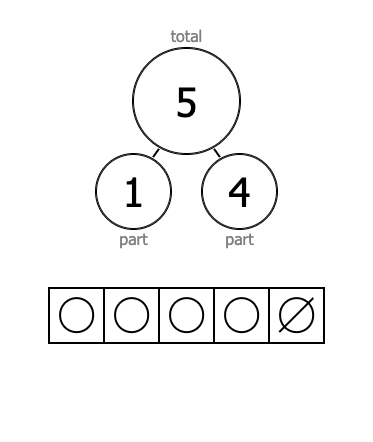
Introduce subtraction as "take away". Given the total and one of the parts on a number bond, find the other part. If the total is 5 and 1 is taken away, how many are left? Start by visualizing 5 on a five frame. Mentally cross off 1. How many are left? Draw or use counters to check that the answer is 4.
Prerequisites: K-30 ○ K-29, K-27, K-26
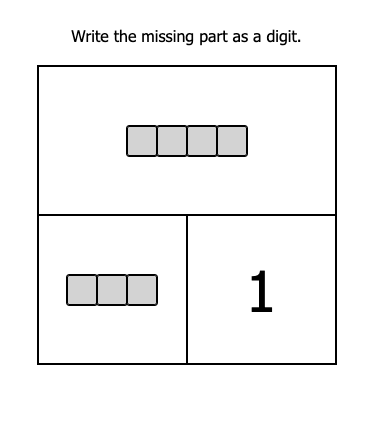
Use snap cubes, tally marks, and dice to model subtraction. Given the total and one of the parts, what's the other part? If there are 4 snap cubes and 3 snap cubes are taken away, how many snap cubes are left? Use number bonds to visualize the relationship between the 2 parts and the total. Draw to find the unknown part.
Prerequisites: K-40 ○ K-31, K-26
K-039: Picture Graphs to Count Backward
Use picture graphs to count backward and build number sense. Visually compare the number of items in each category to the number of items in the next category. Since it has 1 fewer item, the number is 1 less. Count backward to learn the number that comes before each number – a foundational skill for subtraction.
Prerequisites: K-21 ○ K-23
K-040: Take Away using Number Bonds & Five Frames
Introduce subtraction as "take away". Given the total and one of the parts on a number bond, find the other part. If the total is 5 and 1 is taken away, how many are left? Start by visualizing 5 on a five frame. Mentally cross off 1. How many are left? Draw or use counters to check that the answer is 4.
Prerequisites: K-30 ○ K-29, K-27, K-26
K-041: Take Away using Concrete Alternative Models
Use snap cubes, tally marks, and dice to model subtraction. Given the total and one of the parts, what's the other part? If there are 4 snap cubes and 3 snap cubes are taken away, how many snap cubes are left? Use number bonds to visualize the relationship between the 2 parts and the total. Draw to find the unknown part.
Prerequisites: K-40 ○ K-31, K-26
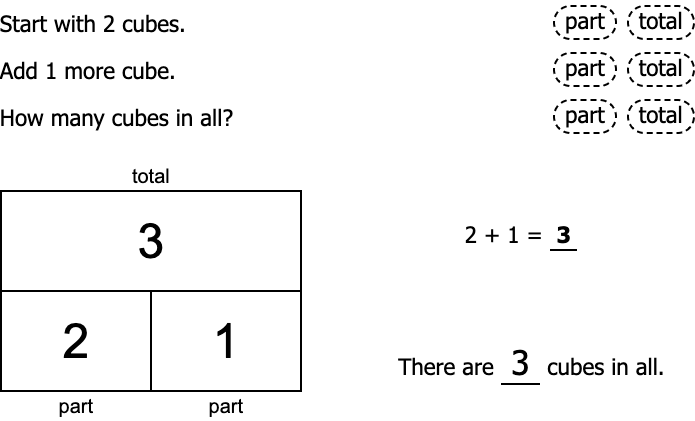
Start with learning problems – word problems that teach explicitly and don't require students to interpret context. Given the starting quantity and how much is added to it – find how many in all. Use a part-total diagram to visually show their relationship. Use snap cubes to model quantities and find the total.
Prerequisites: K-31
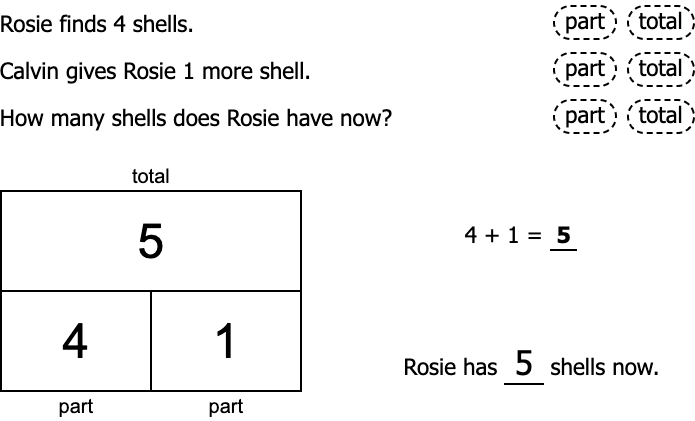
Transition to story problems that provide context and require interpretation. Given the starting quantity – the "start" – and how much is added to it – the "change" – find the sum or total – the "result." Use a part-total model to visually show their relationship. If needed, use five frames or snap cubes to do the arithmetic.
Prerequisites: K-49 ○ K-30
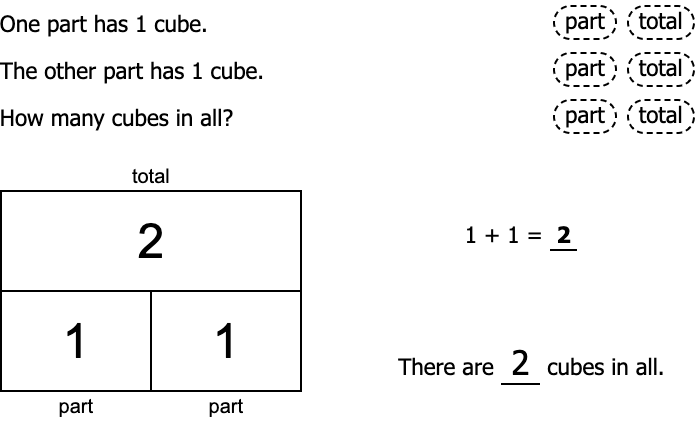
Model "Put-Together" problems. Instead of starting with one part and adding to it, start with two parts and join them together. If there is 1 cube in one part and 1 cube in the other part, how many cubes are there in all? Since 1+1=2, there are 2 cubes in all. Use a part-total model to visually show the relationship between the parts and total.
Prerequisites: K-49
K-049: Add-To Learning Problems
Start with learning problems – word problems that teach explicitly and don't require students to interpret context. Given the starting quantity and how much is added to it – find how many in all. Use a part-total diagram to visually show their relationship. Use snap cubes to model quantities and find the total.
Prerequisites: K-31
K-050: Add-To Story Problems
Transition to story problems that provide context and require interpretation. Given the starting quantity – the "start" – and how much is added to it – the "change" – find the sum or total – the "result." Use a part-total model to visually show their relationship. If needed, use five frames or snap cubes to do the arithmetic.
Prerequisites: K-49 ○ K-30
K-051: Put-Together Learning Problems
Model "Put-Together" problems. Instead of starting with one part and adding to it, start with two parts and join them together. If there is 1 cube in one part and 1 cube in the other part, how many cubes are there in all? Since 1+1=2, there are 2 cubes in all. Use a part-total model to visually show the relationship between the parts and total.
Prerequisites: K-49
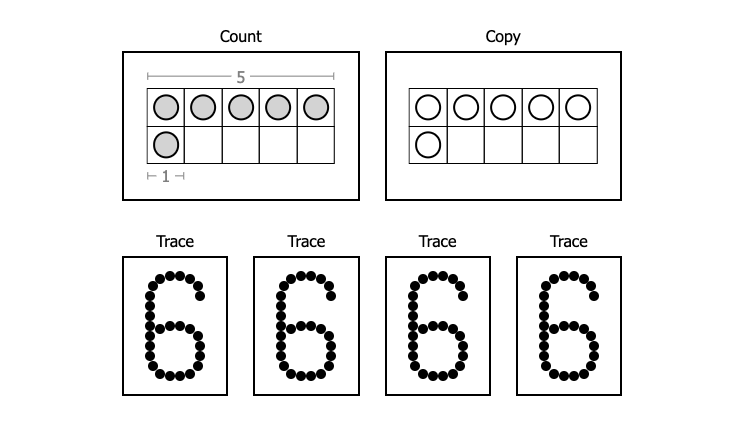
Model, count, and write numbers 6 thru 10. Use ten frames to leverage student understanding of five frames. Start modeling numbers by "anchoring" at 5. Fill the top row first, then add the rest. What's 8? 5 and 3. Later, can model 8 as 4 and 4, and 3 and 5. Learn to write the digits 6-9 by tracing.
Prerequisites: K-12
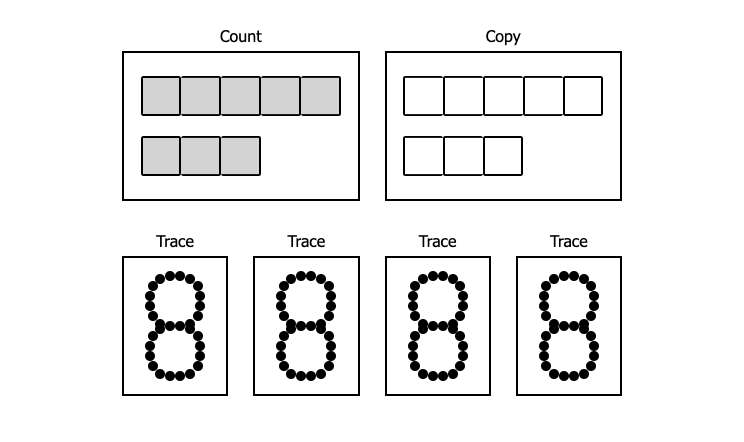
Continue to model numbers 6 to 10 as 5 plus some more. Use snap cubes – real, virtual, or drawn on paper. Snap cubes are important to use because they physically unitize ones into 1 unit. 5 ones can be 1 unit of 5. 8 ones can be 1 unit of 5 and 1 unit of 3. 10 ones can be 1 unit of 10, 2 units of 5, and many others, as well.
Prerequisites: K-59 ○ K-13
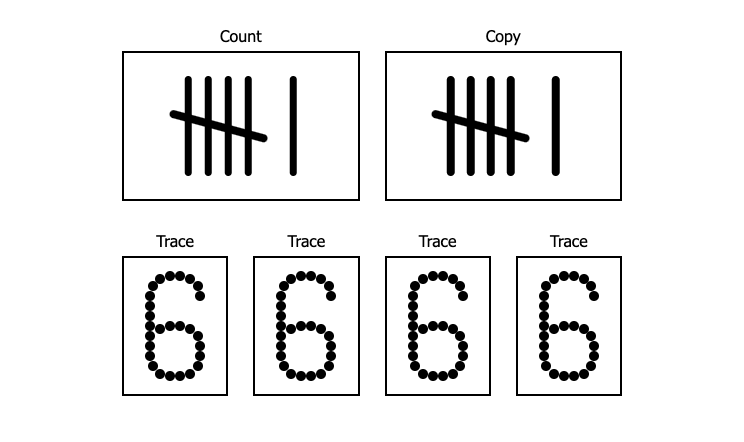
Reinforce part-whole thinking by thinking of numbers 6 to 10 as 5 and some more. Use tally marks, dice, and counters arranged in a circle to "anchor at 5" – then add the rest. What is 6? 5 and 1. What is 7? 5 and 2. Lay the groundwork for teen numbers as 10 and some more and numbers in the twenties as 20 and some more.
Prerequisites: K-60 ○ K-16, K-15, K-14
K-059: Model and Trace Numbers to 10 using Ten Frames
Model, count, and write numbers 6 thru 10. Use ten frames to leverage student understanding of five frames. Start modeling numbers by "anchoring" at 5. Fill the top row first, then add the rest. What's 8? 5 and 3. Later, can model 8 as 4 and 4, and 3 and 5. Learn to write the digits 6-9 by tracing.
Prerequisites: K-12
K-060: Model and Trace Numbers to 10 using Snap Cubes
Continue to model numbers 6 to 10 as 5 plus some more. Use snap cubes – real, virtual, or drawn on paper. Snap cubes are important to use because they physically unitize ones into 1 unit. 5 ones can be 1 unit of 5. 8 ones can be 1 unit of 5 and 1 unit of 3. 10 ones can be 1 unit of 10, 2 units of 5, and many others, as well.
Prerequisites: K-59 ○ K-13
K-061: Model and Trace Numbers to 10 using Alternative Models
Reinforce part-whole thinking by thinking of numbers 6 to 10 as 5 and some more. Use tally marks, dice, and counters arranged in a circle to "anchor at 5" – then add the rest. What is 6? 5 and 1. What is 7? 5 and 2. Lay the groundwork for teen numbers as 10 and some more and numbers in the twenties as 20 and some more.
Prerequisites: K-60 ○ K-16, K-15, K-14
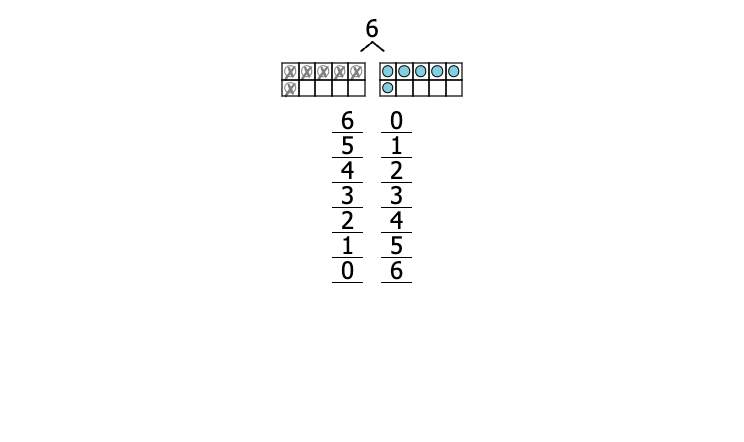
Shift 1 to find all the ways to make the numbers 6 thru 10. Discover and apply the commutative property. When the 2 parts are different, is there another number bond with the parts reversed? Is there a short cut for finding all the number bonds? Shift 1 to find a new number bond, then reverse the parts to find another one.
Prerequisites: K-56
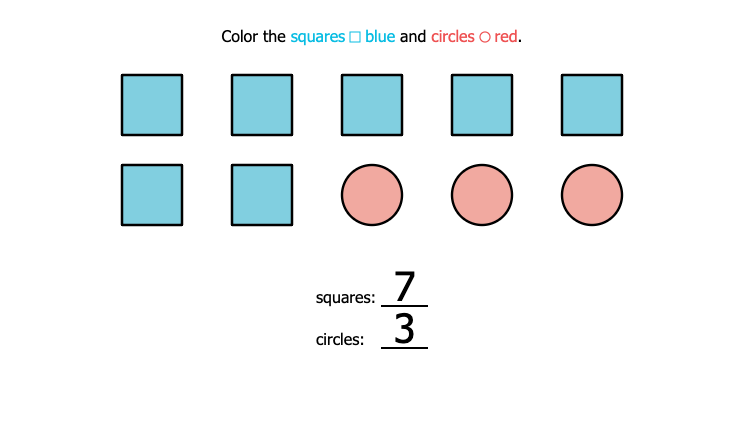
Use "imaginary" ten frames to model combinations of 10 with flat shapes and 3-dimensional solids. Identify both parts and the total using grouping instead of counting strategies. Start by showing parts in familiar ways – 7 is full top row plus 2 more. Generalize to less familiar and more creative ways to think about numbers.
Prerequisites: K-74 ○ K-67, K-3, K-2
Enrich by using "imaginary" ten frames to model combinations of 10. Generalize by finding 3 parts instead of just 2. Identify all 3 parts and the total using grouping instead of counting strategies.
Prerequisites: K-75
K-074: Number Bonds using the Shift 1 Strategy
Shift 1 to find all the ways to make the numbers 6 thru 10. Discover and apply the commutative property. When the 2 parts are different, is there another number bond with the parts reversed? Is there a short cut for finding all the number bonds? Shift 1 to find a new number bond, then reverse the parts to find another one.
Prerequisites: K-56
K-075: Model Combinations of 10 with 2 Parts
Use "imaginary" ten frames to model combinations of 10 with flat shapes and 3-dimensional solids. Identify both parts and the total using grouping instead of counting strategies. Start by showing parts in familiar ways – 7 is full top row plus 2 more. Generalize to less familiar and more creative ways to think about numbers.
Prerequisites: K-74 ○ K-67, K-3, K-2
K-076: Model Combinations of 10 with 3 Parts
Enrich by using "imaginary" ten frames to model combinations of 10. Generalize by finding 3 parts instead of just 2. Identify all 3 parts and the total using grouping instead of counting strategies.
Prerequisites: K-75
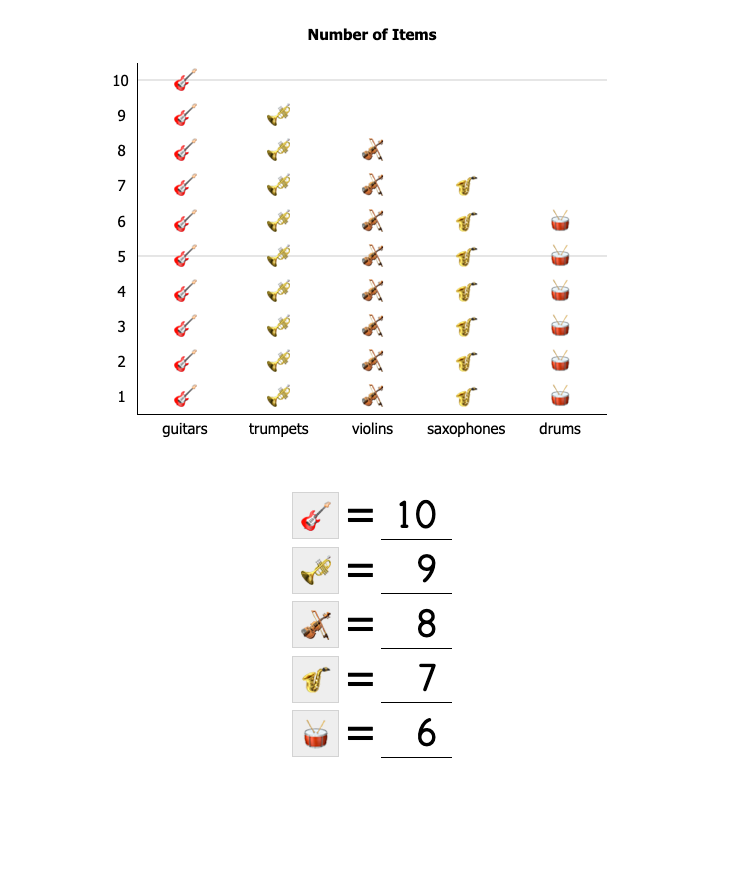
Use picture graphs to count backward and build number sense. Visually compare the number of items in each category to the number of items in the next category. Since it has 1 fewer item, the number is 1 less. Count backward to learn the number that comes before each number – a foundational skill for subtracting.
Prerequisites: K-64 ○ K-66
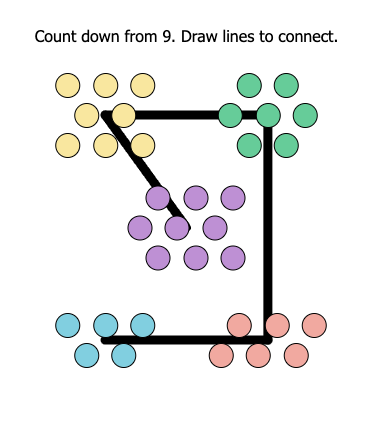
Build number sense by thinking about numbers in decreasing order. Represent numbers as groups of discrete objects. Use grouping strategies to quantify, without counting, how many in each group. Draw a line from the largest group or number to the next largest until all the numbers are connected.
Prerequisites: K-66
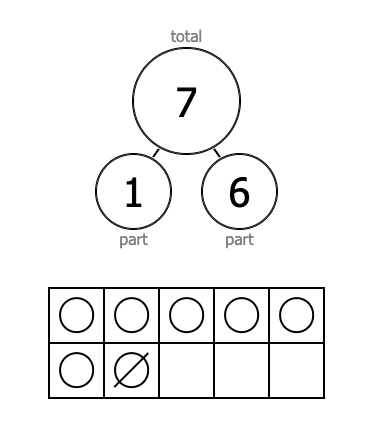
Use number bonds and ten frames to find the unknown part. Given the total amount ("start") and the part taken away ("change"), find the part that's left ("result"). Imagine the total as counters or circles on a ten frame. Mentally take away or cross off part. How many are left? Check for accuracy by drawing.
Prerequisites: K-87 ○ K-86, K-48
K-089: Count Backward with Picture Graphs
Use picture graphs to count backward and build number sense. Visually compare the number of items in each category to the number of items in the next category. Since it has 1 fewer item, the number is 1 less. Count backward to learn the number that comes before each number – a foundational skill for subtracting.
Prerequisites: K-64 ○ K-66
K-090: Count Backward with Sets & Digits
Build number sense by thinking about numbers in decreasing order. Represent numbers as groups of discrete objects. Use grouping strategies to quantify, without counting, how many in each group. Draw a line from the largest group or number to the next largest until all the numbers are connected.
Prerequisites: K-66
K-091: Find the Unknown Part with Number Bonds
Use number bonds and ten frames to find the unknown part. Given the total amount ("start") and the part taken away ("change"), find the part that's left ("result"). Imagine the total as counters or circles on a ten frame. Mentally take away or cross off part. How many are left? Check for accuracy by drawing.
Prerequisites: K-87 ○ K-86, K-48
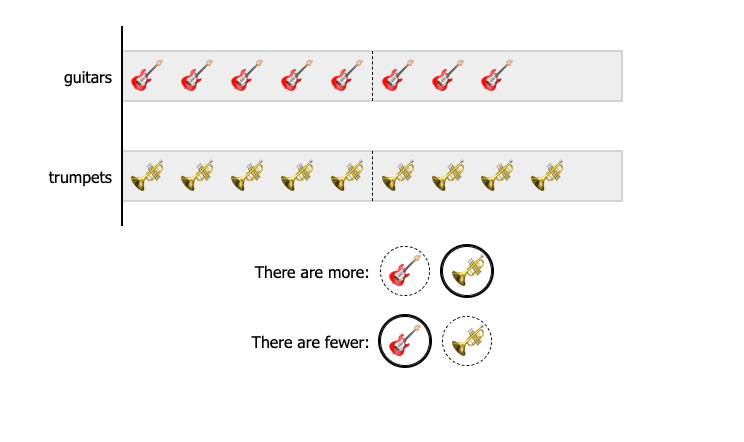
Compare the objects in 2 groups visually using a linear model. Compare without knowing how many are in either group. Focus instead on the extra objects in the group with more, or the missing objects in the group with fewer. Learn the comparison word "more" and the more difficult comparison word "fewer."
Prerequisites: K-63 ○ K-62
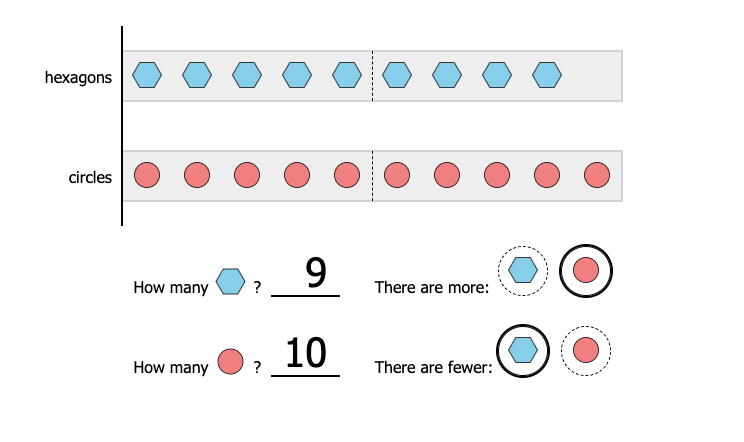
Use a linear model to quantify and compare the objects in 2 groups. Figure out how many are in each group by counting, grouping, adding, and comparing. Which group has more? Circle the extra objects. Which group has fewer? Circle the spot where objects are missing. This lays the foundation for finding the difference, later.
Prerequisites: K-99
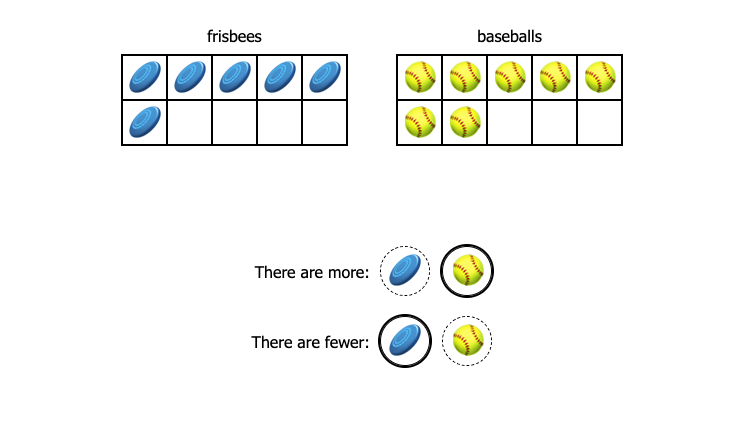
Now compare numbers modeled with ten frames. Encourage part-total thinking by using a compare-the-parts strategy. To compare larger totals, first find parts that are the same and balance each other out – like the top rows. Now just compare the parts that are left. Comparing smaller parts is easier than comparing larger totals.
Prerequisites: K-100 ○ K-99, K-62
K-099: Compare Groups to 10 with Linear Models
Compare the objects in 2 groups visually using a linear model. Compare without knowing how many are in either group. Focus instead on the extra objects in the group with more, or the missing objects in the group with fewer. Learn the comparison word "more" and the more difficult comparison word "fewer."
Prerequisites: K-63 ○ K-62
K-100: Compare and Quantify Groups to 10 with Linear Models
Use a linear model to quantify and compare the objects in 2 groups. Figure out how many are in each group by counting, grouping, adding, and comparing. Which group has more? Circle the extra objects. Which group has fewer? Circle the spot where objects are missing. This lays the foundation for finding the difference, later.
Prerequisites: K-99
K-101: Compare Groups to 10 with Ten Frames
Now compare numbers modeled with ten frames. Encourage part-total thinking by using a compare-the-parts strategy. To compare larger totals, first find parts that are the same and balance each other out – like the top rows. Now just compare the parts that are left. Comparing smaller parts is easier than comparing larger totals.
Prerequisites: K-100 ○ K-99, K-62
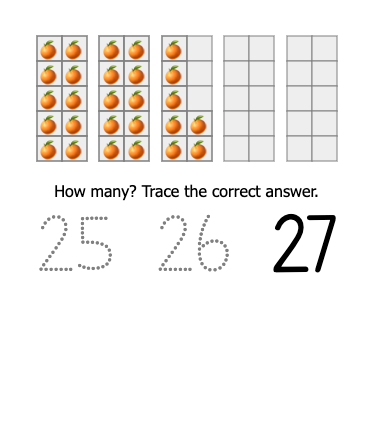
When counting, make sense of numbers and number names by grouping objects in tens and ones. Use vertical ten frames so students can subitize and keep track of how many they have counted. Emphasize that the last number counted represents the whole set of objects, not the last object counted.
Prerequisites: K-112
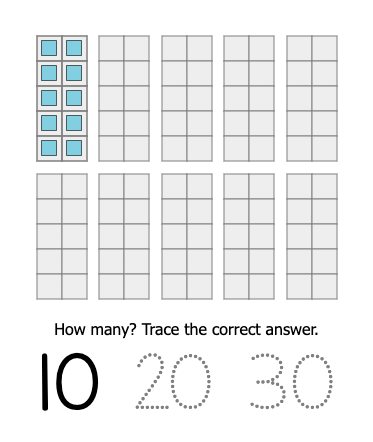
Transition from counting by ones to counting by tens. Model multiples of 10 with ten frames to connect each name with a concrete, visual image. When counting, reinforce Base 10 thinking by saying the quantity, place value, and total value. "1 ten is 10, 2 tens is 20, 3 tens is 30." When ready, skip count. "Ten, twenty, thirty."
Prerequisites: K-113
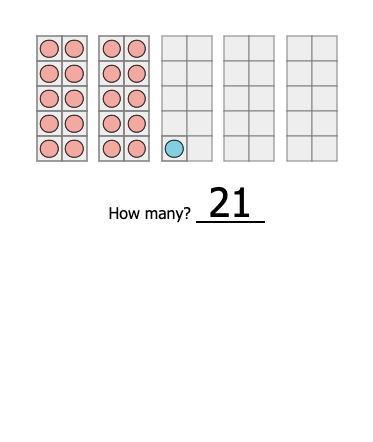
Use quick images to encourage Base 10 thinking. Subitize how many by thinking in groups of ten with ten frames, instead of counting. Start by asking how many. Progress to asking how many more make another 10 and the next multiple of 10. When ready, ask both questions. Limit processing time to develop fluency.
Prerequisites: K-114
K-113: Numbers to 50 - Count All and Count On by 1s
When counting, make sense of numbers and number names by grouping objects in tens and ones. Use vertical ten frames so students can subitize and keep track of how many they have counted. Emphasize that the last number counted represents the whole set of objects, not the last object counted.
Prerequisites: K-112
K-114: Numbers to 50 - Count All by 10s
Transition from counting by ones to counting by tens. Model multiples of 10 with ten frames to connect each name with a concrete, visual image. When counting, reinforce Base 10 thinking by saying the quantity, place value, and total value. "1 ten is 10, 2 tens is 20, 3 tens is 30." When ready, skip count. "Ten, twenty, thirty."
Prerequisites: K-113
K-115: Numbers to 50 - Subitize with Ten Frames
Use quick images to encourage Base 10 thinking. Subitize how many by thinking in groups of ten with ten frames, instead of counting. Start by asking how many. Progress to asking how many more make another 10 and the next multiple of 10. When ready, ask both questions. Limit processing time to develop fluency.
Prerequisites: K-114
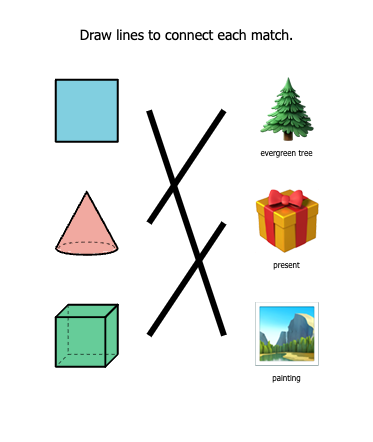
Help students recognize, understand, and remember the names of flat and solid shapes by connecting them to more familiar objects. What is shaped like a cube – a tree, a present, or a picture on a wall? Associating shapes and common objects makes it easier to learn their names and visualize what they look like.
Prerequisites: K-6
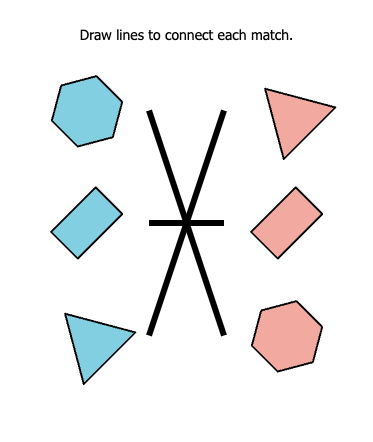
If a rectangle is rotated, is it still a rectangle? What if it's sized larger or smaller? In either case, it is still a rectangle. Orientation and size are "non-defining attributes." They describe shapes and solids, but don't define them. Match shapes and solids, and explore what makes them the same or different.
Prerequisites: K-121 ○ K-8
K-121: Connect Shapes & Common Objects
Help students recognize, understand, and remember the names of flat and solid shapes by connecting them to more familiar objects. What is shaped like a cube – a tree, a present, or a picture on a wall? Associating shapes and common objects makes it easier to learn their names and visualize what they look like.
Prerequisites: K-6
K-122: Identify Rotated Shapes
If a rectangle is rotated, is it still a rectangle? What if it's sized larger or smaller? In either case, it is still a rectangle. Orientation and size are "non-defining attributes." They describe shapes and solids, but don't define them. Match shapes and solids, and explore what makes them the same or different.
Prerequisites: K-121 ○ K-8
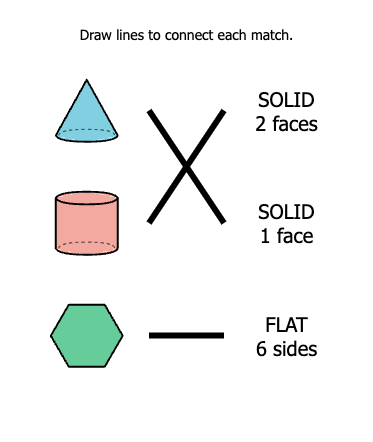
K-123: Identify Defining Attributes of 2D & 3D Shapes
Identify defining attributes of 2 and 3-dimensional shapes. Is the shape flat or a solid? If the shape is flat, how many sides does it have? Are the sides all equal? How many corners or vertices does it have? If the shape is a solid, how many faces does it have?
Prerequisites: K-122 ○ K-6, K-5
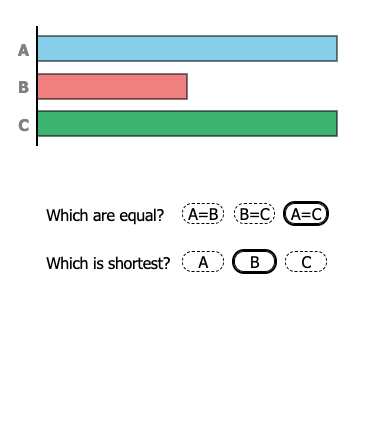
To prepare for fractions, apply the concept of "equal" to length. Use the equal symbol (=) to mean "has the same length as." "B = C" means "B has the same length as C." Given 3 colored bars – A, B, and C – which 2 bars are the same length? Which bar is the longest? Which bar is the shortest?
Prerequisites: K-71 ○ K-88
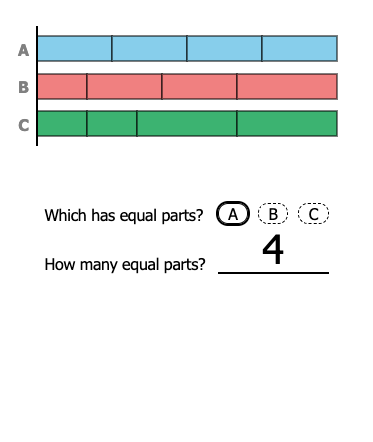
Introduce fractional parts that are equal in size and together make the whole. Use length models – colored rods, strips of paper, drawn bars – to model part-whole relationships. Which bar has equal parts? How many equal parts? What is the name of each part? Learn 2 halves, 3 thirds, and 4 fourths make the whole.
Prerequisites: K-131
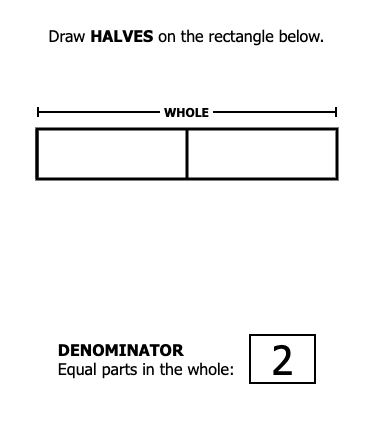
Draw fractions by dividing a bar into equal parts. To draw 2 halves, draw a dot in the middle of the bar and a vertical line thru the dot. To make 4 fourths, draw dots in the middle of each half and 2 more vertical lines thru the dots. To draw 3 thirds, practice drawing 2 vertical lines that make 3 equal parts. Generalize to area.
Prerequisites: K-132
K-131: Apply the Meaning of Equal to Length
To prepare for fractions, apply the concept of "equal" to length. Use the equal symbol (=) to mean "has the same length as." "B = C" means "B has the same length as C." Given 3 colored bars – A, B, and C – which 2 bars are the same length? Which bar is the longest? Which bar is the shortest?
Prerequisites: K-71 ○ K-88
K-132: Recognize & Name Equal Fractional Parts
Introduce fractional parts that are equal in size and together make the whole. Use length models – colored rods, strips of paper, drawn bars – to model part-whole relationships. Which bar has equal parts? How many equal parts? What is the name of each part? Learn 2 halves, 3 thirds, and 4 fourths make the whole.
Prerequisites: K-131
K-133: Divide & Draw Equal Fractional Parts
Draw fractions by dividing a bar into equal parts. To draw 2 halves, draw a dot in the middle of the bar and a vertical line thru the dot. To make 4 fourths, draw dots in the middle of each half and 2 more vertical lines thru the dots. To draw 3 thirds, practice drawing 2 vertical lines that make 3 equal parts. Generalize to area.
Prerequisites: K-132
Additional Resources
Kindergarten math centers on two main critical areas: representing, relating, and operating on whole numbers (starting with concrete sets of objects) and describing shapes and space. Students build foundational number sense by learning to count to 100 by ones and tens, recognize and write numbers from 0 to 20, and understand that each successive number name refers to a quantity that is one more. They count objects to tell "how many," compare numbers (using terms like greater than, less than, or equal to), and begin to model simple addition and subtraction as "putting together" or "taking apart" within 10. Place-value foundations emerge as students work with numbers 11-19, decomposing them into tens and ones. Measurement and data concepts introduce describing and comparing measurable attributes (length, weight, capacity) using direct comparison rather than tools. They classify objects into categories, count the number in each, and sort by attributes. Geometry focuses on identifying, naming, and describing basic two- and three-dimensional shapes (squares, circles, triangles, rectangles, cubes, cones, cylinders, spheres) in various orientations and sizes, while exploring spatial relationships like above, below, beside, and in front of. Throughout the year, students use concrete objects, drawings, and manipulatives to develop these ideas, laying the groundwork for more abstract thinking in later grades.
K.CC.2 Count forward beginning from a given number (instead of having to begin at 1).
K.CC.3 Write numbers from 0 to 20. Represent a number of objects with a written numeral 0-20. Count to tell the number of objects.
K-12, K-13, K-14, K-15, K-16, K-24, K-59, K-60, K-61, K-62, K-103
K.CC.4 Understand the relationship between numbers and quantities; connect counting to cardinality. When counting objects, say the number names in the standard order, pairing each object with one and only one number name and each number name with one and only one object.
K-17, K-18, K-19, K-22, K-23, K-65, K-66, K-90, K-106, 1-6, 1-11
K.CC.5 Count to answer "how many?" questions about as many as 20 things arranged in a line, rectangular array, or circle, or as many as 10 things in a scattered configuration; given a number from 1-20, count out that many objects.
K-20, K-21, K-24, K-25, K-26, K-27, K-39, K-62, K-63, K-64, K-67, K-68, K-72, K-73, K-77, K-89, K-100, K-102, K-103, K-104, K-105, K-107, K-108, K-109, K-110, K-115, K-118, 1-1, 1-2, 1-3, 1-4, 1-5
K.CC.6 Identify whether the number of objects in one group is greater than, less than, or equal to the number of objects in another group (e.g. matching & counting).
K-20, K-21, K-63, K-64, K-89, K-99, K-100, K-101, K-102, K-107, K-108, 1-4, 1-5
K.OA.1 Represent addition and subtraction with objects, fingers, mental images, drawings, sounds, acting situations, verbal explanations, expressions, or equations.
K-28, K-29, K-30, K-31, K-32, K-33, K-34, K-40, K-41, K-42, K-43, K-44, K-78, K-79, K-80, K-81, K-82, K-83, K-86, K-87, K-91, K-92, K-94, K-95, K-96, 1-8, 1-13
K.OA.2 Solve addition and subtraction word problems, and add and subtract within 10 (e.g. by using objects or drawings to represent the problems).
K-49, K-50, K-51, K-52, K-53, K-54, K-55, K-57, K-58, K-84, K-85, K-97, K-98, 1-9, 1-10, 1-14, 1-15
K.OA.3 Decompose numbers less than or equal to 10 into pairs in more than one way (e.g. by using objects, record each decomposition by a drawing or equation (ex 5=2+3 and 5=4+1).
K.OA.4 For any number from 1 to 9, find the number that makes 10 when added to the given number, e.g., by using objects or drawings, and record the answer with a drawing or equation.
K.OA.5 Fluently add and subtract within 5.
K-32, K-33, K-34, K-36, K-37, K-38, K-42, K-43, K-44, K-46, K-47, K-48, 1-7, 1-12
K.NBT.1 Compose and decompose numbers from 11 to 19 into ten ones and some further ones, e.g., by using objects or drawings, and record each composition or decomposition by a drawing or equation (such as 18 = 10 + 8); understand that these numbers are composed of ten ones and one, two, three, four, five, six, seven, eight, or nine ones.
K.MD.1 Describe measurable attributes of objects, such as length or weight. Describe several measurable attributes of a single object.
K.MD.2 Directly compare two objects with a measurable attribute in common, to see which object has more of/less of the attribute, and describe the difference. For example, directly compare the heights of two children and describe one child as taller/shorter.
K.MD.3 Classify objects into given categories; count the numbers of objects in each category and sort the categories by count.
K.G.1 Describe objects in the environment using names of shapes, and describe the relative positions of these objects using terms such as above, below, beside, in front of, behind, and next to.
K.G.2 Correctly name shapes regardless of their orientations or overall size.
K.G.3 Identify shapes as two-dimensional (lying in a plane, "flat") or three-dimensional ("solid").
K.G.4 Analyze and compare two- and three-dimensional shapes, in different sizes and orientations, using informal language to describe their similarities, differences, parts (e.g., number of sides and vertices/"corners") and other attributes (e.g., having sides of equal length).
K.G.5 Model shapes in the world by building shapes from components (e.g., sticks and clay balls) and drawing shapes.
K.G.6 Compose simple shapes to form larger shapes. For example, "Can you join these two triangles with full sides touching to make a rectangle?"
Review key concepts including adding and subtracting within 10, numbers to 100, and making sense of word problems.
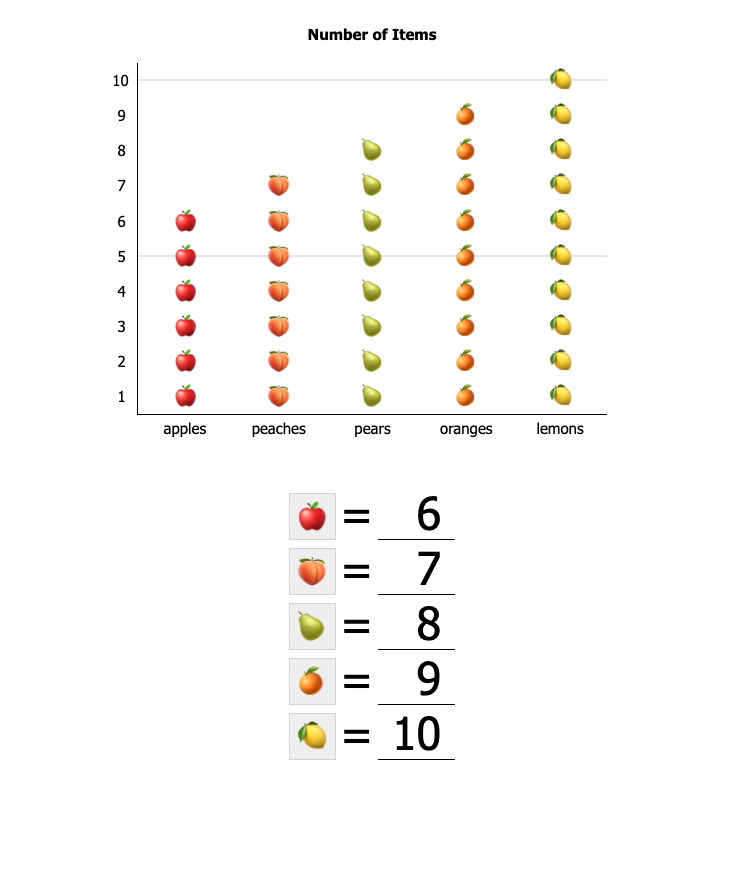
Generalize by representing the numbers 6 to 10 visually with vertical instead of horizontal picture graphs. Figure out how many in each column by counting, comparing, joining, taking away, and reading the vertical axis. Enrich by finding the difference – how many more, or fewer. Practice writing digits from memory.
Prerequisites: K-21 ○ K-63
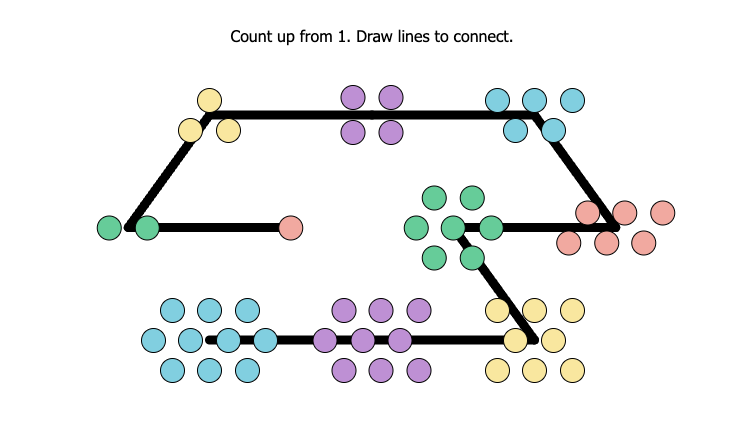
Make sense of numbers to 10 by putting sets of objects and digits in increasing order. Transition from rote counting to understanding the natural numbers as a sequence of quantities that increases by 1. 7 is 1 more than 6. 8 is 1 more than 7. 9 is 1 more than 8, and 10 is 1 more than 9.
Prerequisites: K-22 ○ K-63
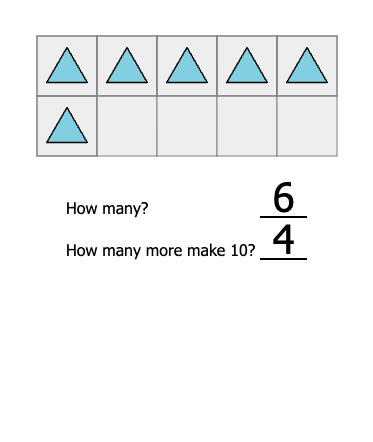
Continue to encourage part-total thinking. Subitize both parts of a ten frame. How many are there and how many are missing – how many more are needed to make 10, the total. Subitize daily to build number sense, master the all-important combinations of 10, recognize shapes and solids, and learn geometric names.
Prerequisites: K-67 ○ K-26
K-064: Vertical Picture Graphs to 10
Generalize by representing the numbers 6 to 10 visually with vertical instead of horizontal picture graphs. Figure out how many in each column by counting, comparing, joining, taking away, and reading the vertical axis. Enrich by finding the difference – how many more, or fewer. Practice writing digits from memory.
Prerequisites: K-21 ○ K-63
K-065: Count Forward to 10
Make sense of numbers to 10 by putting sets of objects and digits in increasing order. Transition from rote counting to understanding the natural numbers as a sequence of quantities that increases by 1. 7 is 1 more than 6. 8 is 1 more than 7. 9 is 1 more than 8, and 10 is 1 more than 9.
Prerequisites: K-22 ○ K-63
K-068: Subitize Numbers to 10 with Ten Frames: Part II
Continue to encourage part-total thinking. Subitize both parts of a ten frame. How many are there and how many are missing – how many more are needed to make 10, the total. Subitize daily to build number sense, master the all-important combinations of 10, recognize shapes and solids, and learn geometric names.
Prerequisites: K-67 ○ K-26
Review key concepts including single-digit fact fluency, adding 1-digit and 2-digit numbers, subtracting multiples of ten, and geometric measurement.
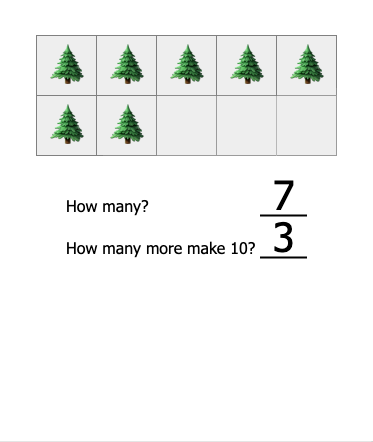
Progress from static images, to finding combinations that make 10 on quick images. Show ten frames for 3 seconds or less to limit processing time, encourage grouping instead of counting, and build number sense. Use non-counting strategies to quickly figure out how many and how many more makes 10.
Prerequisites: K-68, K-67
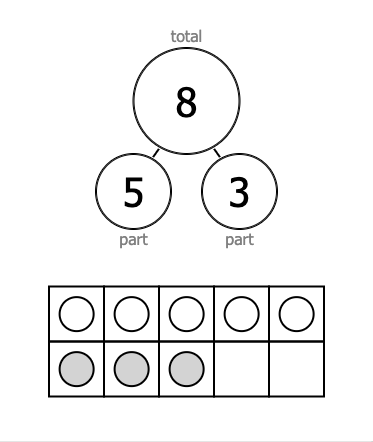
Use number bonds and ten frames to find the total. What's 5 and 3 more? Visualize 5 on a ten frame – the top row is full. Visualize 3 more below. How many in all? Since 2 are missing, the total is 8. Check for accuracy by drawing counters. Encourage students to check their thinking and make adjustments when needed.
Prerequisites: K-78 ○ K-38
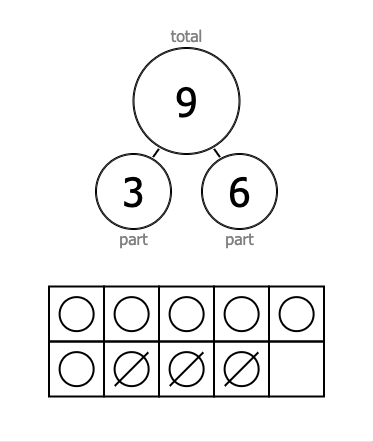
Use number bonds and ten frames to subtract and find the unknown part. What's 9-3? Visualize 9 on a ten frame – a full top row and 4 more. Mentally cross off 3. There is 1 left. How many in all? 6, so 9-3 = 6. Check for accuracy by drawing counters. Encourage students to check their own thinking – metacognition.
Prerequisites: K-91 ○ K-95, K-48, K-43
1-003: Subitize Numbers to 10
Progress from static images, to finding combinations that make 10 on quick images. Show ten frames for 3 seconds or less to limit processing time, encourage grouping instead of counting, and build number sense. Use non-counting strategies to quickly figure out how many and how many more makes 10.
Prerequisites: K-68, K-67
1-008: Add within 10 using Number Bonds & Ten Frames
Use number bonds and ten frames to find the total. What's 5 and 3 more? Visualize 5 on a ten frame – the top row is full. Visualize 3 more below. How many in all? Since 2 are missing, the total is 8. Check for accuracy by drawing counters. Encourage students to check their thinking and make adjustments when needed.
Prerequisites: K-78 ○ K-38
1-013: Subtract within 10
Use number bonds and ten frames to subtract and find the unknown part. What's 9-3? Visualize 9 on a ten frame – a full top row and 4 more. Mentally cross off 3. There is 1 left. How many in all? 6, so 9-3 = 6. Check for accuracy by drawing counters. Encourage students to check their own thinking – metacognition.
Prerequisites: K-91 ○ K-95, K-48, K-43
Review key concepts including subtraction with regrouping, word problems, telling time, measuring length, interpreting graphs, and modeling fractions.
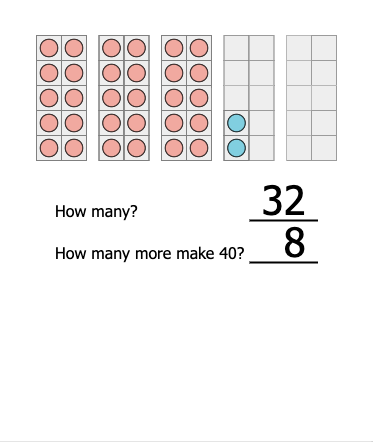
Use quick images to develop number sense, build confidence, and lay the foundation for place-value. Start with ten frames. Progress to base 10 blocks and discs. Subitize how many in all, and how many more make the next multiple of 10 – the key to using the all-important Make 10s strategy to add.
Prerequisites: 1-100 ○ 1-98, 1-96
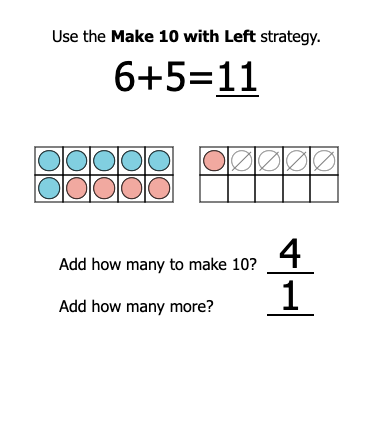
Add single-digit numbers using the all-important Make 10 Addition Strategy. Start with concrete ten frames. What's 6+5? First make 10. Break 5 into 4 and 1. 6+4 = 10. 10+1 = 11. What's 7+8? Since 7+3 = 10, break 8 into 3 and 5. 7+3 = 10. 10+5 = 15. First make 10, then add the rest.
Prerequisites: 1-40 ○ 1-45, 1-43, 1-42, 1-41
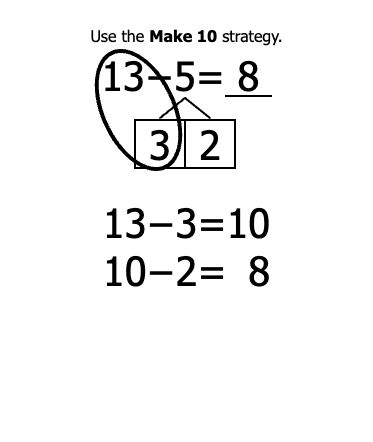
Transition from ten frames to pictorial number bonds. Subtract single-digit numbers by first making 10, then subtracting the rest. What's 13-5? Think of 5 as 3 and 2. Since 13-3 = 10 and 10-2 = 8, 13-5 = 8. When ready, progress to using just equations. Visualize and subtract the parts using mental math.
Prerequisites: 2-10
2-003: Subitize to 100
Use quick images to develop number sense, build confidence, and lay the foundation for place-value. Start with ten frames. Progress to base 10 blocks and discs. Subitize how many in all, and how many more make the next multiple of 10 – the key to using the all-important Make 10s strategy to add.
Prerequisites: 1-100 ○ 1-98, 1-96
2-006: Add using the Make 10 Strategy
Add single-digit numbers using the all-important Make 10 Addition Strategy. Start with concrete ten frames. What's 6+5? First make 10. Break 5 into 4 and 1. 6+4 = 10. 10+1 = 11. What's 7+8? Since 7+3 = 10, break 8 into 3 and 5. 7+3 = 10. 10+5 = 15. First make 10, then add the rest.
Prerequisites: 1-40 ○ 1-45, 1-43, 1-42, 1-41
2-011: Subtract using the Make 10 Strategy with Number Bonds & Equations
Transition from ten frames to pictorial number bonds. Subtract single-digit numbers by first making 10, then subtracting the rest. What's 13-5? Think of 5 as 3 and 2. Since 13-3 = 10 and 10-2 = 8, 13-5 = 8. When ready, progress to using just equations. Visualize and subtract the parts using mental math.
Prerequisites: 2-10
Review key concepts including addition and subtraction to 1,000, multiplying and dividing to 100, rounding, fractions, and elapsed time.
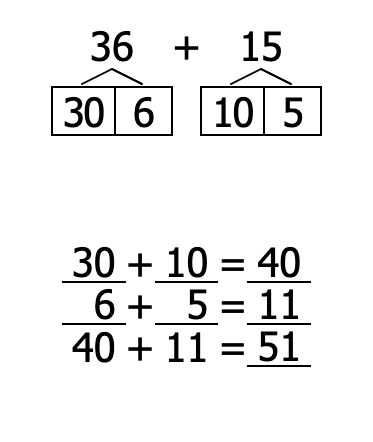
Use number bonds and a partial sums strategy to add 2-digit numbers with regrouping. What's 36+15? Since 30+10 = 40, 6+5 = 11, and 40+11 = 51, 36+15 = 51. Find and add partial sums to get the total sum. Progress from number bonds to equations. With practice, use mental math to become fluent within 100.
Prerequisites: 2-26 ○ 2-25
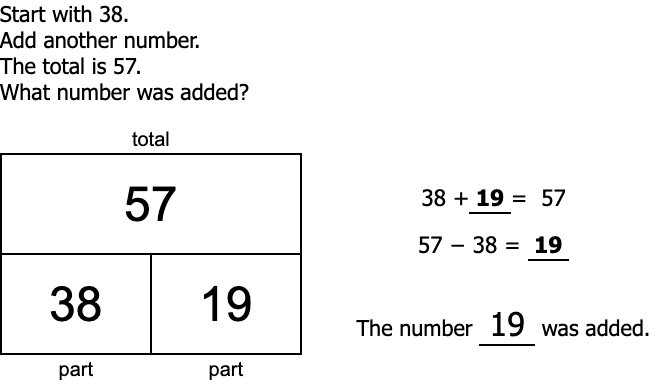
Given the starting amount and the total, find the "change" – how many are added. Given the change and the total, find the starting amount. Use a part-total diagram to visually show the relationship between the parts and total. Solve a subtraction or addition equation to find the unknown "change" or "start".
Prerequisites: 2-37 ○ 2-13
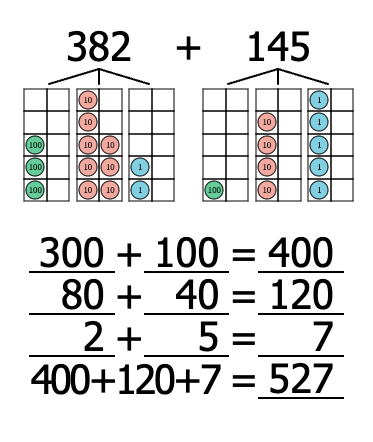
Add 3-digit numbers with 1 regrouping. What's 382+145? Use Base 10 discs to model expanded form. Find and add partial sums to get the total sum. 300+100 = 400, 80+40 = 120, and 2+5 = 7. Shift 100 from 120 to 400. Since 500+20+7 = 527, 382+145 = 527. Start with Base 10 discs and progress to using number bonds.
Prerequisites: 2-94, 2-93
3-003: Add to 100 - Shift 10
Use number bonds and a partial sums strategy to add 2-digit numbers with regrouping. What's 36+15? Since 30+10 = 40, 6+5 = 11, and 40+11 = 51, 36+15 = 51. Find and add partial sums to get the total sum. Progress from number bonds to equations. With practice, use mental math to become fluent within 100.
Prerequisites: 2-26 ○ 2-25
3-005: Add-To Word Problems to 100
Given the starting amount and the total, find the "change" – how many are added. Given the change and the total, find the starting amount. Use a part-total diagram to visually show the relationship between the parts and total. Solve a subtraction or addition equation to find the unknown "change" or "start".
Prerequisites: 2-37 ○ 2-13
3-012: Add to 1,000 with 1 Regrouping
Add 3-digit numbers with 1 regrouping. What's 382+145? Use Base 10 discs to model expanded form. Find and add partial sums to get the total sum. 300+100 = 400, 80+40 = 120, and 2+5 = 7. Shift 100 from 120 to 400. Since 500+20+7 = 527, 382+145 = 527. Start with Base 10 discs and progress to using number bonds.
Prerequisites: 2-94, 2-93
Review key concepts including multi-digit multiplication, division with remainders, fraction and decimal number sense, and quadrilateral classification.
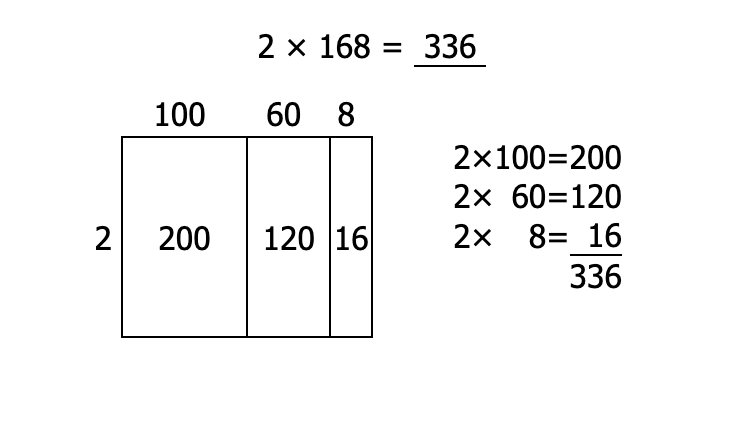
Use area models to visualize the distributive property and multiply. What's 2 x 168? Draw a rectangle with side lengths of 2 and 168. Since 168 = 100+60+8, the area of the rectangle is (2x100) + (2x60) + (2x8) = 200+120+16 = 336. Think expanded form, then find and add partial areas to get the total area.
Prerequisites: 3-107 ○ 4-7
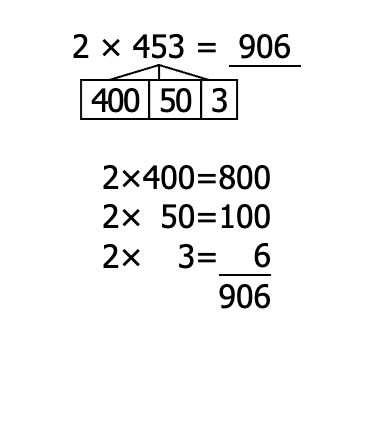
Transition to using number bonds to break 3-digit factors into expanded form. Apply the distributive property by adding partial products to get the total product. Lay the groundwork for both addition and multiplication standard algorithms by writing equations with digits that are vertically aligned according to their place values.
Prerequisites: 4-35 ○ 3-108
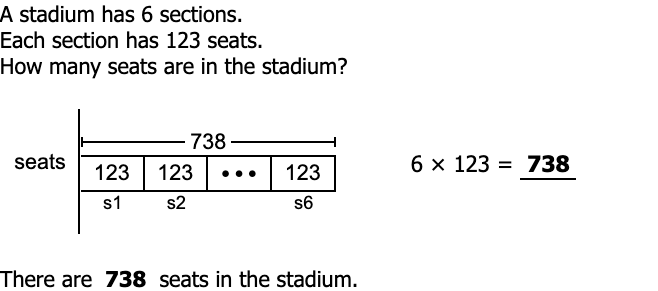
Use story problems to provide context for multiplication. Start with stories that have 1 sentence on each line. Transition to stories in paragraph form. Use bar models to visualize the relationship between the number of groups, the size of each group, and the total. Multiply using number bonds or the partial products algorithm.
Prerequisites: 4-37 ○ 4-10
4-035: Multiply 1-Digit x 3-Digit with Area Models
Use area models to visualize the distributive property and multiply. What's 2 x 168? Draw a rectangle with side lengths of 2 and 168. Since 168 = 100+60+8, the area of the rectangle is (2x100) + (2x60) + (2x8) = 200+120+16 = 336. Think expanded form, then find and add partial areas to get the total area.
Prerequisites: 3-107 ○ 4-7
4-036: Multiply 1-Digit x 3-Digit with Number Bonds
Transition to using number bonds to break 3-digit factors into expanded form. Apply the distributive property by adding partial products to get the total product. Lay the groundwork for both addition and multiplication standard algorithms by writing equations with digits that are vertically aligned according to their place values.
Prerequisites: 4-35 ○ 3-108
4-038: Multiply 1-Digit x 3-Digit Story Problems
Use story problems to provide context for multiplication. Start with stories that have 1 sentence on each line. Transition to stories in paragraph form. Use bar models to visualize the relationship between the number of groups, the size of each group, and the total. Multiply using number bonds or the partial products algorithm.
Prerequisites: 4-37 ○ 4-10
Review key concepts including problem solving with multi-digit multiplication and division, and operations with fractions and decimals.
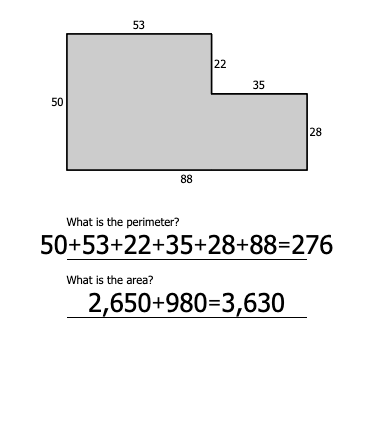
Find the composite perimeter and area of 2-dimensional shapes made from 2 or 3 adjacent rectangles. Start by solving problems with known side lengths. Transition to problems with unknown lengths. Use reasoning to solve for the unknown sides and perimeter. Add or subtract partial areas to find the total area.
Prerequisites: 3-104 ○ 3-103, 3-50
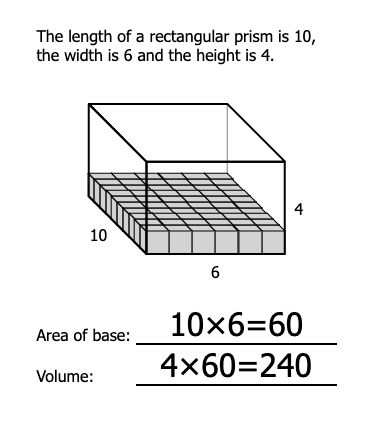
Generalize from length and area, to measuring volume – the number of unit cubes that fit inside a rectangular prism. Multiply length times width to get the area of the prism's base. Then scale the area of the base by the prism's height to get the prism's volume. Derive the formula for volume, V = Area of Base x H = (L x W) x H.
Prerequisites: 3-100
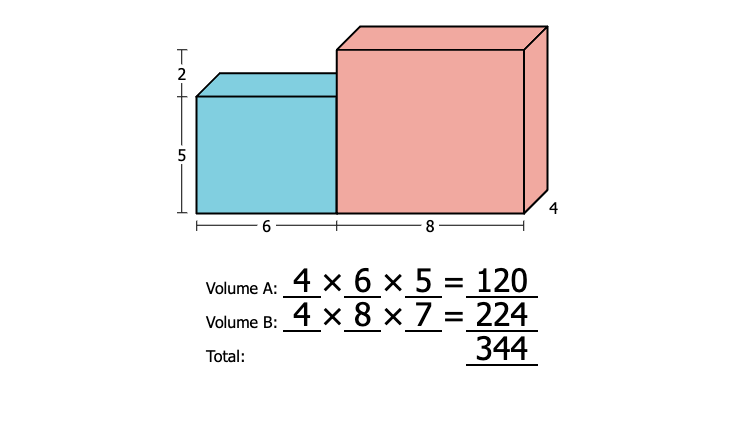
Find the composite (total) volume of a 3-dimensional solid made of 2 or 3 adjacent, rectangular prisms. Start by adding partial volumes that are side-by-side to get the total volume. Transition to problems where partial volumes can be added vertically, or subtracted from a rectangular prism to get the total volume.
Prerequisites: 5-22 ○ 3-103, 3-100
5-021: Composite Perimeter & Area of 2D Shapes
Find the composite perimeter and area of 2-dimensional shapes made from 2 or 3 adjacent rectangles. Start by solving problems with known side lengths. Transition to problems with unknown lengths. Use reasoning to solve for the unknown sides and perimeter. Add or subtract partial areas to find the total area.
Prerequisites: 3-104 ○ 3-103, 3-50
5-022: Volume of Rectangular Prisms
Generalize from length and area, to measuring volume – the number of unit cubes that fit inside a rectangular prism. Multiply length times width to get the area of the prism's base. Then scale the area of the base by the prism's height to get the prism's volume. Derive the formula for volume, V = Area of Base x H = (L x W) x H.
Prerequisites: 3-100
5-023: Composite Volume of Rectangular Prisms
Find the composite (total) volume of a 3-dimensional solid made of 2 or 3 adjacent, rectangular prisms. Start by adding partial volumes that are side-by-side to get the total volume. Transition to problems where partial volumes can be added vertically, or subtracted from a rectangular prism to get the total volume.
Prerequisites: 5-22 ○ 3-103, 3-100
Learn the numbers from 1-10 using picture graphs, counters, digits, and lots of practice. Count forward and backward and subitize numbers to 5. Use a ten frame to build number sense by learning to quickly recognize quantities as 5 and some more, paying attention to how many are there, and how many are missing.
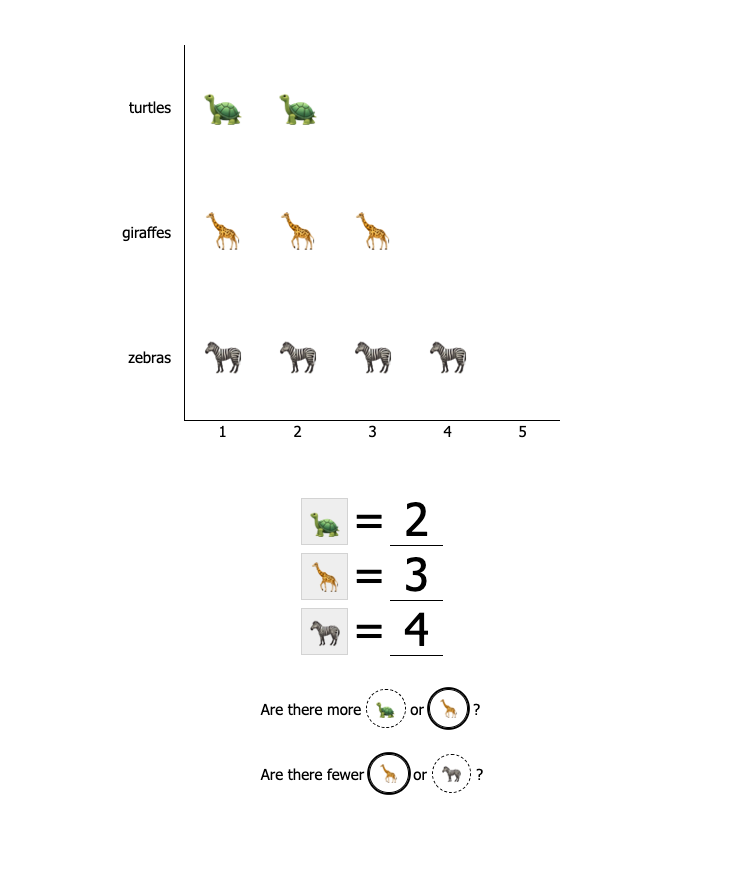
Use picture graphs to represent numbers visually. Find how many in each row by counting. Build number sense by comparing. Is there a pattern? Does the next group or category have the same number of objects, or 1 more? Practice writing digits by tracing. When ready, practice writing digits from memory.
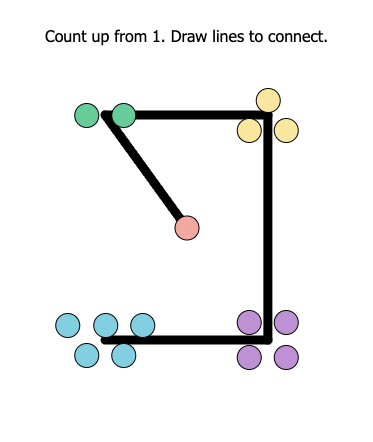
Make sense of numbers to 5 by putting sets of objects in increasing order. Transition from rote counting to understanding the natural numbers as a sequence of quantities that increases by 1. 2 is 1 more than 1. 3 is 1 more than 2. 4 is 1 more than 3, and 5 is 1 more than 4.
Prerequisites: K-13
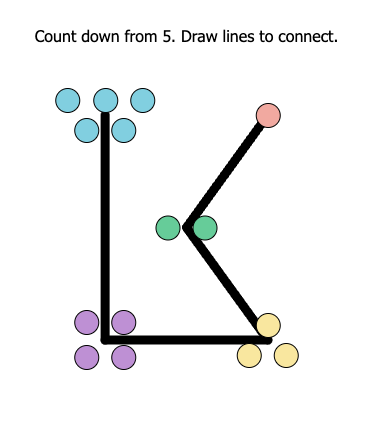
Count backward to deepen understanding of numbers 1 to 5 while laying the groundwork for subtraction. What number is 1 less and comes before 5? 4. What number is 1 less and comes before 4? 3. Put numbers represented visually in groups and abstractly with digits in descending or reverse order.
Prerequisites: K-22
K-020: Horizontal Picture Graphs to 5
Use picture graphs to represent numbers visually. Find how many in each row by counting. Build number sense by comparing. Is there a pattern? Does the next group or category have the same number of objects, or 1 more? Practice writing digits by tracing. When ready, practice writing digits from memory.
K-022: Count Forward to 5
Make sense of numbers to 5 by putting sets of objects in increasing order. Transition from rote counting to understanding the natural numbers as a sequence of quantities that increases by 1. 2 is 1 more than 1. 3 is 1 more than 2. 4 is 1 more than 3, and 5 is 1 more than 4.
Prerequisites: K-13
K-023: Count Backward from 5
Count backward to deepen understanding of numbers 1 to 5 while laying the groundwork for subtraction. What number is 1 less and comes before 5? 4. What number is 1 less and comes before 4? 3. Put numbers represented visually in groups and abstractly with digits in descending or reverse order.
Prerequisites: K-22
Learn the numbers 11-20 as a group of ten ones, and some more ones. Model numbers using arrays, near arrays and digits. Subitize with ten frames to name both parts, and answer "How many?" and "How many more make 20?"
Continue to encourage part-total thinking. Subitize both parts of a ten frame. How many are there and how many are missing – how many more are needed to make 10, the total. Subitize daily to build number sense, master the all-important combinations of 10, recognize shapes and solids, and learn geometric names.
Prerequisites: K-67 ○ K-26
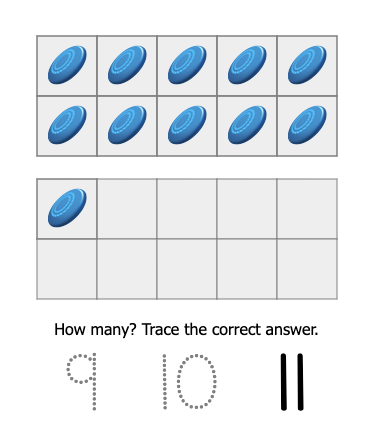
Model teen numbers as 10 and some more. 11 is 10 and 1. 12 is 10 and 2. The names for 11, 12, 13, and 15 can be confusing because they don't follow the pattern. Nicknames like "1 ten 1" for "eleven" and "1 ten 2" for "twelve" can help make sense of numbers and lay the foundation for place value. Practice writing by tracing.
Prerequisites: K-62 ○ K-61, K-60, K-59
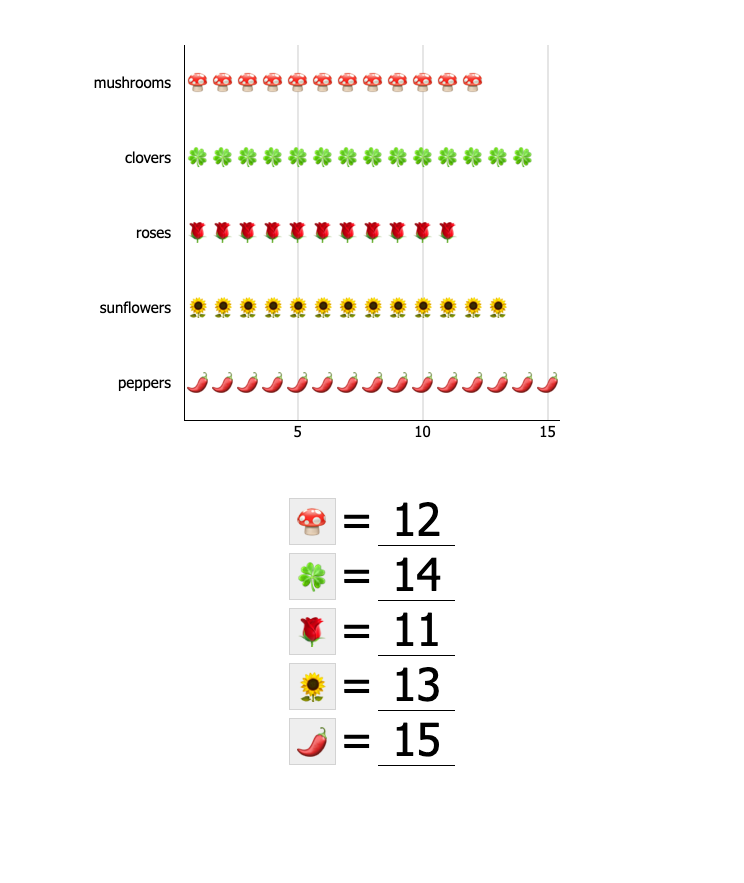
Use horizontal picture graphs to model teen numbers. Figure out how many in each category by counting all, counting on from 5, 10, or 15, adding smaller groups, comparing rows, and learning to read the graph's axis. Build number sense by quantifying, comparing, and using words like "more," "fewer," "greater," and "less."
Prerequisites: K-63 ○ K-102
K-068: Subitize Numbers to 10 with Ten Frames: Part II
Continue to encourage part-total thinking. Subitize both parts of a ten frame. How many are there and how many are missing – how many more are needed to make 10, the total. Subitize daily to build number sense, master the all-important combinations of 10, recognize shapes and solids, and learn geometric names.
Prerequisites: K-67 ○ K-26
K-103: Identify and Trace Numbers 11-20
Model teen numbers as 10 and some more. 11 is 10 and 1. 12 is 10 and 2. The names for 11, 12, 13, and 15 can be confusing because they don't follow the pattern. Nicknames like "1 ten 1" for "eleven" and "1 ten 2" for "twelve" can help make sense of numbers and lay the foundation for place value. Practice writing by tracing.
Prerequisites: K-62 ○ K-61, K-60, K-59
K-104: Picture Graphs to 20
Use horizontal picture graphs to model teen numbers. Figure out how many in each category by counting all, counting on from 5, 10, or 15, adding smaller groups, comparing rows, and learning to read the graph's axis. Build number sense by quantifying, comparing, and using words like "more," "fewer," "greater," and "less."
Prerequisites: K-63 ○ K-102
Trace and write numbers from 1-10. Combine writing practice with counting and copying a variety of models. Use five frames, ten frames, snap cubes, tally marks, dice patterns and circular arrangements to model numbers.
Introduce numbers to describe how many objects in a group or set. Use 1-to-1 correspondence to count and quantify the number of counters on a five frame. Emphasize that the last number counted represents the whole group of objects, not the last object. Count and draw counters on five frames. Learn digits by tracing.
Use snap cubes as the go-to manipulative for modeling numbers concretely. They can be unsnapped or broken apart to find smaller parts. They can be snapped together or unitized to make the total or whole. Count, quantify, draw, and trace numbers to 5 using snap cubes.
Prerequisites: K-12
Draw tally marks to model numbers pictorially. Use straws, stirrers, and toothpicks to model concretely, and continue tracing digits to represent numbers abstractly. Why is the 5th tally drawn horizontally or diagonally instead of vertically like the other 4? Want to unitize and show 1 group of 5, instead of 5 groups of 1.
Prerequisites: K-13
K-012: Model and Trace Numbers to 5 using Five Frames
Introduce numbers to describe how many objects in a group or set. Use 1-to-1 correspondence to count and quantify the number of counters on a five frame. Emphasize that the last number counted represents the whole group of objects, not the last object. Count and draw counters on five frames. Learn digits by tracing.
K-013: Model and Trace Numbers to 5 using Snap Cubes
Use snap cubes as the go-to manipulative for modeling numbers concretely. They can be unsnapped or broken apart to find smaller parts. They can be snapped together or unitized to make the total or whole. Count, quantify, draw, and trace numbers to 5 using snap cubes.
Prerequisites: K-12
K-014: Model and Trace Numbers to 5 using Tally Marks
Draw tally marks to model numbers pictorially. Use straws, stirrers, and toothpicks to model concretely, and continue tracing digits to represent numbers abstractly. Why is the 5th tally drawn horizontally or diagonally instead of vertically like the other 4? Want to unitize and show 1 group of 5, instead of 5 groups of 1.
Prerequisites: K-13
Build number sense, quantify, add to, and subtract from 20, to prepare for the Kindergarten curriculum. Learn geometric concepts by measuring total side length of polygons, and comparing area, length, height, and width of circles and polygons.
Comparing is a key aspect of learning. Given 2 columns of pictures, match each picture on the left with the same picture on the right. Explore what makes 2 pictures the same and what makes other pictures different. Matching activities introduce the concept of 1-to-1 correspondence. They help prepare students for counting.
Introduce 2D shapes. Which shape on the left matches the same shape on the right? Matching sides and corners helps with one-to-one correspondence. Does a shape have an extra side or corner? Does it have more? If one shape has more, does the other shape have fewer? Match shapes to objects in the room.
Prerequisites: K-1
Introduce 3D solids. When possible, use real solids as well as pictures of solids. Recognize and learn their geometric names by making connections to common and familiar objects. Which solid looks like a can of soup? Which solid looks like an ice cream cone? Which looks like an ice cube? A box? A ball?
Prerequisites: K-2
K-001: Match Objects
Comparing is a key aspect of learning. Given 2 columns of pictures, match each picture on the left with the same picture on the right. Explore what makes 2 pictures the same and what makes other pictures different. Matching activities introduce the concept of 1-to-1 correspondence. They help prepare students for counting.
K-002: Match Shapes
Introduce 2D shapes. Which shape on the left matches the same shape on the right? Matching sides and corners helps with one-to-one correspondence. Does a shape have an extra side or corner? Does it have more? If one shape has more, does the other shape have fewer? Match shapes to objects in the room.
Prerequisites: K-1
K-003: Match Solids
Introduce 3D solids. When possible, use real solids as well as pictures of solids. Recognize and learn their geometric names by making connections to common and familiar objects. Which solid looks like a can of soup? Which solid looks like an ice cream cone? Which looks like an ice cube? A box? A ball?
Prerequisites: K-2
Identify numbers without counting. Quick images develop number sense, build confidence, and lay the foundation for place value. Subitizing how many in all, and how many more make the next multiple of 10, is the key to adding single and double-digit numbers using the Make 10s strategy.
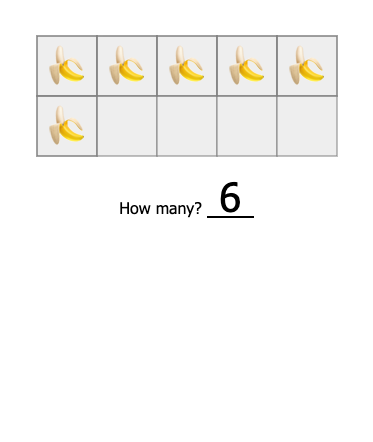
Subitize to build number sense. Show ten frames for 3 seconds or less. Figure out how many quickly by recognizing quantities as 5 and some more. 6 is 5 and 1 more. 7 is 5 and 2 more. Encourage students to also subtilize how many are missing. If 2 are missing, there are 8. If 1 is missing, there are 9.
Prerequisites: K-25
Continue to encourage part-total thinking. Subitize both parts of a ten frame. How many are there and how many are missing – how many more are needed to make 10, the total. Subitize daily to build number sense, master the all-important combinations of 10, recognize shapes and solids, and learn geometric names.
Prerequisites: K-67 ○ K-26
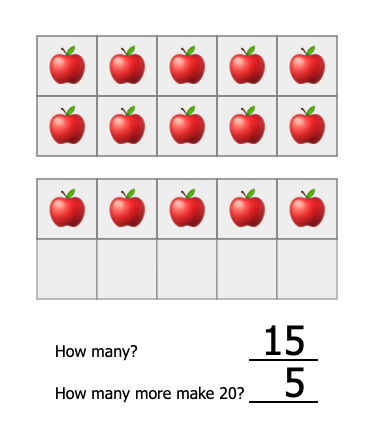
Start by modeling teen numbers visually on static ten frames. Progress to quick images that encourage grouping and subitizing – figuring out how many quickly without counting – by limiting processing time. Subitize daily to develop number sense and lay the groundwork for place value.
Prerequisites: K-109 ○ K-103, K-68
K-067: Subitize Numbers to 10 with Ten Frames: Part I
Subitize to build number sense. Show ten frames for 3 seconds or less. Figure out how many quickly by recognizing quantities as 5 and some more. 6 is 5 and 1 more. 7 is 5 and 2 more. Encourage students to also subtilize how many are missing. If 2 are missing, there are 8. If 1 is missing, there are 9.
Prerequisites: K-25
K-068: Subitize Numbers to 10 with Ten Frames: Part II
Continue to encourage part-total thinking. Subitize both parts of a ten frame. How many are there and how many are missing – how many more are needed to make 10, the total. Subitize daily to build number sense, master the all-important combinations of 10, recognize shapes and solids, and learn geometric names.
Prerequisites: K-67 ○ K-26
1-031: Subitize Teen Numbers using Ten Frames
Start by modeling teen numbers visually on static ten frames. Progress to quick images that encourage grouping and subitizing – figuring out how many quickly without counting – by limiting processing time. Subitize daily to develop number sense and lay the groundwork for place value.
Prerequisites: K-109 ○ K-103, K-68
Develop fluency with expanded form, shifting, and comparing 2-digit numbers. Using formal number names and nicknames, and a compare-the-parts strategy, along with expanded form, encourages base ten thinking. Shifting builds number sense and prepares for regrouping.
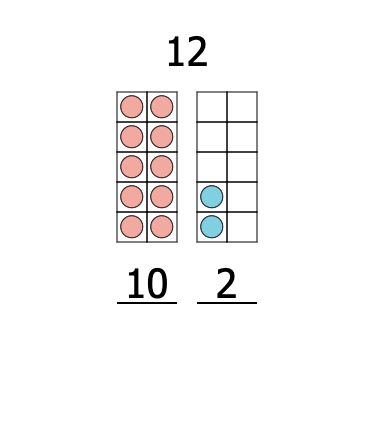
Lay the foundation for place value. Start by modeling teen numbers on ten frames. 12 is 10 counters and 2 counters – 10 ones and 2 ones – 12 ones in all. Transition to using Base 10 blocks or snap cubes to "unitize" 10 ones as 1 rod or unit. 12 is now 1 ten and 2 ones – 1 rod and 2 ones – not 12 cubes or counters.
Prerequisites: K-110 ○ 1-31
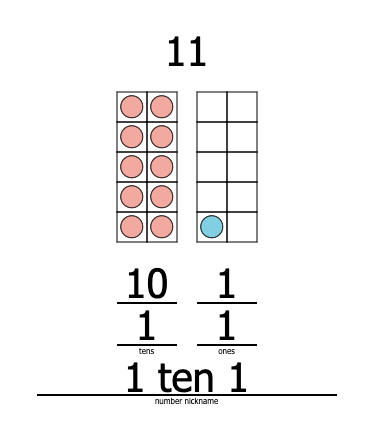
Since formal number names like "eleven," "twelve," and "twenty-six" do not emphasize tens and ones, use number nicknames that do. What's 11? It's 1 group of ten and 1 more, so its nickname is "1 ten 1." What's 26? It's 2 groups of ten and 6 more, so its nickname is "2 ten 6." Nicknames encourage Base 10 thinking.
Prerequisites: 1-87
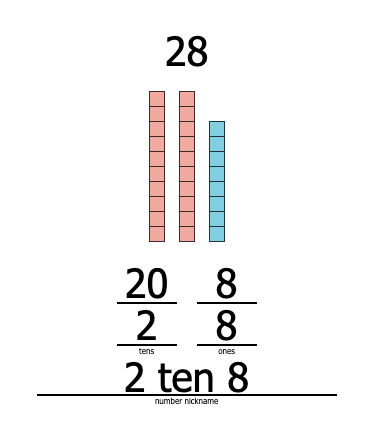
Transition from ten frames to using Base 10 blocks to unitize and model numbers in units of ten and one. What's 28? 20 and 8. It's also 2 tens and 8 ones. To know there are 8 ones, subitize the 2 that are missing. To encourage Base 10 thinking, use both formal names and nicknames. 28 is both "twenty-eight" and "2 ten 8."
Prerequisites: 1-88
1-037: Place Value to 20: Expanded Form
Lay the foundation for place value. Start by modeling teen numbers on ten frames. 12 is 10 counters and 2 counters – 10 ones and 2 ones – 12 ones in all. Transition to using Base 10 blocks or snap cubes to "unitize" 10 ones as 1 rod or unit. 12 is now 1 ten and 2 ones – 1 rod and 2 ones – not 12 cubes or counters.
Prerequisites: K-110 ○ 1-31
1-088: Expanded Form to 50 using Ten Frames
Since formal number names like "eleven," "twelve," and "twenty-six" do not emphasize tens and ones, use number nicknames that do. What's 11? It's 1 group of ten and 1 more, so its nickname is "1 ten 1." What's 26? It's 2 groups of ten and 6 more, so its nickname is "2 ten 6." Nicknames encourage Base 10 thinking.
Prerequisites: 1-87
1-090: Expanded Form to 50 using Base 10 Blocks
Transition from ten frames to using Base 10 blocks to unitize and model numbers in units of ten and one. What's 28? 20 and 8. It's also 2 tens and 8 ones. To know there are 8 ones, subitize the 2 that are missing. To encourage Base 10 thinking, use both formal names and nicknames. 28 is both "twenty-eight" and "2 ten 8."
Prerequisites: 1-88
Apply the place value skills involving expanded form, shifting, and comparing, to larger numbers. Shift both 100 and 10, compare 3-digit numbers, model 4 and 5-digit numbers, and continue the place value pattern from 1 one 10 ones, 100 ones, to 1 thousand, 10 thousands and 100 thousands.
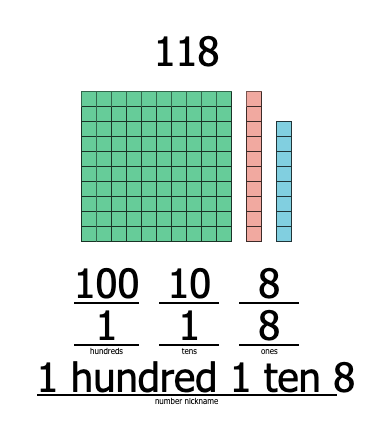
Progress from ten frames to more abstract Base 10 blocks. To start, use 10 rods to model 1 group of 100. What's 118? It's 100+10+8 = 1 hundred + 1 ten + 8 ones. When ready, transition to using 1 flat to model 1 group of 100. Notice that 10 rods "fit" on 1 flat. What's 104? It's 100+0+4 = 1 hundred + 0 tens + 4 ones.
Prerequisites: 1-104 ○ 1-97
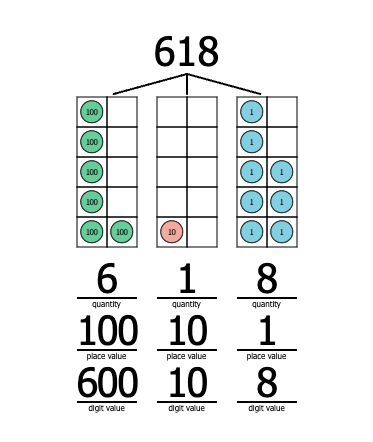
Encourage Base 10 thinking by decomposing numbers into expanded form. Use non-proportional Base 10 discs and ten frames to model quantities and place values concretely. What's 618? 6 hundreds, 1 ten, and 8 ones. Use "nicknames" to emphasize each digit's quantity and place value. "Six hundred, one ten, eight."
Prerequisites: 1-106 ○ 1-105
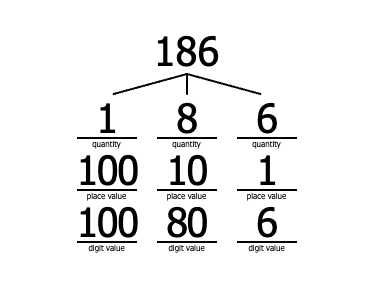
Transition from concrete Base 10 discs to pictorial number bonds. Break numbers into expanded form – hundreds, tens, and ones. Use "nicknames" to emphasize each digit's quantity and place value. What's 186? "One hundred, eight ten, six." 672? "Six hundred, seven ten, two." Write both nicknames and formal names.
Prerequisites: 2-76
1-105: Expanded Form to 120 with Base 10 Blocks
Progress from ten frames to more abstract Base 10 blocks. To start, use 10 rods to model 1 group of 100. What's 118? It's 100+10+8 = 1 hundred + 1 ten + 8 ones. When ready, transition to using 1 flat to model 1 group of 100. Notice that 10 rods "fit" on 1 flat. What's 104? It's 100+0+4 = 1 hundred + 0 tens + 4 ones.
Prerequisites: 1-104 ○ 1-97
2-076: Place Value to 1,000 with Base 10 Discs
Encourage Base 10 thinking by decomposing numbers into expanded form. Use non-proportional Base 10 discs and ten frames to model quantities and place values concretely. What's 618? 6 hundreds, 1 ten, and 8 ones. Use "nicknames" to emphasize each digit's quantity and place value. "Six hundred, one ten, eight."
Prerequisites: 1-106 ○ 1-105
2-077: Place Value to 1,000 with Number Bonds
Transition from concrete Base 10 discs to pictorial number bonds. Break numbers into expanded form – hundreds, tens, and ones. Use "nicknames" to emphasize each digit's quantity and place value. What's 186? "One hundred, eight ten, six." 672? "Six hundred, seven ten, two." Write both nicknames and formal names.
Prerequisites: 2-76
Compare the value of individual digits within a number, or between numbers. Compare the value of a digit with the value of the same digit 1 place to the right -- additively. How much greater is one than the other? Tansition to multiplicative comparison. How many times is the value of one than the other? Find the scale factor.
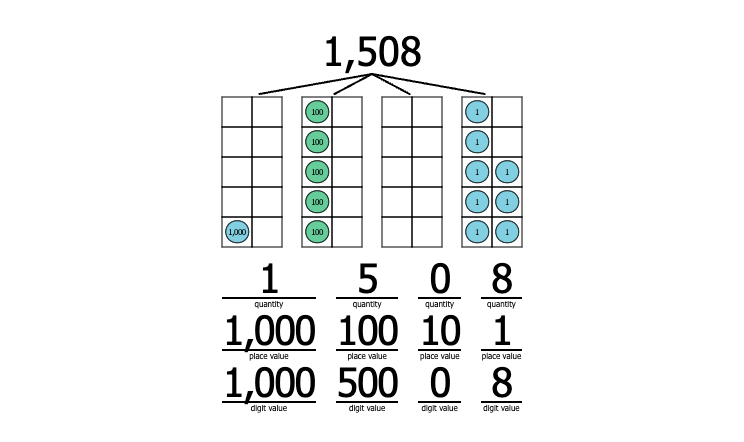
Enrich by modeling 4-digit and 5-digit numbers. The pattern for ones – 1, 10, 100 – continues with thousands. The place values from right-to-left are: 1 one, 10 ones, 100 ones, 1 thousand, 10 thousands, 100 thousands. A comma separates the ones and thousands. What is 23,456? It’s (2 x 10,000) + (3 x 1,000) + (4 x 100) + (5 x 10) + (6 x 1) = 20,000 + 3,000 + 400 + 50 + 6. *Worksheets Updated 9/16/24
Prerequisites: 3-22 ○ 2-76
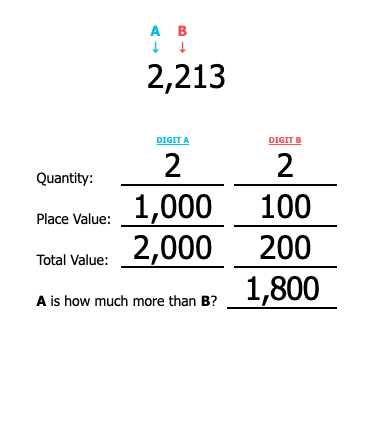
Compare the value of a digit with the value of the same digit 1 place to the right. How much greater is the value of a 2 in the thousands place than a 2 in the hundreds place? Subtract to find the difference. 2,000-200 = 1,800. How much greater is the value of a 7 in the hundreds place than a 7 in the tens place? 700-70 = 630.
Prerequisites: 4-24 ○ 4-5, 2-32, 2-12
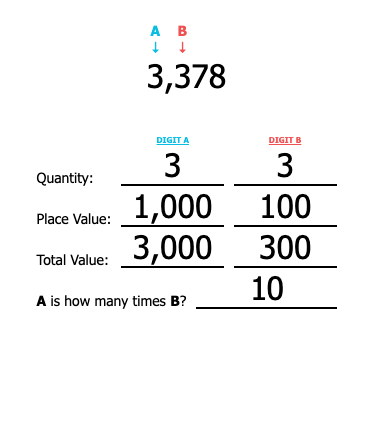
Transition to comparing multiplicatively a digit and the value of the same digit 1 place to the right. The value of a 3 in the thousands place is how many times the value of a 3 in the hundreds place? Find the scale factor by multiplying or dividing. 10 x 300 = 3,000 and 3,000÷300 = 10. 3,000 is 10 times the value of 300.
Prerequisites: 4-29 ○ 3-109, 3-106
3-026: Place Value to 10,000: Expanded Form*
Enrich by modeling 4-digit and 5-digit numbers. The pattern for ones – 1, 10, 100 – continues with thousands. The place values from right-to-left are: 1 one, 10 ones, 100 ones, 1 thousand, 10 thousands, 100 thousands. A comma separates the ones and thousands. What is 23,456? It’s (2 x 10,000) + (3 x 1,000) + (4 x 100) + (5 x 10) + (6 x 1) = 20,000 + 3,000 + 400 + 50 + 6. *Worksheets Updated 9/16/24
Prerequisites: 3-22 ○ 2-76
4-029: Compare Digits to 10,000 Additively
Compare the value of a digit with the value of the same digit 1 place to the right. How much greater is the value of a 2 in the thousands place than a 2 in the hundreds place? Subtract to find the difference. 2,000-200 = 1,800. How much greater is the value of a 7 in the hundreds place than a 7 in the tens place? 700-70 = 630.
Prerequisites: 4-24 ○ 4-5, 2-32, 2-12
4-030: Compare Digits to 10,000 Multiplicatively
Transition to comparing multiplicatively a digit and the value of the same digit 1 place to the right. The value of a 3 in the thousands place is how many times the value of a 3 in the hundreds place? Find the scale factor by multiplying or dividing. 10 x 300 = 3,000 and 3,000÷300 = 10. 3,000 is 10 times the value of 300.
Prerequisites: 4-29 ○ 3-109, 3-106
Round a whole number to any place, by systematically applying familiar skills rather than an algorithm. Rename hundreds as tens and hundreds as tens and ones. Use an open number line and bar model to understand that rounding means finding a simpler, shorter, or more convenient number that a particular number is closest to.
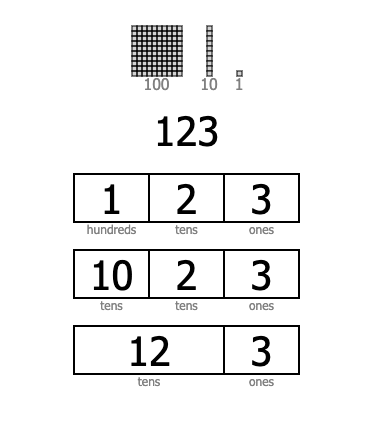
Think flexibly about hundreds. How many tens in 123? Since 1 hundred = 10 tens, there are (10+2) tens = 12 tens in 123. How many tens in 267? Since 2 hundred is (2 groups of 10) tens = 20 tens, there are (20+6) tens = 26 tens in 267. How many tens in 389? Using mental math, 3 hundreds in 30 tens, so there are 38 tens.
Prerequisites: 3-10 ○ 3-1
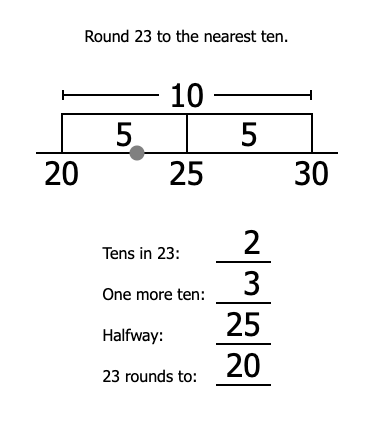
Use an open number line and bar model to determine if a number is closer to the number of tens it has, or 1 more ten. What's 23 rounded to the nearest ten? The nearest multiples of ten are 20 and 30 – 2 tens and 3 tens. Halfway between 20 and 30 is 25. Since 23 is less than 25, it's closer to 2 tens. Round down to 20.
Prerequisites: 3-22
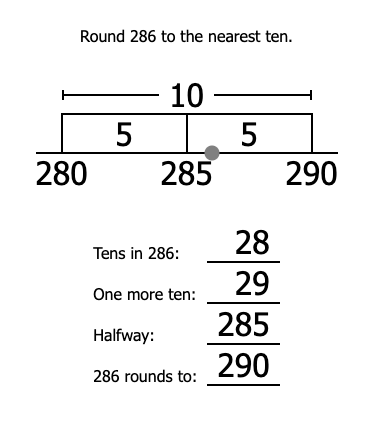
Generalize by determining if a 3-digit number is closer to the number of tens it has, or 1 more ten. What's 286 rounded to the nearest ten? The nearest multiples of ten are 280 and 290 – 28 tens and 29 tens. Halfway between 280 and 290 is 285. 286 is greater than 285, so it's closer to 29 tens. Round up to 290.
Prerequisites: 3-23
3-022: Place Value to 1,000: Rename Hundreds as Tens
Think flexibly about hundreds. How many tens in 123? Since 1 hundred = 10 tens, there are (10+2) tens = 12 tens in 123. How many tens in 267? Since 2 hundred is (2 groups of 10) tens = 20 tens, there are (20+6) tens = 26 tens in 267. How many tens in 389? Using mental math, 3 hundreds in 30 tens, so there are 38 tens.
Prerequisites: 3-10 ○ 3-1
3-023: Rounding 2-Digit Numbers to the Nearest Ten
Use an open number line and bar model to determine if a number is closer to the number of tens it has, or 1 more ten. What's 23 rounded to the nearest ten? The nearest multiples of ten are 20 and 30 – 2 tens and 3 tens. Halfway between 20 and 30 is 25. Since 23 is less than 25, it's closer to 2 tens. Round down to 20.
Prerequisites: 3-22
3-024: Rounding 3-Digit Numbers to the Nearest Ten
Generalize by determining if a 3-digit number is closer to the number of tens it has, or 1 more ten. What's 286 rounded to the nearest ten? The nearest multiples of ten are 280 and 290 – 28 tens and 29 tens. Halfway between 280 and 290 is 285. 286 is greater than 285, so it's closer to 29 tens. Round up to 290.
Prerequisites: 3-23
Combine two addends (parts) into a sum (total) that is 10 or less. Use five frames, ten frames, and number bonds, to break numbers into easier parts to visuallize, in order to use mental math to figure out how many, without counting.
Use five frames to visually break a set of up to 5 counters into parts. Start by outlining each part. Count or subitize to know how many are in each group, and how many altogether. Recognize and read the words "part" and "total." Make sense of both by connecting the objects in the five frame with each digit being traced.
Prerequisites: K-27
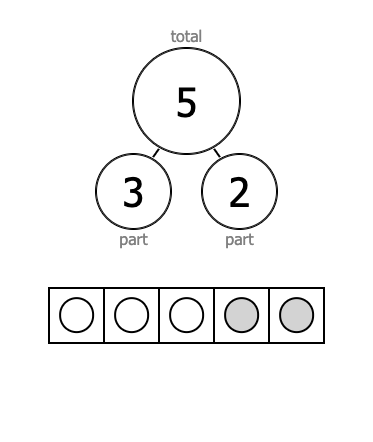
Use number bonds and five frames to find the total. Given 2 parts in a number bond, visualize them mentally on a five frame. How many in all? Encourage metacognition by first visualizing the total mentally. Check for correctness – think about our thinking – by drawing or using real counters. Work toward fluency within 5.
Prerequisites: K-29 ○ K-12
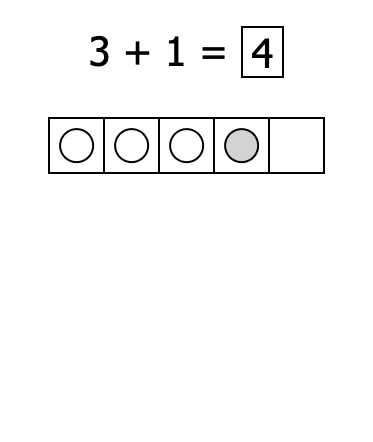
Given an addition equation with 2 addends, find the sum. Use five frames to help students visualize the parts and find the total, if possible, without counting. What's 3+1? Imagine 3 counters plus 1 more. Since one frame is still empty, the total is 4. Check the answer by drawing or using counters.
Prerequisites: K-32
K-028: Add Concretely by Identifying the Parts & Total
Use five frames to visually break a set of up to 5 counters into parts. Start by outlining each part. Count or subitize to know how many are in each group, and how many altogether. Recognize and read the words "part" and "total." Make sense of both by connecting the objects in the five frame with each digit being traced.
Prerequisites: K-27
K-030: Add Concretely using Number Bonds & Five Frames
Use number bonds and five frames to find the total. Given 2 parts in a number bond, visualize them mentally on a five frame. How many in all? Encourage metacognition by first visualizing the total mentally. Check for correctness – think about our thinking – by drawing or using real counters. Work toward fluency within 5.
Prerequisites: K-29 ○ K-12
K-033: Find the Total using Equations & Five Frames
Given an addition equation with 2 addends, find the sum. Use five frames to help students visualize the parts and find the total, if possible, without counting. What's 3+1? Imagine 3 counters plus 1 more. Since one frame is still empty, the total is 4. Check the answer by drawing or using counters.
Prerequisites: K-32
Break apart single-digit addends flexibly by creating a group of 10 -- and the rest. This is a crucial key skill for making math easier. Students make 10 first (an easy number to add on to) to find the total, instead of counting.
Continue to encourage part-total thinking. Subitize both parts of a ten frame. How many are there and how many are missing – how many more are needed to make 10, the total. Subitize daily to build number sense, master the all-important combinations of 10, recognize shapes and solids, and learn geometric names.
Prerequisites: K-67 ○ K-26
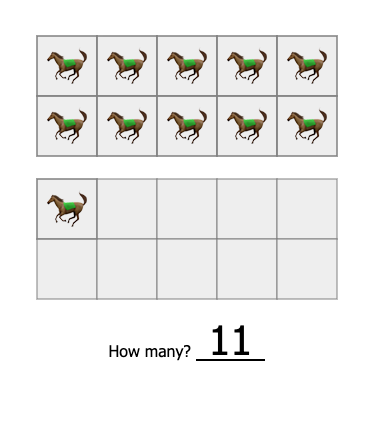
Solidify understanding of teen numbers as 10 and some more by using quick images. Instantly recognize a full ten frame is 10. Subitize the bottom ten frame to know how many more. Add both parts to find the total. Start by asking "How many?" Build number sense by asking "How many more make 20?"
Prerequisites: K-103 ○ K-67
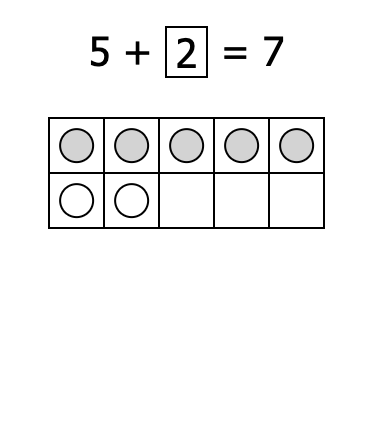
Use ten frames to find an unknown part in an addition equation. 5 + __ = 7? Visualize 5 on a ten frame – a full top row. Now imagine 7 – a full top row and 2 more. What's the "change" – how many need to be added to 5 to make 7? Since 5+2 = 7, the part needing to be added is 2. Draw to check for accuracy.
Prerequisites: K-87, K-86 ○ K-80
K-068: Subitize Numbers to 10 with Ten Frames: Part II
Continue to encourage part-total thinking. Subitize both parts of a ten frame. How many are there and how many are missing – how many more are needed to make 10, the total. Subitize daily to build number sense, master the all-important combinations of 10, recognize shapes and solids, and learn geometric names.
Prerequisites: K-67 ○ K-26
K-109: Subitize with Ten Frames to Name One Part
Solidify understanding of teen numbers as 10 and some more by using quick images. Instantly recognize a full ten frame is 10. Subitize the bottom ten frame to know how many more. Add both parts to find the total. Start by asking "How many?" Build number sense by asking "How many more make 20?"
Prerequisites: K-103 ○ K-67
1-018: Add within 10 Change-Unknown & Start-Unknown
Use ten frames to find an unknown part in an addition equation. 5 + __ = 7? Visualize 5 on a ten frame – a full top row. Now imagine 7 – a full top row and 2 more. What's the "change" – how many need to be added to 5 to make 7? Since 5+2 = 7, the part needing to be added is 2. Draw to check for accuracy.
Prerequisites: K-87, K-86 ○ K-80
Add double-digit numbers by combining tens, combining ones, and then adding the partial sums. This module reinforces the skills of using expanded form, the Make 10s and Make 20 strategies, and adding multiples of 10, in order to add 2-digit numbers with and without regrouping.
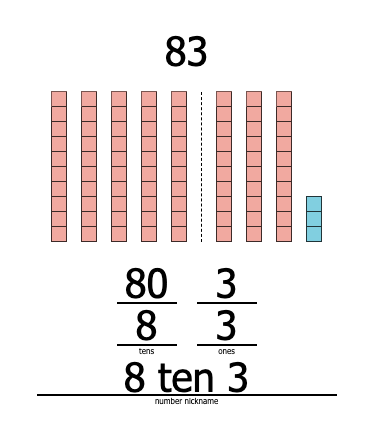
Transition from ten frames to using Base 10 blocks to unitize and model numbers in units of ten and one. What's 83? 80 and 3. It's also 8 tens and 3 ones. To know there are 8 tens, add 5 tens and 3 tens. To encourage Base 10 thinking, use both formal names and nicknames. 83 is both "eighty-three" and "8 ten 3."
Prerequisites: 1-96 ○ 1-90
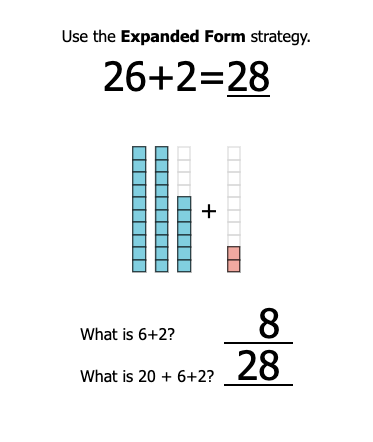
Add 2-digit and 1-digit numbers with no regrouping. First add the ones, then add back the tens to get the total. What's 26+2? Since 6+2 = 8 and 20+8 = 28, 26+2 = 28. Start by modeling numbers with concrete Base 10 Blocks or snap cubes. Progress to using pictorial number bonds and finally, just mental math.
Prerequisites: 1-49
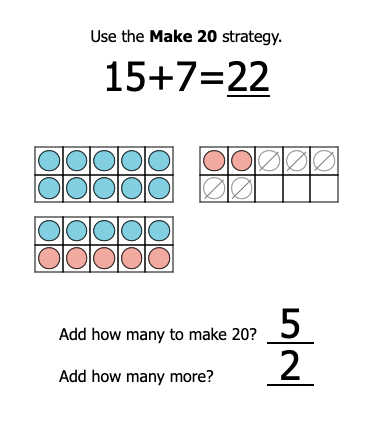
Generalize the Make 10 strategy to the Make 20 strategy. Continue using ten frames to model the parts and total. What's 18 + 6? Break 6 into 2 parts. First make 20, then add the rest. Since 6 = 2 + 4, add 18 + 2 = 20, then add 20 + 4 = 24. Encourage students to think in groups of 10 whenever possible.
Prerequisites: 1-45
1-097: Expanded Form to 100 with Base 10 Blocks
Transition from ten frames to using Base 10 blocks to unitize and model numbers in units of ten and one. What's 83? 80 and 3. It's also 8 tens and 3 ones. To know there are 8 tens, add 5 tens and 3 tens. To encourage Base 10 thinking, use both formal names and nicknames. 83 is both "eighty-three" and "8 ten 3."
Prerequisites: 1-96 ○ 1-90
1-108: Add a Single-Digit Number with No Regrouping
Add 2-digit and 1-digit numbers with no regrouping. First add the ones, then add back the tens to get the total. What's 26+2? Since 6+2 = 8 and 20+8 = 28, 26+2 = 28. Start by modeling numbers with concrete Base 10 Blocks or snap cubes. Progress to using pictorial number bonds and finally, just mental math.
Prerequisites: 1-49
1-109: Add using the Make 20 Strategy
Generalize the Make 10 strategy to the Make 20 strategy. Continue using ten frames to model the parts and total. What's 18 + 6? Break 6 into 2 parts. First make 20, then add the rest. Since 6 = 2 + 4, add 18 + 2 = 20, then add 20 + 4 = 24. Encourage students to think in groups of 10 whenever possible.
Prerequisites: 1-45
Calculate sums greater than 100 with two, three, or four 2-digit addends. Use expanded form, the Make 10s and Make 100 addition strategies, and adding multiples of 10, to find the partial sums and then the total sum -- up to 1,000.
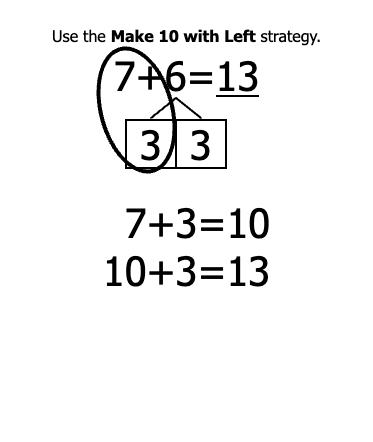
Practice using all 3 Make 10 strategies. Develop visualization and abstract thinking skills by using pictorial number bonds instead of ten frames. When both addends are greater than 5, any of the 3 strategies can be used. When only 1 addend is greater than 5, use either the Make 10 Left or Make 10 Right strategy.
Prerequisites: 1-44, 1-43, 1-42
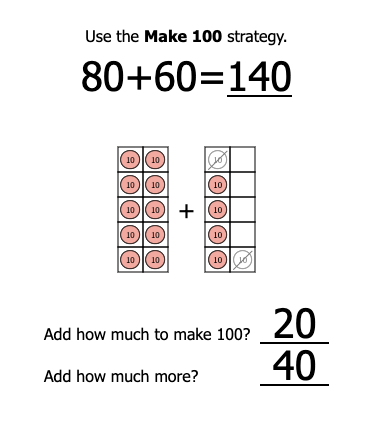
Add multiples of 10 by generalizing from the Make 10 strategy to the Make 100 strategy. What's 80+60? First make 100, then add the rest. Think of 60 as 20 and 40. Since 80+20 = 100 and 100+40 = 140, 80+60 = 140. Start by modeling numbers concretely with Base 10 discs and ten frames. Transition to number bonds.
Prerequisites: 1-112
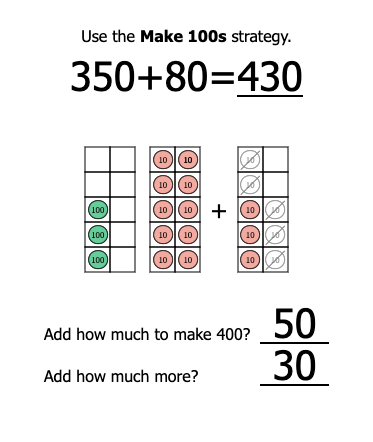
Generalize from making 100 to making 100s – multiples of 100. What's 350+80? First make 400, then add the rest. Think of 80 as 50 and 30. Since 350+50 = 400 and 400+30 = 430, 350+80 = 430. Start by modeling numbers concretely with Base 10 discs and ten frames. Transition to number bonds and equations.
Prerequisites: 2-84 ○ 2-8, 1-112
1-045: Master all Make 10 Addition Strategies
Practice using all 3 Make 10 strategies. Develop visualization and abstract thinking skills by using pictorial number bonds instead of ten frames. When both addends are greater than 5, any of the 3 strategies can be used. When only 1 addend is greater than 5, use either the Make 10 Left or Make 10 Right strategy.
Prerequisites: 1-44, 1-43, 1-42
2-084: Add Multiples of 10 using the Make 100 Strategy
Add multiples of 10 by generalizing from the Make 10 strategy to the Make 100 strategy. What's 80+60? First make 100, then add the rest. Think of 60 as 20 and 40. Since 80+20 = 100 and 100+40 = 140, 80+60 = 140. Start by modeling numbers concretely with Base 10 discs and ten frames. Transition to number bonds.
Prerequisites: 1-112
2-085: Add Multiples of 10 using the Make 100s Strategy
Generalize from making 100 to making 100s – multiples of 100. What's 350+80? First make 400, then add the rest. Think of 80 as 50 and 30. Since 350+50 = 400 and 400+30 = 430, 350+80 = 430. Start by modeling numbers concretely with Base 10 discs and ten frames. Transition to number bonds and equations.
Prerequisites: 2-84 ○ 2-8, 1-112
Calculate sums greater than 100 with 3-digit addends. Use expanded form, the Make 10s and Make 100 addition strategies, adding multiples of 100, and shifting, to find the partial sums and then the total sum -- up to 1,000.
Encourage Base 10 thinking by decomposing numbers into expanded form. Use non-proportional Base 10 discs and ten frames to model quantities and place values concretely. What's 618? 6 hundreds, 1 ten, and 8 ones. Use "nicknames" to emphasize each digit's quantity and place value. "Six hundred, one ten, eight."
Prerequisites: 1-106 ○ 1-105
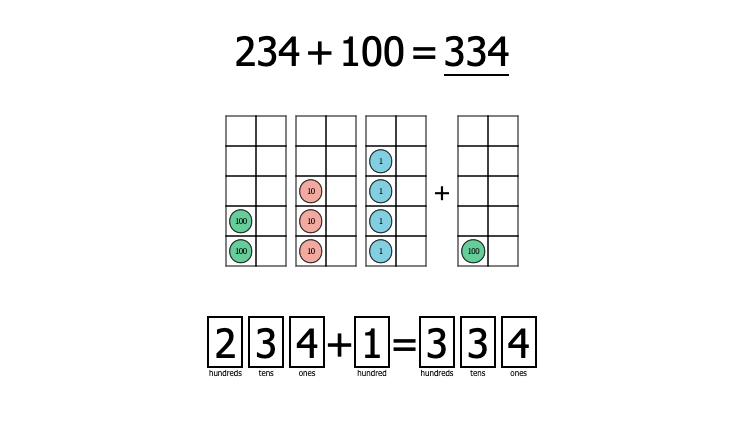
Generalize from adding tens and ones to adding hundreds. What is 346+200? 300+200 is 3 hundreds + 2 hundreds = 5 hundreds or 500. 346+200 = 546. Think in units of one hundred to make adding multiples of 100 easier.
Prerequisites: 2-85 ○ 1-114
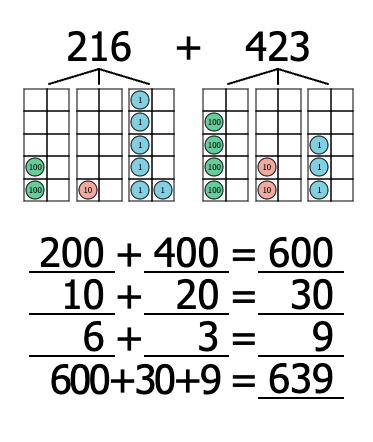
Use Base 10 discs to model and add 3-digit addends with no regrouping. What's 216+423? Group same units together. Add hundreds. Add tens. Add ones. 200+400 = 600, 10+20 = 30, and 6+3 = 9. Add the 3 partial sums to get the total sum. 216+423 = 600+30+9 = 639. Transition to number bonds and equations.
Prerequisites: 2-91 ○ 2-86
2-076: Place Value to 1,000 with Base 10 Discs
Encourage Base 10 thinking by decomposing numbers into expanded form. Use non-proportional Base 10 discs and ten frames to model quantities and place values concretely. What's 618? 6 hundreds, 1 ten, and 8 ones. Use "nicknames" to emphasize each digit's quantity and place value. "Six hundred, one ten, eight."
Prerequisites: 1-106 ○ 1-105
2-091: Add Multiples of 100
Generalize from adding tens and ones to adding hundreds. What is 346+200? 300+200 is 3 hundreds + 2 hundreds = 5 hundreds or 500. 346+200 = 546. Think in units of one hundred to make adding multiples of 100 easier.
Prerequisites: 2-85 ○ 1-114
2-092: 3-Digit Addends: No Shifting
Use Base 10 discs to model and add 3-digit addends with no regrouping. What's 216+423? Group same units together. Add hundreds. Add tens. Add ones. 200+400 = 600, 10+20 = 30, and 6+3 = 9. Add the 3 partial sums to get the total sum. 216+423 = 600+30+9 = 639. Transition to number bonds and equations.
Prerequisites: 2-91 ○ 2-86
Remove or separate a part from the total to find the value of the remaining part. Count backward, find the unknown part and subtract by subitzing, to build fluency and find how many are left.
Count backward to deepen understanding of numbers 1 to 5 while laying the groundwork for subtraction. What number is 1 less and comes before 5? 4. What number is 1 less and comes before 4? 3. Put numbers represented visually in groups and abstractly with digits in descending or reverse order.
Prerequisites: K-22
Introduce subtraction as "take away". Given the total and one of the parts on a number bond, find the other part. If the total is 5 and 1 is taken away, how many are left? Start by visualizing 5 on a five frame. Mentally cross off 1. How many are left? Draw or use counters to check that the answer is 4.
Prerequisites: K-30 ○ K-29, K-27, K-26
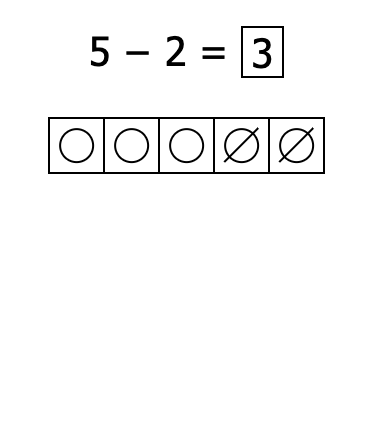
Introduce subtraction equations as a more formal and abstract way to show the relationship between a total and its parts. Combine all 3 models – concrete five frames, pictorial number bonds, and abstract equations – to make connections and help students see that the total minus one of the parts leaves the other part.
Prerequisites: K-41 ○ K-32, K-26
K-023: Count Backward from 5
Count backward to deepen understanding of numbers 1 to 5 while laying the groundwork for subtraction. What number is 1 less and comes before 5? 4. What number is 1 less and comes before 4? 3. Put numbers represented visually in groups and abstractly with digits in descending or reverse order.
Prerequisites: K-22
K-040: Take Away using Number Bonds & Five Frames
Introduce subtraction as "take away". Given the total and one of the parts on a number bond, find the other part. If the total is 5 and 1 is taken away, how many are left? Start by visualizing 5 on a five frame. Mentally cross off 1. How many are left? Draw or use counters to check that the answer is 4.
Prerequisites: K-30 ○ K-29, K-27, K-26
K-042: Introduce Equations to Subtract
Introduce subtraction equations as a more formal and abstract way to show the relationship between a total and its parts. Combine all 3 models – concrete five frames, pictorial number bonds, and abstract equations – to make connections and help students see that the total minus one of the parts leaves the other part.
Prerequisites: K-41 ○ K-32, K-26
Subtract double-digit numbers using the same place value strategies as when adding. Shift 10, use the Make 10s subtraction strategy, and subtract multiples of 10.
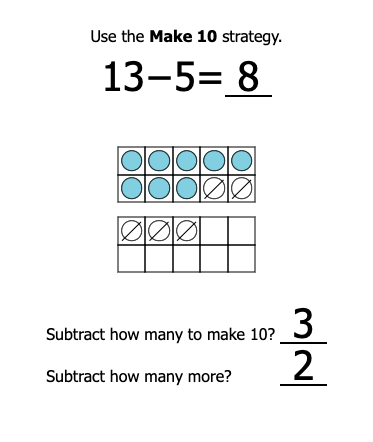
Use the Make 10 Strategy to subtract a single-digit number. What's 13-5? Visualize 13 on ten frames. Subtract 5 in 2 parts. Imagine crossing off 3 to make 10, then crossing off 2 more. How many are left? 8. Check for accuracy by using or drawing counters. Since 13-3 = 10 and 10-2 = 8, 13-5 = 8.
Prerequisites: 1-42, 1-41 ○ 1-37, K-109
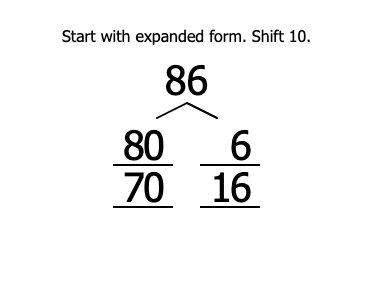
Transition from using concrete Base 10 Discs to using pictorial number bonds. What's 86? It's 80 and 6. Shift 10. The new number bond is 70 and 16. The Funny Number "seventy-sixteen" equals the real number "eighty-six." Start by shifting 10 in 2 steps. With practice, visualize and shift 10 in 1 step.
Prerequisites: 1-102
Add 2-digit and 1-digit numbers with no regrouping. First add the ones, then add back the tens to get the total. What's 26+2? Since 6+2 = 8 and 20+8 = 28, 26+2 = 28. Start by modeling numbers with concrete Base 10 Blocks or snap cubes. Progress to using pictorial number bonds and finally, just mental math.
Prerequisites: 1-49
1-057: Subtract using the Make 10 Strategy
Use the Make 10 Strategy to subtract a single-digit number. What's 13-5? Visualize 13 on ten frames. Subtract 5 in 2 parts. Imagine crossing off 3 to make 10, then crossing off 2 more. How many are left? 8. Check for accuracy by using or drawing counters. Since 13-3 = 10 and 10-2 = 8, 13-5 = 8.
Prerequisites: 1-42, 1-41 ○ 1-37, K-109
1-103: Shift 10 with Number Bonds
Transition from using concrete Base 10 Discs to using pictorial number bonds. What's 86? It's 80 and 6. Shift 10. The new number bond is 70 and 16. The Funny Number "seventy-sixteen" equals the real number "eighty-six." Start by shifting 10 in 2 steps. With practice, visualize and shift 10 in 1 step.
Prerequisites: 1-102
1-108: Add a Single-Digit Number with No Regrouping
Add 2-digit and 1-digit numbers with no regrouping. First add the ones, then add back the tens to get the total. What's 26+2? Since 6+2 = 8 and 20+8 = 28, 26+2 = 28. Start by modeling numbers with concrete Base 10 Blocks or snap cubes. Progress to using pictorial number bonds and finally, just mental math.
Prerequisites: 1-49
Subtract 3-digit numbers by shifting 10, 100, or 10 and 100, before calculating partial differences. Solve problems subtracting across double zeros, an equal number of tens, or zero tens.
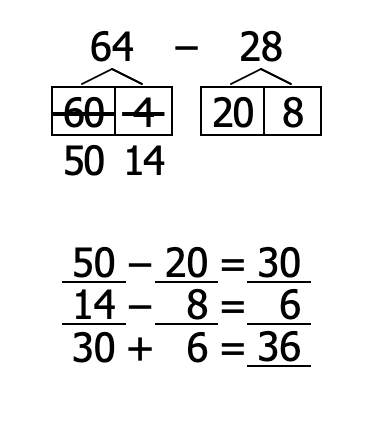
Transition from using concrete Base 10 discs to model regrouping problems, to using pictorial number bonds. What's 64–28? 64 in expanded form is 60 and 4. 28 is 20 and 8. There are not enough ones, so shift 10. "Sixty-four" becomes "fifty-fourteen." Since 50-20 = 30, 14-8 = 6, and 30+6 = 36, 64-28 = 36.
Prerequisites: 2-34 ○ 1-103
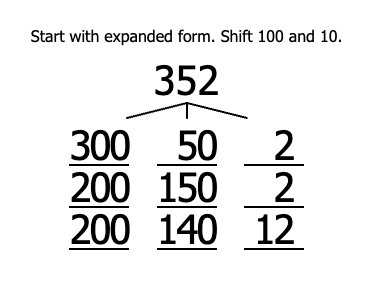
Transition from Base 10 blocks to using number bonds to model numbers and shift 100 and 10. What's 352? It's 3 hundreds, 5 tens, and 2 ones, or 300+50+2. Shift 100. It's 200+150+2. Now shift 10. It's 200+140+12. Start by writing 3 number bonds. With practice, mentally shift 100 and 10 and write the final number bond.
Prerequisites: 2-81
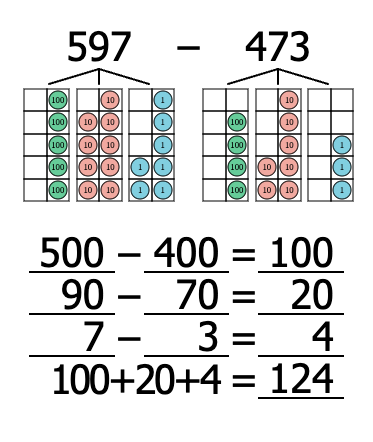
Use Base 10 discs to subtract 3-digit numbers with no regrouping. What's 597-473? Subtract same units – hundreds, tens, and ones. 500-400 = 100, 90-70 = 20, and 7-3 = 4. Add the 3 partial differences to get the total difference. Since 100+20+4 = 124, 597-473 = 124. Transition to number bonds and equations.
Prerequisites: 2-99
2-035: Subtract Double-Digit Numbers with Regrouping using Number Bonds
Transition from using concrete Base 10 discs to model regrouping problems, to using pictorial number bonds. What's 64–28? 64 in expanded form is 60 and 4. 28 is 20 and 8. There are not enough ones, so shift 10. "Sixty-four" becomes "fifty-fourteen." Since 50-20 = 30, 14-8 = 6, and 30+6 = 36, 64-28 = 36.
Prerequisites: 2-34 ○ 1-103
2-082: Shift 100 & 10 to Regroup using Number Bonds
Transition from Base 10 blocks to using number bonds to model numbers and shift 100 and 10. What's 352? It's 3 hundreds, 5 tens, and 2 ones, or 300+50+2. Shift 100. It's 200+150+2. Now shift 10. It's 200+140+12. Start by writing 3 number bonds. With practice, mentally shift 100 and 10 and write the final number bond.
Prerequisites: 2-81
2-103: 3-Digit Subtrahends: No Shifting
Use Base 10 discs to subtract 3-digit numbers with no regrouping. What's 597-473? Subtract same units – hundreds, tens, and ones. 500-400 = 100, 90-70 = 20, and 7-3 = 4. Add the 3 partial differences to get the total difference. Since 100+20+4 = 124, 597-473 = 124. Transition to number bonds and equations.
Prerequisites: 2-99
Introduce multiplication as equal groups, using bar models and arays. Systematically study 0-1, 2-3, 4, and 5 groups of 1-9. Break apart groups rather than skip-count, and use number bonds and equations to build fluency.
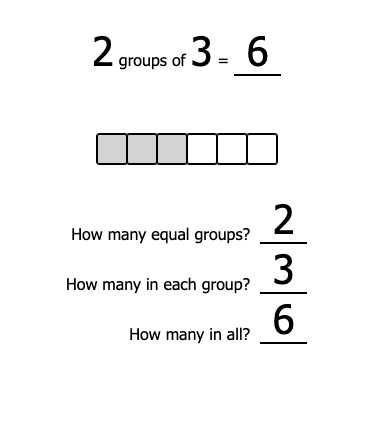
Use snap cubes to model equal groups. Represent values by the number and length of cubes snapped together. Focus on seeing, hearing, and understanding the difference between the number of groups and the number in each group – the size of each group. Add in smart ways to figure out how many in all – the total.
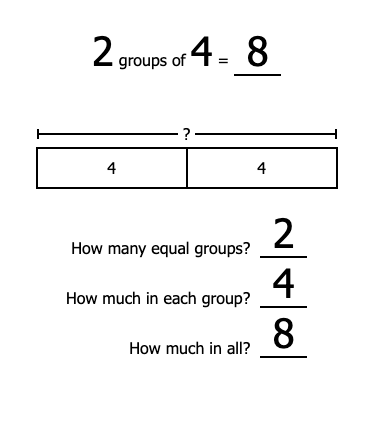
Use bar models to model equal groups. Represent values by the lengths of bars. To draw equal groups, draw a shorter bar and make copies. Alternatively, draw a longer bar and divide it into equal lengths. Draw halves to make 2 equal groups. Divide each half in half to make 4 equal groups. Visually estimate 3 and 5 equal groups.
Prerequisites: 2-17
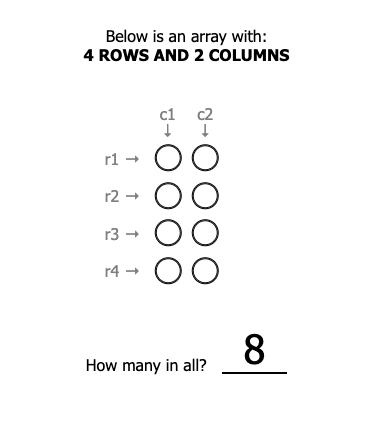
Color or draw an array with up to 5 rows and 5 columns of circles or dots. Use the convention that the number of rows represents the number of groups, and the number of columns represents the size or number in each group. An array with 4 rows and 2 columns is 4 groups of 2. Since 2+2+2+2 = 8, the array has 8 circles in all.
Prerequisites: 2-18
2-017: Model Equal Groups with Snap Cubes
Use snap cubes to model equal groups. Represent values by the number and length of cubes snapped together. Focus on seeing, hearing, and understanding the difference between the number of groups and the number in each group – the size of each group. Add in smart ways to figure out how many in all – the total.
2-018: Model Equal Groups with Bar Models
Use bar models to model equal groups. Represent values by the lengths of bars. To draw equal groups, draw a shorter bar and make copies. Alternatively, draw a longer bar and divide it into equal lengths. Draw halves to make 2 equal groups. Divide each half in half to make 4 equal groups. Visually estimate 3 and 5 equal groups.
Prerequisites: 2-17
2-019: Model Arrays with Counters
Color or draw an array with up to 5 rows and 5 columns of circles or dots. Use the convention that the number of rows represents the number of groups, and the number of columns represents the size or number in each group. An array with 4 rows and 2 columns is 4 groups of 2. Since 2+2+2+2 = 8, the array has 8 circles in all.
Prerequisites: 2-18
Extend multiplication facts to multiply 6, 7, 8, 9, and 10 groups. Fluently multiply to 100 by breaking 2-digit factors into tens and ones, using number bonds, arrays, and area models. Multiply multiples of 10.
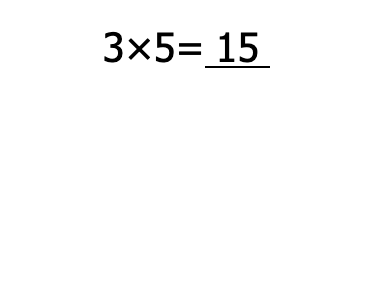
Transition from using number bonds to writing equations and using mental math. What's 3x5? Visualize 3 groups of 5 as 2 groups of 5 and 1 group of 5. Since 2x5 = 10 and 1x5 = 5, 3x5 = 10+5 = 15. Find and add partial products to get the total product – the distributive property. The goal is fluency first, then automaticity.
Prerequisites: 3-32
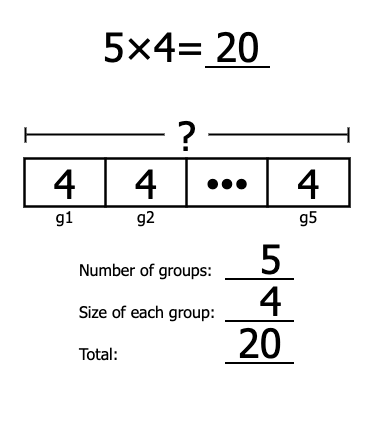
Use an ellipsis as a shortcut when drawing 5 or more groups. What's 5x4? Instead of drawing all 5 groups, draw groups 1 and 2 with 4 in each group. Draw a bar with "•••" to show the pattern of 4s continues, then draw the last 4 – group 5. Which groups does the "•••" represent? The ellipsis represents groups 3 and 4.
Prerequisites: 3-34
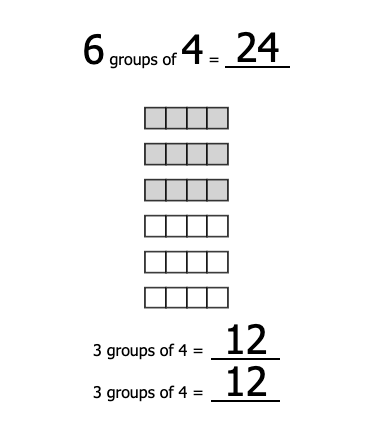
Use a bar model to visualize 6 equal groups. Start by explicitly drawing all 6 groups. What's 6x4? Find and add partial products to get the total product. "A group of 6 is quick to see, if you think in groups of 3." 6x4 = 3x4 + 3x4 = 12+12 = 24. Transition to modeling 6 groups with an ellipsis. Use "•••" to represent groups 3 to 5.
Prerequisites: 3-39
3-033: Multiply 2-5 Groups Fluently with Equations
Transition from using number bonds to writing equations and using mental math. What's 3x5? Visualize 3 groups of 5 as 2 groups of 5 and 1 group of 5. Since 2x5 = 10 and 1x5 = 5, 3x5 = 10+5 = 15. Find and add partial products to get the total product – the distributive property. The goal is fluency first, then automaticity.
Prerequisites: 3-32
3-039: Introduce the Ellipsis Symbol ( ••• ) in Bar Models
Use an ellipsis as a shortcut when drawing 5 or more groups. What's 5x4? Instead of drawing all 5 groups, draw groups 1 and 2 with 4 in each group. Draw a bar with "•••" to show the pattern of 4s continues, then draw the last 4 – group 5. Which groups does the "•••" represent? The ellipsis represents groups 3 and 4.
Prerequisites: 3-34
3-040: Multiply 6 Groups
Use a bar model to visualize 6 equal groups. Start by explicitly drawing all 6 groups. What's 6x4? Find and add partial products to get the total product. "A group of 6 is quick to see, if you think in groups of 3." 6x4 = 3x4 + 3x4 = 12+12 = 24. Transition to modeling 6 groups with an ellipsis. Use "•••" to represent groups 3 to 5.
Prerequisites: 3-39
Combine knowledge of multiplication facts and place value to multiply multi-digit numbers. Transition from multiplying single digits fluently, to multiplying 1-digit by 3-digit multiples of 100, up to 2-digit by 2-digit and 1-digit by 4-digit numbers. Use area models, number bonds, and the partial products algorithm.
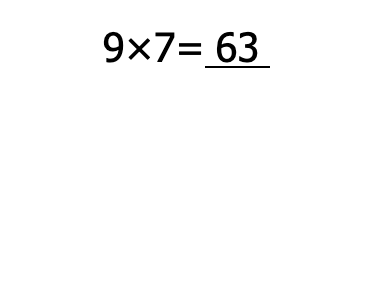
Transition from number bonds to using equations and mental math. What's 9x7? 9 groups are 5 groups and 4 groups. Since 5x7 = 35 and 4x7 = 28, 9x7 = 35+28 = 63. 9 groups are also 10 groups minus 1 group. Since 10x7 = 70, 9x7 = 70-7 = 63. Build computational fluency by breaking numbers apart in different ways.
Prerequisites: 3-45
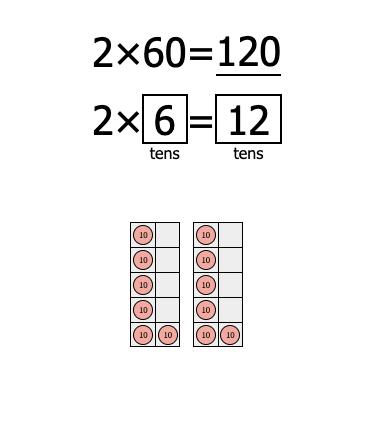
Multiply 1-digit numbers and multiples of 10. What's 2x60? Since 60 is 6 tens, 2x60 = 2x6 tens = 12 tens = 10 tens+2 tens = 100+20 = 120. What's 3x50? Since 50 is 5 tens, 3x50 = 3 x 5 tens = 15 tens = 10 tens + 5 tens = 100+50 = 150. Think of multiples of 10 in units of 10. What's 4x70? 70 is 7 tens, so 4x70 = 28 tens = 280.
Prerequisites: 3-44
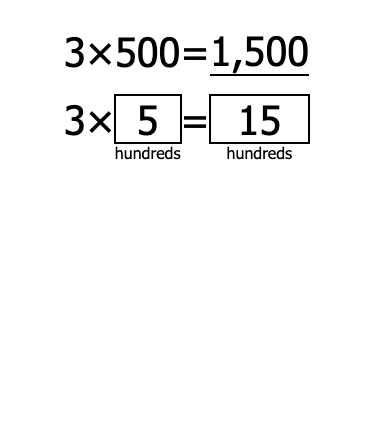
Multiply a 1-digit number and multiple of 100 by thinking in hundreds. What's 3 x 500? 500 is 5 hundreds, so 3 x 5 hundreds = 15 hundreds = 10 hundreds + 5 hundreds = 1,000+500 = 1,500. Think of "00" as hundreds. What's 4 x 600? 4 x 6 hundreds = 24 hundreds = 20 hundreds + 4 hundreds = 2,000 + 400 = 2,400.
Prerequisites: 3-106
3-046: Multiply 6-10 Groups using Mental Math
Transition from number bonds to using equations and mental math. What's 9x7? 9 groups are 5 groups and 4 groups. Since 5x7 = 35 and 4x7 = 28, 9x7 = 35+28 = 63. 9 groups are also 10 groups minus 1 group. Since 10x7 = 70, 9x7 = 70-7 = 63. Build computational fluency by breaking numbers apart in different ways.
Prerequisites: 3-45
3-106: Multiply Multiples of 10
Multiply 1-digit numbers and multiples of 10. What's 2x60? Since 60 is 6 tens, 2x60 = 2x6 tens = 12 tens = 10 tens+2 tens = 100+20 = 120. What's 3x50? Since 50 is 5 tens, 3x50 = 3 x 5 tens = 15 tens = 10 tens + 5 tens = 100+50 = 150. Think of multiples of 10 in units of 10. What's 4x70? 70 is 7 tens, so 4x70 = 28 tens = 280.
Prerequisites: 3-44
4-034: Multiply 1-Digit x 3-Digit Multiples of 100
Multiply a 1-digit number and multiple of 100 by thinking in hundreds. What's 3 x 500? 500 is 5 hundreds, so 3 x 5 hundreds = 15 hundreds = 10 hundreds + 5 hundreds = 1,000+500 = 1,500. Think of "00" as hundreds. What's 4 x 600? 4 x 6 hundreds = 24 hundreds = 20 hundreds + 4 hundreds = 2,000 + 400 = 2,400.
Prerequisites: 3-106
Use multiplication skills and patterns to identify multiples, common multiples and least common multiples. Determine divisibility, find factor pairs and identify prime and composite numbers using number bonds, partial quotients, and number lines.
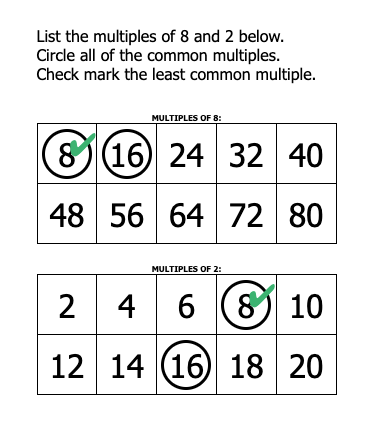
Find multiples, common multiples, and the least common multiple. List the first 10 multiples of 2 single-digit numbers. What are the multiples of 8 and 2? For 8, they are 1x8 = 8, 2x8 = 16, 3x8 = 24, etc. For 2, they are 1x2 = 2, 2x2 = 4, 3x2 = 6, etc. The common multiples are 8 and 16, so the least common multiple is 8.
Prerequisites: 3-38
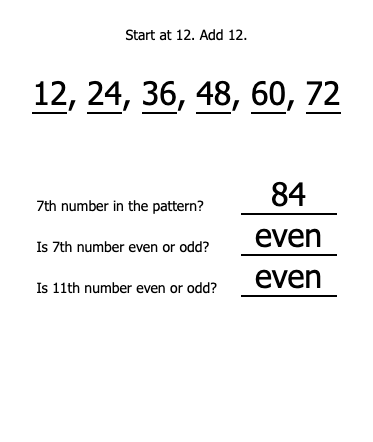
Use patterns to find multiples. Start with a rule and find the pattern. Start with a pattern and find the rule. If 12 is the first multiple and the rule is to add 12, what's the 7th multiple? It's 7x12 = 84. What's the 17th multiple? It's 17x12 = 204. Or, add 10 groups of 12 to the 7th multiple to get the 17th multiple. 84+120 = 204.
Prerequisites: 4-59
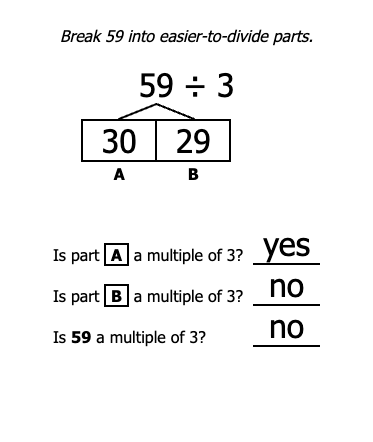
Use multiples to check for divisibility. Does 59 divide evenly by 3? 59 is divisible by 3 if it's a multiple of 3. To check, break 59 into 2 smaller parts. If both parts are multiples of 3, then 59 is a multiple of 3. Since 59 is 30 and 29, it is not a multiple of 3. 30 is a multiple of 3, but 29 is not. Check smaller parts instead of larger totals.
Prerequisites: 4-60 ○ 4-14
4-059: Multiples, Common Multiples & Least Common Multiples
Find multiples, common multiples, and the least common multiple. List the first 10 multiples of 2 single-digit numbers. What are the multiples of 8 and 2? For 8, they are 1x8 = 8, 2x8 = 16, 3x8 = 24, etc. For 2, they are 1x2 = 2, 2x2 = 4, 3x2 = 6, etc. The common multiples are 8 and 16, so the least common multiple is 8.
Prerequisites: 3-38
4-060: Use Patterns & Rules to Find Multiples
Use patterns to find multiples. Start with a rule and find the pattern. Start with a pattern and find the rule. If 12 is the first multiple and the rule is to add 12, what's the 7th multiple? It's 7x12 = 84. What's the 17th multiple? It's 17x12 = 204. Or, add 10 groups of 12 to the 7th multiple to get the 17th multiple. 84+120 = 204.
Prerequisites: 4-59
4-061: Use Multiples to Check for Divisibility
Use multiples to check for divisibility. Does 59 divide evenly by 3? 59 is divisible by 3 if it's a multiple of 3. To check, break 59 into 2 smaller parts. If both parts are multiples of 3, then 59 is a multiple of 3. Since 59 is 30 and 29, it is not a multiple of 3. 30 is a multiple of 3, but 29 is not. Check smaller parts instead of larger totals.
Prerequisites: 4-60 ○ 4-14
Connect division to related multiplication problems and differentiate between sharing and grouping contexts. The two give the same answer, but represent very different real-world models. This helps students solve word problems with deeper understanding.
Transition from using concrete Base 10 Discs to using pictorial number bonds. What's 86? It's 80 and 6. Shift 10. The new number bond is 70 and 16. The Funny Number "seventy-sixteen" equals the real number "eighty-six." Start by shifting 10 in 2 steps. With practice, visualize and shift 10 in 1 step.
Prerequisites: 1-102
Transition from using number bonds to writing equations and using mental math. What's 3x5? Visualize 3 groups of 5 as 2 groups of 5 and 1 group of 5. Since 2x5 = 10 and 1x5 = 5, 3x5 = 10+5 = 15. Find and add partial products to get the total product – the distributive property. The goal is fluency first, then automaticity.
Prerequisites: 3-32
Transition from number bonds to using equations and mental math. What's 9x7? 9 groups are 5 groups and 4 groups. Since 5x7 = 35 and 4x7 = 28, 9x7 = 35+28 = 63. 9 groups are also 10 groups minus 1 group. Since 10x7 = 70, 9x7 = 70-7 = 63. Build computational fluency by breaking numbers apart in different ways.
Prerequisites: 3-45
1-103: Shift 10 with Number Bonds
Transition from using concrete Base 10 Discs to using pictorial number bonds. What's 86? It's 80 and 6. Shift 10. The new number bond is 70 and 16. The Funny Number "seventy-sixteen" equals the real number "eighty-six." Start by shifting 10 in 2 steps. With practice, visualize and shift 10 in 1 step.
Prerequisites: 1-102
3-033: Multiply 2-5 Groups Fluently with Equations
Transition from using number bonds to writing equations and using mental math. What's 3x5? Visualize 3 groups of 5 as 2 groups of 5 and 1 group of 5. Since 2x5 = 10 and 1x5 = 5, 3x5 = 10+5 = 15. Find and add partial products to get the total product – the distributive property. The goal is fluency first, then automaticity.
Prerequisites: 3-32
3-046: Multiply 6-10 Groups using Mental Math
Transition from number bonds to using equations and mental math. What's 9x7? 9 groups are 5 groups and 4 groups. Since 5x7 = 35 and 4x7 = 28, 9x7 = 35+28 = 63. 9 groups are also 10 groups minus 1 group. Since 10x7 = 70, 9x7 = 70-7 = 63. Build computational fluency by breaking numbers apart in different ways.
Prerequisites: 3-45
Break dividends into easier-to-divide multiples of hundreds, tens, and ones, using the partial quotients algorithm. This methoid maintains place value and is a bridge to the more abstract long division algorithm.
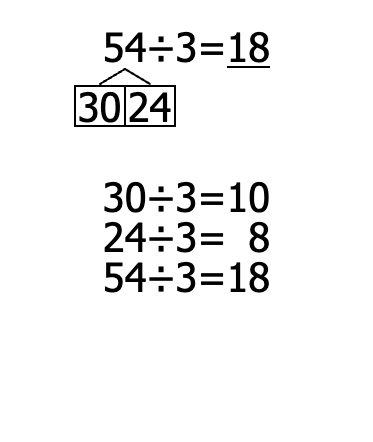
Use number bonds and mental math to solve division regrouping problems fluently. What's 54÷3? 54 = 50+4, but neither 50 nor 4 are multiples of 3. Regroup by shifting 10 twice – shifting 20 in all – to make 30 and 24. Since 30÷3 = 10, 24÷3 = 8, and 10+8 = 18, 54÷3 = 18. Find and add partial quotients to get the total quotient.
Prerequisites: 3-111 ○ 3-71
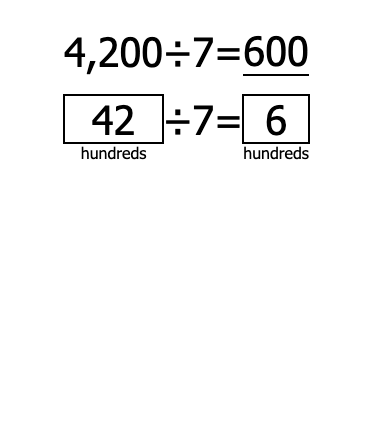
Divide a multiple of 100 by a single-digit number by thinking in units of 100. What's 4,200 ÷ 7? 4,000 = 40 hundreds and 200 = 2 hundreds, so 4,200 = 42 hundreds. 42 hundreds ÷ 7 = 6 hundreds = 600. Think of "00" as hundreds. What's 2,400 ÷ 3? 2,400 = 24 hundreds, and 24 hundreds ÷ 3 = 8 hundreds = 800.
Prerequisites: 3-109
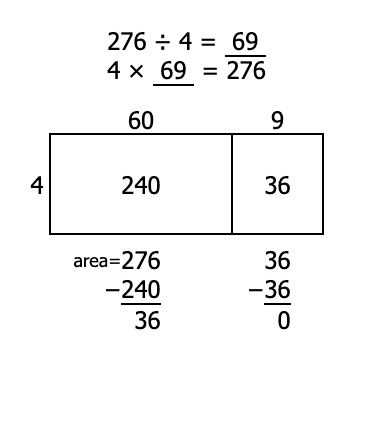
Divide using area models. What's 276÷4? Draw a rectangle with area 276 and short side of 4. What's the other side? 4 x __ = 276? Break the total area into partial areas. 276 = 240+36, so 276÷4 = (240÷4) + (36÷4). Since 4x60 = 240 and 4x9 = 36, 276÷4 = 60+9 = 69. Find and add partial quotients to get the total quotient.
Prerequisites: 4-12 ○ 4-12
3-112: Divide to 100 with Regrouping: Number Bonds & Equations
Use number bonds and mental math to solve division regrouping problems fluently. What's 54÷3? 54 = 50+4, but neither 50 nor 4 are multiples of 3. Regroup by shifting 10 twice – shifting 20 in all – to make 30 and 24. Since 30÷3 = 10, 24÷3 = 8, and 10+8 = 18, 54÷3 = 18. Find and add partial quotients to get the total quotient.
Prerequisites: 3-111 ○ 3-71
4-046: Divide Multiples of 100
Divide a multiple of 100 by a single-digit number by thinking in units of 100. What's 4,200 ÷ 7? 4,000 = 40 hundreds and 200 = 2 hundreds, so 4,200 = 42 hundreds. 42 hundreds ÷ 7 = 6 hundreds = 600. Think of "00" as hundreds. What's 2,400 ÷ 3? 2,400 = 24 hundreds, and 24 hundreds ÷ 3 = 8 hundreds = 800.
Prerequisites: 3-109
4-047: Divide 3-Digit Numbers with Area Models
Divide using area models. What's 276÷4? Draw a rectangle with area 276 and short side of 4. What's the other side? 4 x __ = 276? Break the total area into partial areas. 276 = 240+36, so 276÷4 = (240÷4) + (36÷4). Since 4x60 = 240 and 4x9 = 36, 276÷4 = 60+9 = 69. Find and add partial quotients to get the total quotient.
Prerequisites: 4-12 ○ 4-12
Divide whole numbers in cases where there is a remainder. Transition from using area models and number bonds to the partial quotients algorithm. Develop fluency with procedures in order to focus on understanding and interpreting the meaning of the remainder. This work lays the foundation for understanding fractions and decimals.
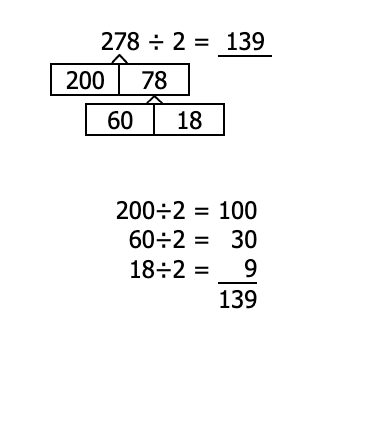
Transition from area models to number bonds. Divide by breaking the total into smaller, known multiples that are easier to divide. What's 278÷2? Think of 278 as 200+60+18, or 2 hundreds, 6 tens, and 18 ones. 278÷2 = (200÷2) + (60÷2) + (18÷2) = 100+30+9 = 139. Find and add partial quotients to get the total quotient.
Prerequisites: 4-47 ○ 4-13
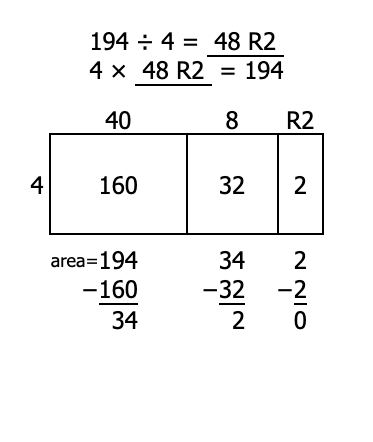
Divide numbers that are not multiples of the divisor. What's 194÷4? Draw a rectangle with area 194 and short side 4. Break the total area recursively into partial areas that are multiples of 4 and what's left. Since 194 = 160+32+2 and 2 is less than the divisor, it's the remainder. 194÷4 = (160÷4) + (32÷4) + (2÷4) = 48 R2.
Prerequisites: 4-47
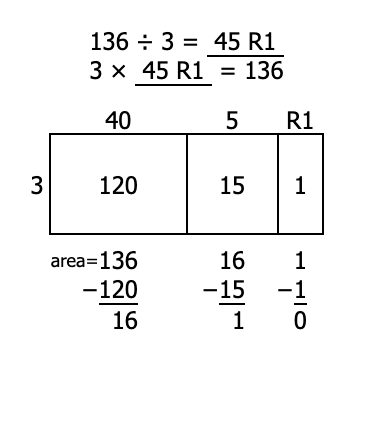
Transition from dividing concretely with area models to dividing pictorially with number bonds. What's 136÷3? Divide the total recursively into known multiples of 3 and what's left. Since 136 = 120+15+1, 136÷3 = (120÷3) + (15÷3) + (1÷3) = 45 R1. Any part smaller than the divisor is called the remainder.
Prerequisites: 4-48
4-048: Divide 3-Digit Numbers with Number Bonds
Transition from area models to number bonds. Divide by breaking the total into smaller, known multiples that are easier to divide. What's 278÷2? Think of 278 as 200+60+18, or 2 hundreds, 6 tens, and 18 ones. 278÷2 = (200÷2) + (60÷2) + (18÷2) = 100+30+9 = 139. Find and add partial quotients to get the total quotient.
Prerequisites: 4-47 ○ 4-13
4-064: Divide 3-Digit Numbers with Remainders using Area Models
Divide numbers that are not multiples of the divisor. What's 194÷4? Draw a rectangle with area 194 and short side 4. Break the total area recursively into partial areas that are multiples of 4 and what's left. Since 194 = 160+32+2 and 2 is less than the divisor, it's the remainder. 194÷4 = (160÷4) + (32÷4) + (2÷4) = 48 R2.
Prerequisites: 4-47
4-065: Divide 3-Digit Numbers with Remainders using Area Models & Number Bonds
Transition from dividing concretely with area models to dividing pictorially with number bonds. What's 136÷3? Divide the total recursively into known multiples of 3 and what's left. Since 136 = 120+15+1, 136÷3 = (120÷3) + (15÷3) + (1÷3) = 45 R1. Any part smaller than the divisor is called the remainder.
Prerequisites: 4-48
Reason about remainders in different contexts. Solve word problems where the total, the group size or the group number is unknown, and report a remainder as a simplified fraction. Use the context of the problem to decide how to interpret the remainder. Can it be ignored or does it mean that the number of groups is 1 more than calculated?
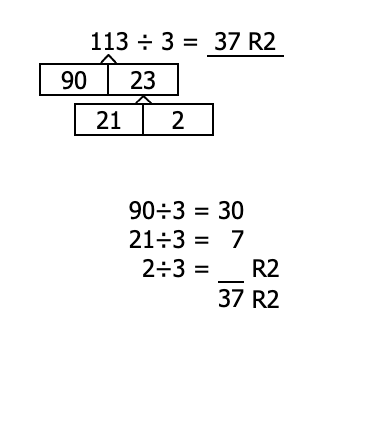
Transition from number bonds to the vertical, partial quotients algorithm. Start by solving problems with both models, side-by-side. Use the distributive property to break totals into parts, then add partial quotients to get the total quotient. When a part is less than the divisor so can't be broken apart further, label it the remainder.
Prerequisites: 4-50
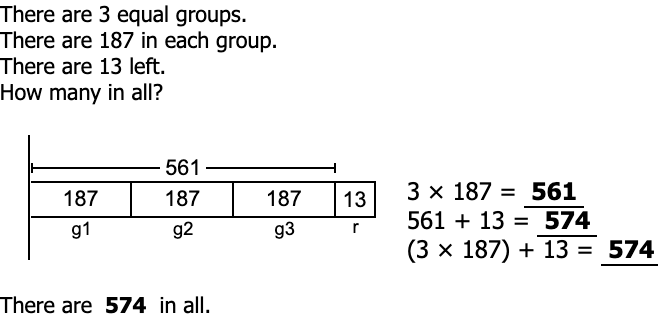
Interpret the remainder when the total is unknown. If there are 3 groups with 187 in each group, plus 13 more, how many in all? Multiply 3x187 = 561. Add 13 to get a total of 561+13 = 574. To solve as a single equation, use parentheses to group numbers explicitly. Follow the correct order of operations to get (3x187)+13 = 574.
Prerequisites: 4-68 ○ 4-55
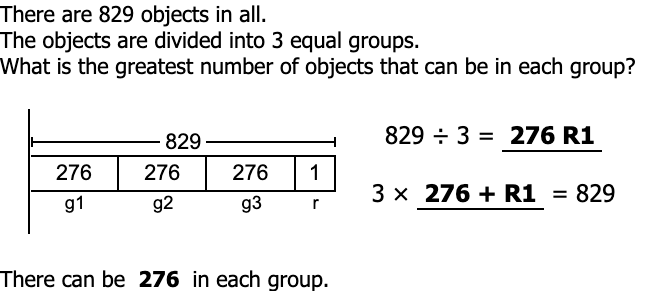
Interpret the remainder when dividing to find the size of each group. If 829 is divided into 3 equal groups, what's the most that can be in each group? 829 = 600+210+18+1, so 829÷3 = (6 hundreds÷3) + (21 tens÷3) + (18 ones÷3) + (1 one÷3) = 276 R1. The most that can be in each group is 276, so the remainder is ignored.
Prerequisites: 4-69
4-067: Divide 3-Digit Numbers with Remainders using the Partial Quotients Algorithm
Transition from number bonds to the vertical, partial quotients algorithm. Start by solving problems with both models, side-by-side. Use the distributive property to break totals into parts, then add partial quotients to get the total quotient. When a part is less than the divisor so can't be broken apart further, label it the remainder.
Prerequisites: 4-50
4-069: Interpret the Remainder Word Problems: Total-Unknown
Interpret the remainder when the total is unknown. If there are 3 groups with 187 in each group, plus 13 more, how many in all? Multiply 3x187 = 561. Add 13 to get a total of 561+13 = 574. To solve as a single equation, use parentheses to group numbers explicitly. Follow the correct order of operations to get (3x187)+13 = 574.
Prerequisites: 4-68 ○ 4-55
4-070: Interpret the Remainder Word Problems: Group-Size-Unknown
Interpret the remainder when dividing to find the size of each group. If 829 is divided into 3 equal groups, what's the most that can be in each group? 829 = 600+210+18+1, so 829÷3 = (6 hundreds÷3) + (21 tens÷3) + (18 ones÷3) + (1 one÷3) = 276 R1. The most that can be in each group is 276, so the remainder is ignored.
Prerequisites: 4-69
Identify which words describe a part and which describe the total. Use a part-total diagram to record, then calculate the missing value, in all of the different types of word problems. Start with learning problems, using numbers without a context, and progress to story problems that have a context to interpret.
Start with learning problems – word problems that teach explicitly and don't require students to interpret context. Given the starting quantity and how much is added to it – find how many in all. Use a part-total diagram to visually show their relationship. Use snap cubes to model quantities and find the total.
Prerequisites: K-31
Model "Put-Together" problems. Instead of starting with one part and adding to it, start with two parts and join them together. If there is 1 cube in one part and 1 cube in the other part, how many cubes are there in all? Since 1+1=2, there are 2 cubes in all. Use a part-total model to visually show the relationship between the parts and total.
Prerequisites: K-49
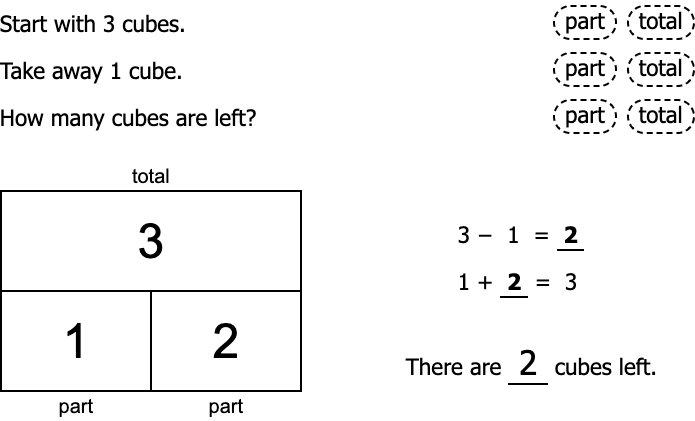
Model "Take-From" problems. Start with a total – the "start" – and take some away – the "change" – how much is left – the "result?" Use a part-part-total model to visually show the relationship between the parts and total. Use five frames and snap cubes if concrete manipulatives are needed.
Prerequisites: K-43 ○ K-49
K-049: Add-To Learning Problems
Start with learning problems – word problems that teach explicitly and don't require students to interpret context. Given the starting quantity and how much is added to it – find how many in all. Use a part-total diagram to visually show their relationship. Use snap cubes to model quantities and find the total.
Prerequisites: K-31
K-051: Put-Together Learning Problems
Model "Put-Together" problems. Instead of starting with one part and adding to it, start with two parts and join them together. If there is 1 cube in one part and 1 cube in the other part, how many cubes are there in all? Since 1+1=2, there are 2 cubes in all. Use a part-total model to visually show the relationship between the parts and total.
Prerequisites: K-49
K-054: Take-From Learning Problems
Model "Take-From" problems. Start with a total – the "start" – and take some away – the "change" – how much is left – the "result?" Use a part-part-total model to visually show the relationship between the parts and total. Use five frames and snap cubes if concrete manipulatives are needed.
Prerequisites: K-43 ○ K-49
Identify a larger amount, smaller amount, and difference. Comparison problems are challenging because nothing is being added or taken away, so it is not obvious how to proceed. Use bar models to label and draw the relationship between the amounts. Use these visual models to make sense of key words in an intuitive way.
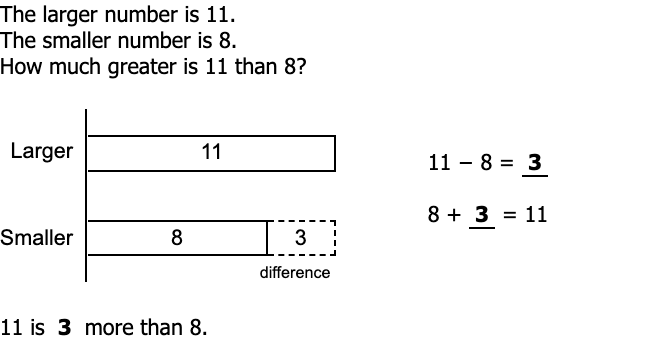
Compare 2 numbers. The larger number is how much greater than the smaller number? The smaller number is how much less than the larger number? Find the difference by adding to the smaller number to make the larger number, or by subtracting the smaller number from the larger number.
Prerequisites: K-108
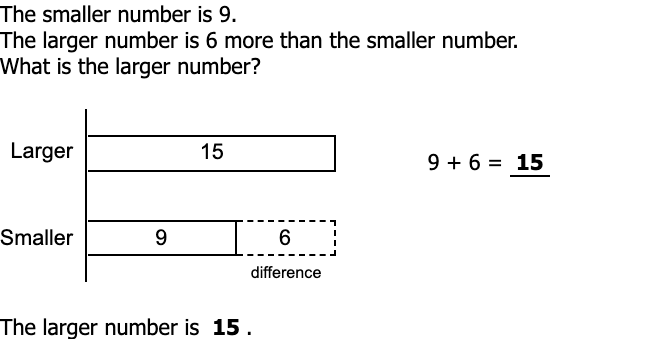
Compare 2 numbers using the word "more" in an intuitive way. Given the smaller number and how many more is the larger number, find the larger number. Add the difference to the smaller number using a Make 10 addition strategy and ten frames, number bonds, or mental math.
Prerequisites: 1-73 ○ 1-45
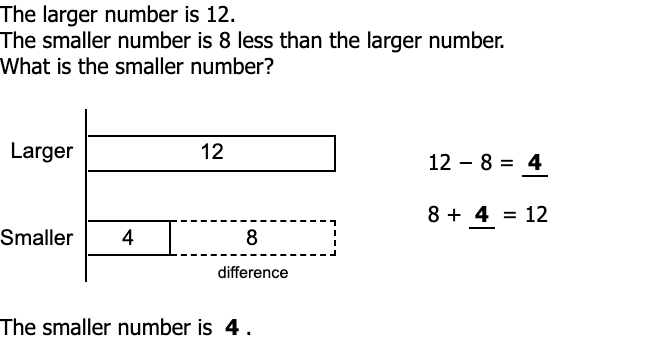
Compare 2 numbers using the words "less" and "fewer" in an intuitive way. Given the larger number and how much less or how many fewer is the smaller number, find the smaller number. Subtract the difference from the larger number using the Make 10, From 10, or Missing Part strategy.
Prerequisites: 1-74 ○ 1-60
1-073: Comparison Difference-Unknown Word Problems
Compare 2 numbers. The larger number is how much greater than the smaller number? The smaller number is how much less than the larger number? Find the difference by adding to the smaller number to make the larger number, or by subtracting the smaller number from the larger number.
Prerequisites: K-108
1-074: Comparison Larger-Unknown Word Problems
Compare 2 numbers using the word "more" in an intuitive way. Given the smaller number and how many more is the larger number, find the larger number. Add the difference to the smaller number using a Make 10 addition strategy and ten frames, number bonds, or mental math.
Prerequisites: 1-73 ○ 1-45
1-075: Comparison Smaller-Unknown Word Problems
Compare 2 numbers using the words "less" and "fewer" in an intuitive way. Given the larger number and how much less or how many fewer is the smaller number, find the smaller number. Subtract the difference from the larger number using the Make 10, From 10, or Missing Part strategy.
Prerequisites: 1-74 ○ 1-60
Solve word problems, requiring more than 1 calculation, by drawing models to identify the operation needed at each step. Label information to understand what the numbers mean, and to accurately decide what to do next.
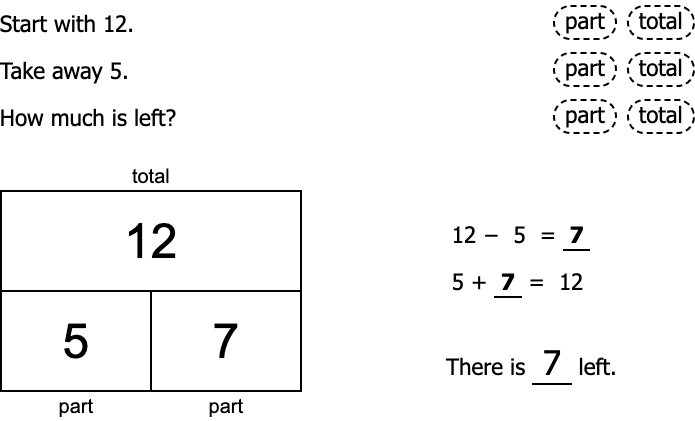
Given the starting amount (total) and how much is taken away (change), find the ending amount (result). Use a visual model to show the relationship between the parts and total. Calculate the unknown part using a Make 10 or Missing Part strategy, and ten frames, number bonds, or mental math.
Prerequisites: 1-14 ○ 1-60
Compare 2 numbers using the word "more" in an intuitive way. Given the smaller number and how many more is the larger number, find the larger number. Add the difference to the smaller number using a Make 10 addition strategy and ten frames, number bonds, or mental math.
Prerequisites: 1-73 ○ 1-45
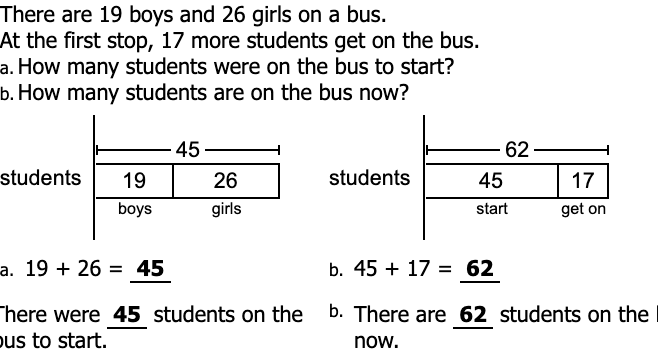
Model 2-step word problems that require part-whole thinking in both steps. Scaffold the problem by asking explicitly what needs to be solved in each step. In the first step, join 2 parts together. In the second step, join or remove another part. For clarity and practice, draw 2 bar models, 1 model for each step.
Prerequisites: 2-36
1-069: Take-From Result-Unknown Word Problems
Given the starting amount (total) and how much is taken away (change), find the ending amount (result). Use a visual model to show the relationship between the parts and total. Calculate the unknown part using a Make 10 or Missing Part strategy, and ten frames, number bonds, or mental math.
Prerequisites: 1-14 ○ 1-60
1-074: Comparison Larger-Unknown Word Problems
Compare 2 numbers using the word "more" in an intuitive way. Given the smaller number and how many more is the larger number, find the larger number. Add the difference to the smaller number using a Make 10 addition strategy and ten frames, number bonds, or mental math.
Prerequisites: 1-73 ○ 1-45
2-063: Scaffolded Join & Separate Word Problems
Model 2-step word problems that require part-whole thinking in both steps. Scaffold the problem by asking explicitly what needs to be solved in each step. In the first step, join 2 parts together. In the second step, join or remove another part. For clarity and practice, draw 2 bar models, 1 model for each step.
Prerequisites: 2-36
Use multiplicative reasoning to scale, or change, the size of the group -- by multiplying or dividing. Identify the number of groups, and the size of each group, in addition to the total value, and record notes with a bar model to see how they relate.
Use snap cubes to model equal groups. Represent values by the number and length of cubes snapped together. Focus on seeing, hearing, and understanding the difference between the number of groups and the number in each group – the size of each group. Add in smart ways to figure out how many in all – the total.
Use bar models to model equal groups. Represent values by the lengths of bars. To draw equal groups, draw a shorter bar and make copies. Alternatively, draw a longer bar and divide it into equal lengths. Draw halves to make 2 equal groups. Divide each half in half to make 4 equal groups. Visually estimate 3 and 5 equal groups.
Prerequisites: 2-17
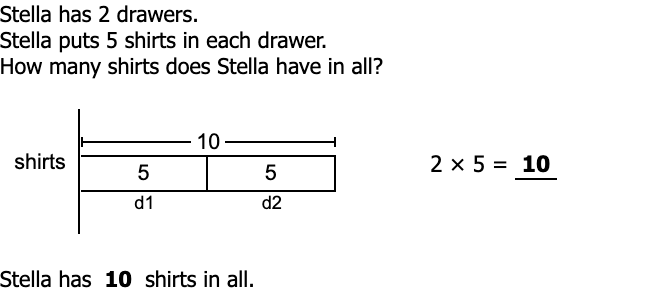
Use and interpret story problems to provide context for multiplication. Given the number of equal groups and the size of each group, find the product, or total. Use bar models to visualize the relationship between the parts and total. Apply the distributive property to find and add partial products to get the total product.
Prerequisites: 3-33
2-017: Model Equal Groups with Snap Cubes
Use snap cubes to model equal groups. Represent values by the number and length of cubes snapped together. Focus on seeing, hearing, and understanding the difference between the number of groups and the number in each group – the size of each group. Add in smart ways to figure out how many in all – the total.
2-018: Model Equal Groups with Bar Models
Use bar models to model equal groups. Represent values by the lengths of bars. To draw equal groups, draw a shorter bar and make copies. Alternatively, draw a longer bar and divide it into equal lengths. Draw halves to make 2 equal groups. Divide each half in half to make 4 equal groups. Visually estimate 3 and 5 equal groups.
Prerequisites: 2-17
3-034: Multiply 2-5 Groups: Equal Groups Story Problems
Use and interpret story problems to provide context for multiplication. Given the number of equal groups and the size of each group, find the product, or total. Use bar models to visualize the relationship between the parts and total. Apply the distributive property to find and add partial products to get the total product.
Prerequisites: 3-33
Use bar model drawing to reason and solve equal groups problems involving geometric measurement. Use multiplication, rather than repeated addition, to find the perimeters of different geometric shapes. Use the sharing and grouping models of division to calculate the lengths of sides of various shapes.
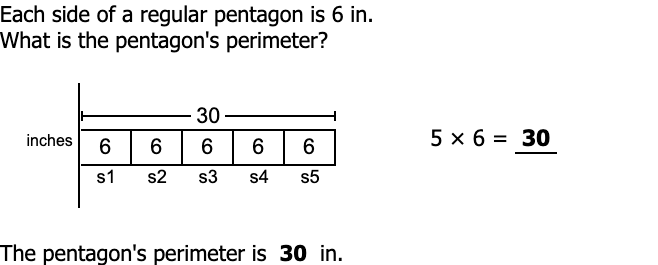
Use bar models to find the perimeter of equilateral triangles, squares, and regular pentagons. Given the shape and side lengths measured in inches, feet, centimeters, or meters, find the perimeter. Use a bar model to show the relationship between the number of sides, the length of each side, and the perimeter.
Prerequisites: 3-35, 3-34
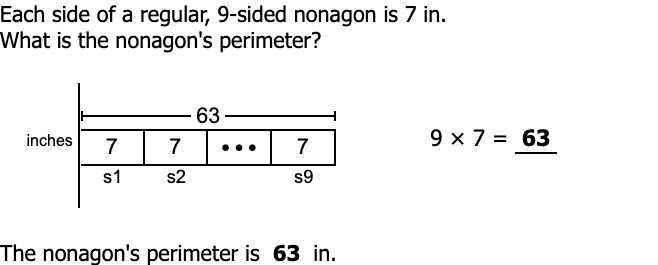
Use bar models to find the perimeter of regular hexagons, heptagons, octagons, and nonagons. Given the shape and side lengths measured in inches, feet, centimeters, or meters, find the perimeter. Use a bar model to show the relationship between the number of sides, the length of each side, and the perimeter.
Prerequisites: 3-36
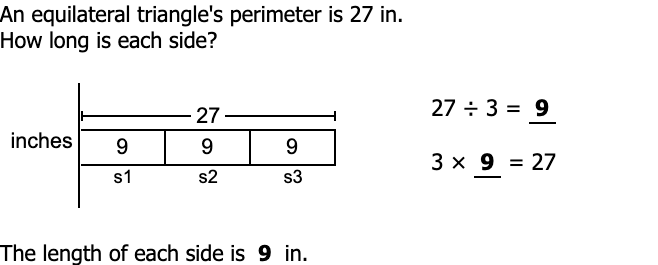
Use the sharing model of division to find the length of each side of an equilateral triangle, square, or regular pentagon. Draw a bar model to visualize the relationship between the number of sides, the length of each side, and the perimeter. Calculate lengths in inches, feet, centimeters, and meters.
Prerequisites: 3-50
3-036: Multiply 2-5 Groups: Perimeter Problems
Use bar models to find the perimeter of equilateral triangles, squares, and regular pentagons. Given the shape and side lengths measured in inches, feet, centimeters, or meters, find the perimeter. Use a bar model to show the relationship between the number of sides, the length of each side, and the perimeter.
Prerequisites: 3-35, 3-34
3-051: Multiply 6-10 Groups in Perimeter Problems Part II
Use bar models to find the perimeter of regular hexagons, heptagons, octagons, and nonagons. Given the shape and side lengths measured in inches, feet, centimeters, or meters, find the perimeter. Use a bar model to show the relationship between the number of sides, the length of each side, and the perimeter.
Prerequisites: 3-36
3-063: Divide-by-Sharing Perimeter Problems with 2-5 Groups
Use the sharing model of division to find the length of each side of an equilateral triangle, square, or regular pentagon. Draw a bar model to visualize the relationship between the number of sides, the length of each side, and the perimeter. Calculate lengths in inches, feet, centimeters, and meters.
Prerequisites: 3-50
Draw equal-group models in contexts that have remainders, and decide the meaning of the remainder. For example, if we are finding the number of people that fit in a car, a remainder of 2 may mean that we need another car. Use bar models to visualize equal groups word problems when one or both numbers are fractions.
Interpret the remainder when the total is unknown. If there are 3 groups with 187 in each group, plus 13 more, how many in all? Multiply 3x187 = 561. Add 13 to get a total of 561+13 = 574. To solve as a single equation, use parentheses to group numbers explicitly. Follow the correct order of operations to get (3x187)+13 = 574.
Prerequisites: 4-68 ○ 4-55
Interpret the remainder when dividing to find the size of each group. If 829 is divided into 3 equal groups, what's the most that can be in each group? 829 = 600+210+18+1, so 829÷3 = (6 hundreds÷3) + (21 tens÷3) + (18 ones÷3) + (1 one÷3) = 276 R1. The most that can be in each group is 276, so the remainder is ignored.
Prerequisites: 4-69
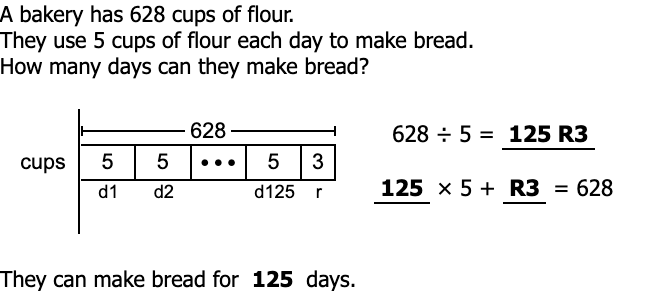
Interpret the remainder when using division to find the number of equal groups. Depending on the context, the remainder can either be ignored or can mean the number of groups is 1 more than what was calculated.
Prerequisites: 4-70
4-069: Interpret the Remainder Word Problems: Total-Unknown
Interpret the remainder when the total is unknown. If there are 3 groups with 187 in each group, plus 13 more, how many in all? Multiply 3x187 = 561. Add 13 to get a total of 561+13 = 574. To solve as a single equation, use parentheses to group numbers explicitly. Follow the correct order of operations to get (3x187)+13 = 574.
Prerequisites: 4-68 ○ 4-55
4-070: Interpret the Remainder Word Problems: Group-Size-Unknown
Interpret the remainder when dividing to find the size of each group. If 829 is divided into 3 equal groups, what's the most that can be in each group? 829 = 600+210+18+1, so 829÷3 = (6 hundreds÷3) + (21 tens÷3) + (18 ones÷3) + (1 one÷3) = 276 R1. The most that can be in each group is 276, so the remainder is ignored.
Prerequisites: 4-69
4-071: Interpret the Remainder Word Problems: Group-Number-Unknown
Interpret the remainder when using division to find the number of equal groups. Depending on the context, the remainder can either be ignored or can mean the number of groups is 1 more than what was calculated.
Prerequisites: 4-70
Solve comparison word problems by identifying the larger unknown, the smaller unknown, or the scale factor that relates both amounts multiplicatively. Use bar models, the standard multiplication algorithm, and division in 1-step solutions.
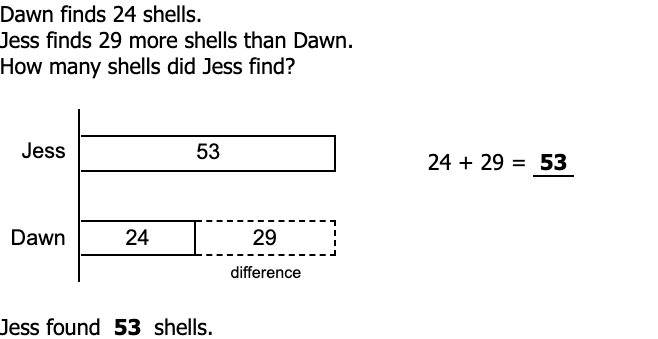
Assess understanding of additive comparison by solving problems where the keyword "more" or "fewer" is used to describe the difference. Include problems where the difference, larger number, or smaller number is unknown. Interpret and understand context to make sense of how keywords are being used.
Prerequisites: 2-51, 2-50
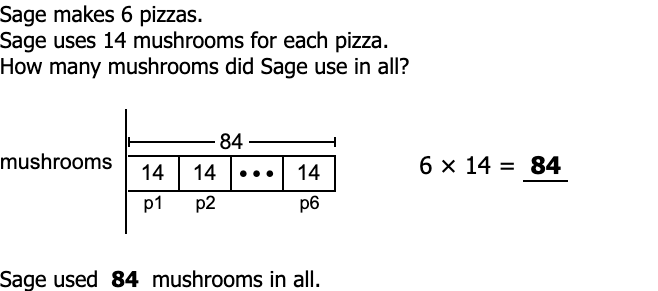
Model story problems to provide context for multiplication. Given the number of equal groups and size of each group, find the total. Use a bar model to represent the relationship between the parts and total. Apply the distributive property to find and add partial products to get the total product.
Prerequisites: 3-108 ○ 3-47
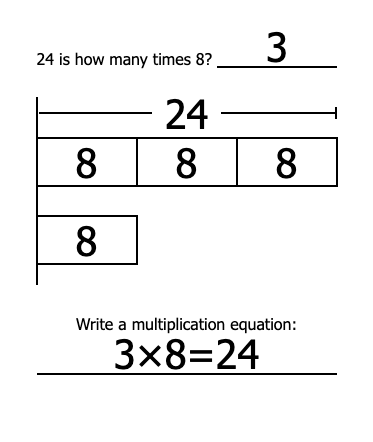
Introduce multiplicative comparison. How much greater is 24 than 8? Instead of thinking additively that 24 is 16 more than 8, think multiplicatively and find the scale factor – 24 is how many times 8. Draw a bar model or use multiplication facts to know 3x8 = 24, so 3 is the scale factor and 24 is 3 times as many as 8.
Prerequisites: 4-9
2-052: Comparison Word Problems
Assess understanding of additive comparison by solving problems where the keyword "more" or "fewer" is used to describe the difference. Include problems where the difference, larger number, or smaller number is unknown. Interpret and understand context to make sense of how keywords are being used.
Prerequisites: 2-51, 2-50
3-113: Multiply to 100 Story Problems
Model story problems to provide context for multiplication. Given the number of equal groups and size of each group, find the total. Use a bar model to represent the relationship between the parts and total. Apply the distributive property to find and add partial products to get the total product.
Prerequisites: 3-108 ○ 3-47
4-016: Compare Numbers and find the Scale Factor by Multiplying
Introduce multiplicative comparison. How much greater is 24 than 8? Instead of thinking additively that 24 is 16 more than 8, think multiplicatively and find the scale factor – 24 is how many times 8. Draw a bar model or use multiplication facts to know 3x8 = 24, so 3 is the scale factor and 24 is 3 times as many as 8.
Prerequisites: 4-9
Solve comparison problems that require both additive and multiplicative thinking -- at the same time. Use bar models to set up and keep track of work in 2-step word problems. Break a problem into manageable parts to decide the best order of steps to solve the problem.
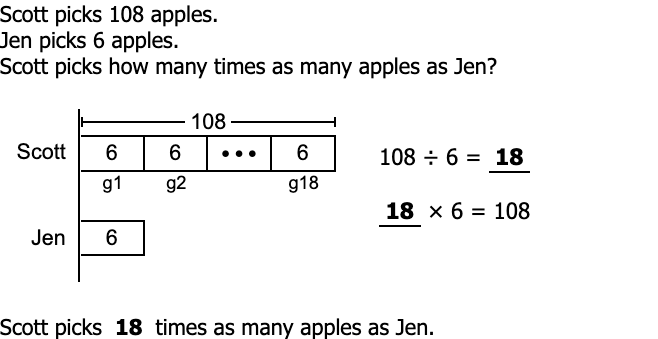
Assess understanding of multiplicative comparison by varying which is unknown – the scale factor, the larger number, or the smaller number. Multiply using partial products when the larger number is unknown. Divide using the grouping model and partial quotients when the scale factor or smaller number is unknown.
Prerequisites: 4-19, 4-18 ○ 3-10, 3-9
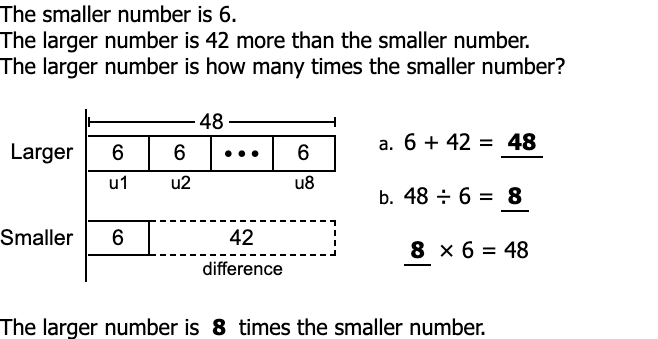
Use bar models to solve problems that compare numbers both additively and multiplicatively. If 6 is the smaller number and 42 is the difference, what's the larger number and scale factor? Since the larger number is 6+42 = 48, the scale factor is 48÷6 = 8. 48 is 42 more than 6. 42 is also 8 times as many as 6.
Prerequisites: 4-20 ○ 4-18
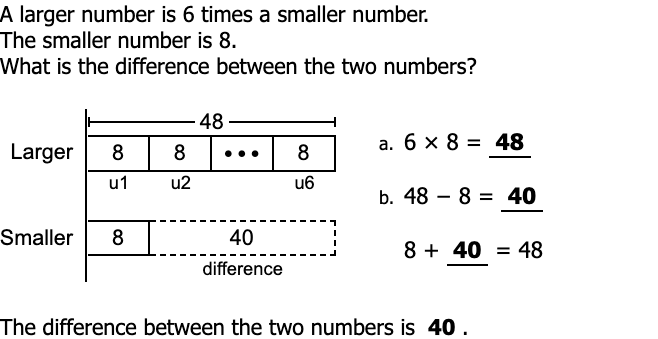
Transition to solving problems where the scale factor is known, but the difference is unknown. If the smaller number is 8 and the scale factor is 6, what's the larger number and the difference? Since the larger number is 6x8 = 48, the difference is 48-8 = 40. 48 is 6 times as many as 8. 48 is also 40 more than 8.
Prerequisites: 4-20 ○ 3-7
4-020: Multiplicative Comparison Story Problems
Assess understanding of multiplicative comparison by varying which is unknown – the scale factor, the larger number, or the smaller number. Multiply using partial products when the larger number is unknown. Divide using the grouping model and partial quotients when the scale factor or smaller number is unknown.
Prerequisites: 4-19, 4-18 ○ 3-10, 3-9
4-021: Multistep Comparison Story Problems: Scale-Factor-Unknown
Use bar models to solve problems that compare numbers both additively and multiplicatively. If 6 is the smaller number and 42 is the difference, what's the larger number and scale factor? Since the larger number is 6+42 = 48, the scale factor is 48÷6 = 8. 48 is 42 more than 6. 42 is also 8 times as many as 6.
Prerequisites: 4-20 ○ 4-18
4-022: Multistep Comparison Story Problems: Difference-Unknown
Transition to solving problems where the scale factor is known, but the difference is unknown. If the smaller number is 8 and the scale factor is 6, what's the larger number and the difference? Since the larger number is 6x8 = 48, the difference is 48-8 = 40. 48 is 6 times as many as 8. 48 is also 40 more than 8.
Prerequisites: 4-20 ○ 3-7
Explore strategies and algorithms for solving geometric measurement problems. Use a 2-dimensional area model rather than length-only bar models. Use multiplication and division to find area, perimeter and missing side lengths of rectangles, and solve multi-step word problems.
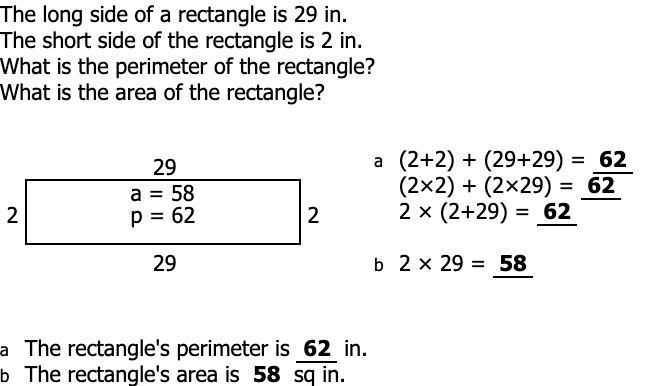
Use geometric measurement to provide context for multiplying. Explore strategies and algorithms for finding a rectangle's perimeter. Use a combination of addition and multiplication, and parentheses to group numbers and operations explicitly. For the same rectangle, calculate its area to differentiate it from perimeter.
Prerequisites: 3-104 ○ 3-99, 3-35
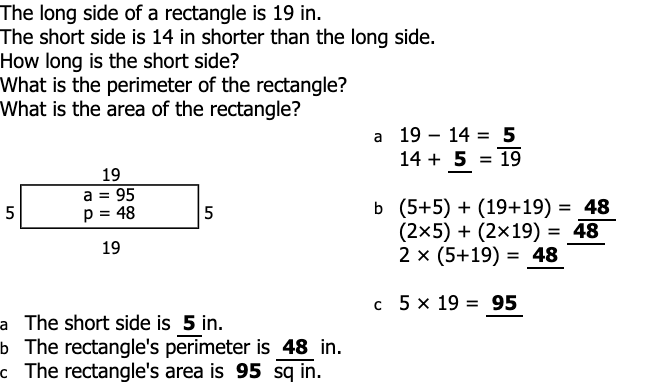
Progress to solving sequential, multistep problems. Given one side of a rectangle, find the length of the other side, the perimeter, and area. Emphasize more challenging, non-intuitive problems. If one side is 14 inches and it's 5 inches longer than the other side, how long is the other side? Would some answer 19 inches? Why?
Prerequisites: 3-115
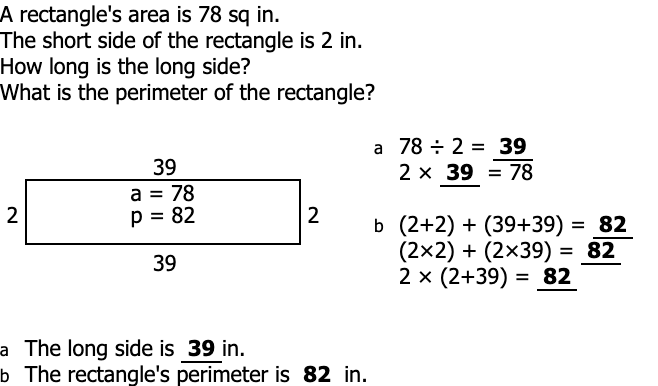
Generalize to problems using both multiplication and division. Given the area of a rectangle and length of one side, find the other side and the perimeter. Develop algebraic thinking by reasoning about the relationship between area, perimeter, and length. If 2 rectangles have equal areas, which will have a longer perimeter?
Prerequisites: 3-116
3-115: Multiply & Divide to 100 Perimeter & Area Problems
Use geometric measurement to provide context for multiplying. Explore strategies and algorithms for finding a rectangle's perimeter. Use a combination of addition and multiplication, and parentheses to group numbers and operations explicitly. For the same rectangle, calculate its area to differentiate it from perimeter.
Prerequisites: 3-104 ○ 3-99, 3-35
3-116: Multiply to 100 Multistep Word Problems
Progress to solving sequential, multistep problems. Given one side of a rectangle, find the length of the other side, the perimeter, and area. Emphasize more challenging, non-intuitive problems. If one side is 14 inches and it's 5 inches longer than the other side, how long is the other side? Would some answer 19 inches? Why?
Prerequisites: 3-115
3-117: Divide to 100 Multistep Word Problems
Generalize to problems using both multiplication and division. Given the area of a rectangle and length of one side, find the other side and the perimeter. Develop algebraic thinking by reasoning about the relationship between area, perimeter, and length. If 2 rectangles have equal areas, which will have a longer perimeter?
Prerequisites: 3-116
Balance equations to build the understanding that the equal sign means "has the same value as" and not, "the answer is." Evaluate equations and create true equations when a number is missing, using addition and subtraction within 20.
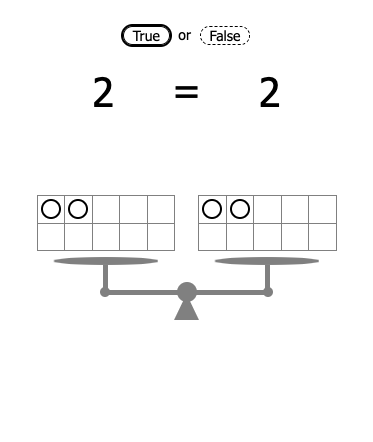
Reinforce the meaning of “equal” and the equal sign by comparing the value of one side of an equation with the value of the other side. Do both sides have the same value? If so, both sides are equal and the equation is "true." If both sides are not equal, the equation is "false" and the "equation" is not really an equation.
Prerequisites: K-26
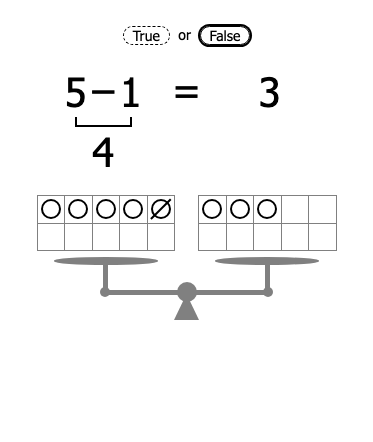
Develop fluency and reinforce the meaning of the equal sign. Compare the value of a subtraction expression to a number. Is the value of the expression 5-1 equal to 3? Since 5-1 = 4, 5-1 is not equal to 3. The "equation" is false and is not an equation. For enrichment, compare expressions on both sides of the equal sign.
Prerequisites: K-42 ○ K-35
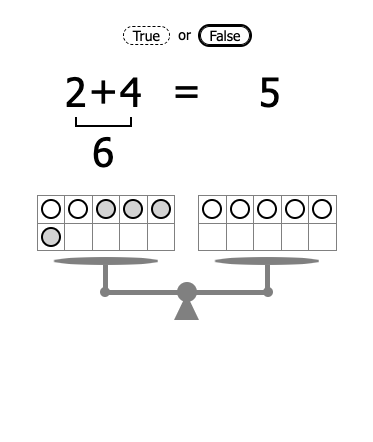
Develop fluency while reinforcing the meaning of "equal." Start by comparing an addition expression to a number. Are their values the same? If so, the equation is true. If not, the "equation" is false. In an equation, both sides of the equal sign must have the same value. When ready, compare 2 expressions in 1 equation.
Prerequisites: K-83 ○ K-80, K-45
K-035: Balance Equations - Add within 5
Reinforce the meaning of “equal” and the equal sign by comparing the value of one side of an equation with the value of the other side. Do both sides have the same value? If so, both sides are equal and the equation is "true." If both sides are not equal, the equation is "false" and the "equation" is not really an equation.
Prerequisites: K-26
K-045: Balance Equations - Subtract within 5*
Develop fluency and reinforce the meaning of the equal sign. Compare the value of a subtraction expression to a number. Is the value of the expression 5-1 equal to 3? Since 5-1 = 4, 5-1 is not equal to 3. The "equation" is false and is not an equation. For enrichment, compare expressions on both sides of the equal sign.
Prerequisites: K-42 ○ K-35
K-088: Balance Equations - Add within 10*
Develop fluency while reinforcing the meaning of "equal." Start by comparing an addition expression to a number. Are their values the same? If so, the equation is true. If not, the "equation" is false. In an equation, both sides of the equal sign must have the same value. When ready, compare 2 expressions in 1 equation.
Prerequisites: K-83 ○ K-80, K-45
Solve equations using the rules of order of operations. Progress from simple adding and subtracting to all four operations with grouping symbols. Interpret verbal expressions and write the corresponding arithmetic expression using numbers and symbols. And, interpret numeric expressions and write the corresponding verbal expression.
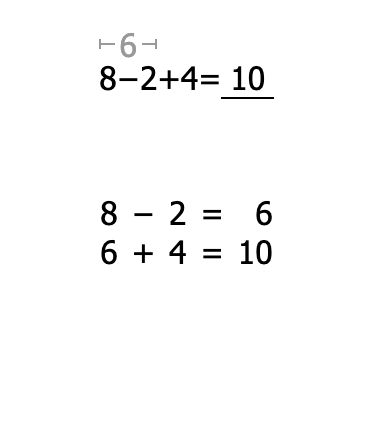
Provide enrichment by introducing order of operations with addition and subtraction. Correct the common misconception that adding always comes before subtracting. Read equations left to right and do the operation that comes first. What's 8-2+4? Subtract first, then add. Since 8-2 = 6 and 6+4 = 10, 8-2+4 = 10.
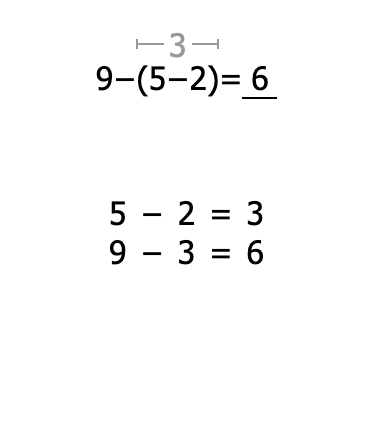
Provide enrichment by using parentheses - a grouping symbol - to group numbers and operations explicitly. Simplify expressions inside any parentheses first. What's 9-(5-2)? First subtract 5-2 = 3. Then subtract 9-3 = 6. What's (9-2) - (3+1)? First subtract 9-2 = 7. Then add 3+1 = 4. Finally, subtract 7-4 = 3.
Prerequisites: 2-23
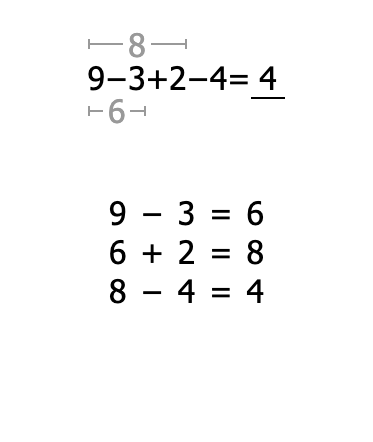
Introduce the correct order of operations without grouping symbols. When equations have only addition and subtraction, or only multiplication and division, do operations from left to right. When 3 or 4 different operations, multiply and divide first, then add and subtract. What's 3 + 4 x 5? 4x5 = 20, and 3+20 = 23.
Prerequisites: 2-24
2-023: Order of Operations*
Provide enrichment by introducing order of operations with addition and subtraction. Correct the common misconception that adding always comes before subtracting. Read equations left to right and do the operation that comes first. What's 8-2+4? Subtract first, then add. Since 8-2 = 6 and 6+4 = 10, 8-2+4 = 10.
2-024: Order of Operations with Parentheses*
Provide enrichment by using parentheses - a grouping symbol - to group numbers and operations explicitly. Simplify expressions inside any parentheses first. What's 9-(5-2)? First subtract 5-2 = 3. Then subtract 9-3 = 6. What's (9-2) - (3+1)? First subtract 9-2 = 7. Then add 3+1 = 4. Finally, subtract 7-4 = 3.
Prerequisites: 2-23
3-060: Order of Operations
Introduce the correct order of operations without grouping symbols. When equations have only addition and subtraction, or only multiplication and division, do operations from left to right. When 3 or 4 different operations, multiply and divide first, then add and subtract. What's 3 + 4 x 5? 4x5 = 20, and 3+20 = 23.
Prerequisites: 2-24
Identify when fractional parts are equal in size and together make the whole. Learn the names of halfs, thirds, and fourths, to describe when the whole has 2, 3, or 4 equal parts. Work with fractional parts that are the same size, but not the same shape, and begin to use fraction notation. Learn the meaning of the words numerator and denominator.
To prepare for fractions, apply the concept of "equal" to length. Use the equal symbol (=) to mean "has the same length as." "B = C" means "B has the same length as C." Given 3 colored bars – A, B, and C – which 2 bars are the same length? Which bar is the longest? Which bar is the shortest?
Prerequisites: K-71 ○ K-88
Introduce fractional parts that are equal in size and together make the whole. Use length models – colored rods, strips of paper, drawn bars – to model part-whole relationships. Which bar has equal parts? How many equal parts? What is the name of each part? Learn 2 halves, 3 thirds, and 4 fourths make the whole.
Prerequisites: K-131
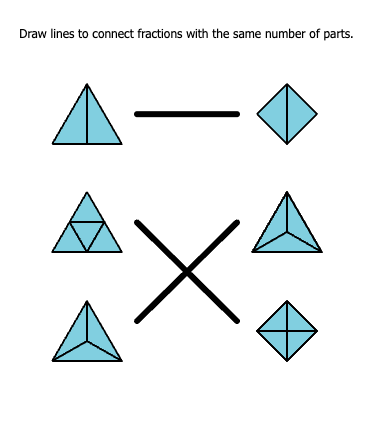
Generalize from squares and circles to identifying fractional parts of equilateral triangles and rotated squares. Which shapes have 2 equal parts? 3 equal parts? 4 equal parts? Match shapes that have the same number of equal parts. When ready, match shapes to the correct number and name of their equal parts.
Prerequisites: K-133
K-131: Apply the Meaning of Equal to Length
To prepare for fractions, apply the concept of "equal" to length. Use the equal symbol (=) to mean "has the same length as." "B = C" means "B has the same length as C." Given 3 colored bars – A, B, and C – which 2 bars are the same length? Which bar is the longest? Which bar is the shortest?
Prerequisites: K-71 ○ K-88
K-132: Recognize & Name Equal Fractional Parts
Introduce fractional parts that are equal in size and together make the whole. Use length models – colored rods, strips of paper, drawn bars – to model part-whole relationships. Which bar has equal parts? How many equal parts? What is the name of each part? Learn 2 halves, 3 thirds, and 4 fourths make the whole.
Prerequisites: K-131
K-134: Match Fractional Parts & Names
Generalize from squares and circles to identifying fractional parts of equilateral triangles and rotated squares. Which shapes have 2 equal parts? 3 equal parts? 4 equal parts? Match shapes that have the same number of equal parts. When ready, match shapes to the correct number and name of their equal parts.
Prerequisites: K-133
Partition bars, squares, and circles into equal groups of halves, thirds, and fourths. Demonstrate understanding of unit fractions by coloring any 1 of the parts to show 1 half, 1 third, or 1 fourth. Understand that when the whole is the same, 1 half is greater than 1 third, and greater than 1 fourth.
Draw fractions by dividing a bar into equal parts. To draw 2 halves, draw a dot in the middle of the bar and a vertical line thru the dot. To make 4 fourths, draw dots in the middle of each half and 2 more vertical lines thru the dots. To draw 3 thirds, practice drawing 2 vertical lines that make 3 equal parts. Generalize to area.
Prerequisites: K-132
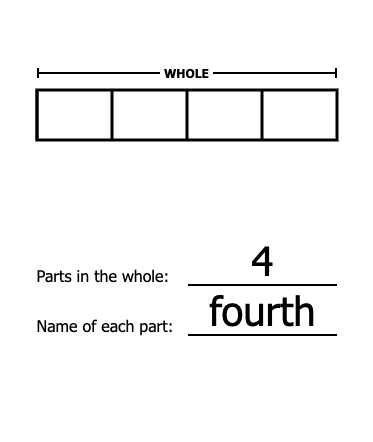
Start with 1-dimensional, linear models. Divide the length of a bar into 2, 3, or 4 equal parts. To draw 2 halves or 3 thirds, estimate visually. To draw 4 fourths, first draw 2 halves. Divide each half in half to make 4 equal parts.
Prerequisites: 1-78 ○ K-133
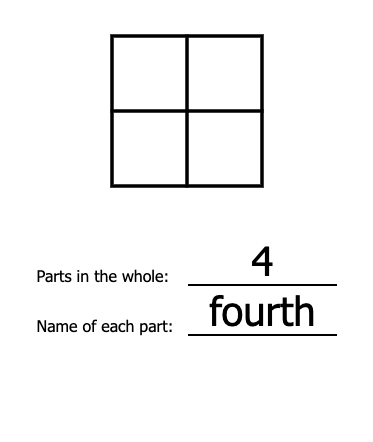
Generalize from dividing the length of a bar to dividing the area or space "inside" a square into equal parts. Explore different ways of drawing 2 halves, 3 thirds, and 4 fourths – using horizontal, vertical, and diagonal lines. Fold paper to model and reinforce equal parts concretely.
Prerequisites: 1-79 ○ K-134
K-133: Divide & Draw Equal Fractional Parts
Draw fractions by dividing a bar into equal parts. To draw 2 halves, draw a dot in the middle of the bar and a vertical line thru the dot. To make 4 fourths, draw dots in the middle of each half and 2 more vertical lines thru the dots. To draw 3 thirds, practice drawing 2 vertical lines that make 3 equal parts. Generalize to area.
Prerequisites: K-132
1-079: Model Halves, Thirds & Fourths with Bars
Start with 1-dimensional, linear models. Divide the length of a bar into 2, 3, or 4 equal parts. To draw 2 halves or 3 thirds, estimate visually. To draw 4 fourths, first draw 2 halves. Divide each half in half to make 4 equal parts.
Prerequisites: 1-78 ○ K-133
1-080: Model Halves, Thirds & Fourths with Squares
Generalize from dividing the length of a bar to dividing the area or space "inside" a square into equal parts. Explore different ways of drawing 2 halves, 3 thirds, and 4 fourths – using horizontal, vertical, and diagonal lines. Fold paper to model and reinforce equal parts concretely.
Prerequisites: 1-79 ○ K-134
Extend fraction modeling skills to work with denominators of eighths and sixths. Model proper fractions flexibly, and know, for example, that any 2 of the parts can be colored in to show 2 thirds. Prove that fractional parts of different shapes are the same size by dividing them into smaller squares and confirming that they each have the same number of smaller parts.
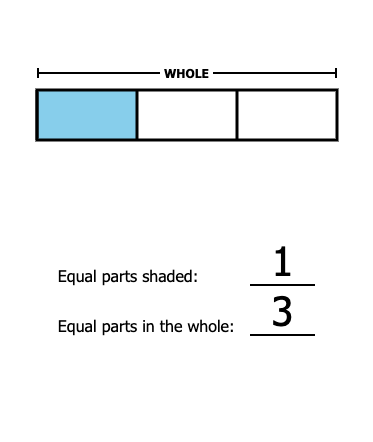
Use linear bar models to model 1 half, 1 third, 1 fourth, and 1 eighth. Draw halves by dividing the whole – the length of a bar – into 2 equal parts. Make thirds by drawing 3 equal parts. Make fourths or quarters by dividing halves in half to make 4 equal parts. Make eighths by dividing fourths in half to make 8 equal parts.
Prerequisites: 1-82
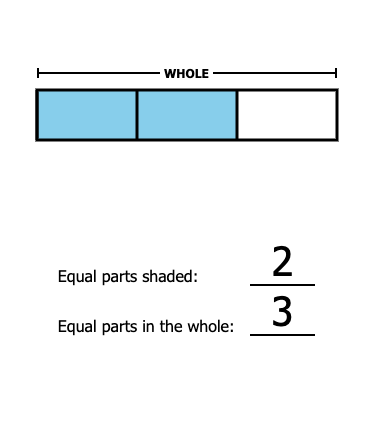
Use colored rods and draw bar models to represent proper fractions - fractions less than a whole. If the bar is divided into thirds - 1 third is a unit fraction, 2 thirds is a proper fraction, and 3 thirds is the whole. Since a unit is less than the whole, it is also a proper fraction.
Prerequisites: 2-53
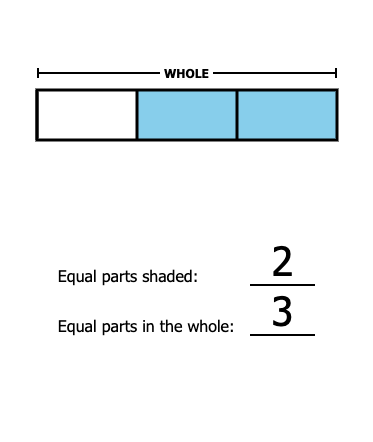
Generalize about equal parts by modeling fractions in different ways. What does 2 thirds mean? 2 out of 3 equal parts - any 2. The go-to way to show proper fractions using a bar model is left-to-right, with no gaps - a length model. Encourage flexibility by modeling them right-to-left, and with gaps - an area model.
Prerequisites: 2-55
2-053: Model Unit Fractions using Linear Bar Models
Use linear bar models to model 1 half, 1 third, 1 fourth, and 1 eighth. Draw halves by dividing the whole – the length of a bar – into 2 equal parts. Make thirds by drawing 3 equal parts. Make fourths or quarters by dividing halves in half to make 4 equal parts. Make eighths by dividing fourths in half to make 8 equal parts.
Prerequisites: 1-82
2-055: Model Proper Fractions using Rods & Bar Models
Use colored rods and draw bar models to represent proper fractions - fractions less than a whole. If the bar is divided into thirds - 1 third is a unit fraction, 2 thirds is a proper fraction, and 3 thirds is the whole. Since a unit is less than the whole, it is also a proper fraction.
Prerequisites: 2-53
2-056: Model Proper Fractions Flexibly
Generalize about equal parts by modeling fractions in different ways. What does 2 thirds mean? 2 out of 3 equal parts - any 2. The go-to way to show proper fractions using a bar model is left-to-right, with no gaps - a length model. Encourage flexibility by modeling them right-to-left, and with gaps - an area model.
Prerequisites: 2-55
Explore the inverse relationship between the number of fractional parts and each part’s size by seeing that a larger number in the denominator does not mean a larger piece. Students convert fractions to mixed numbers, mixed numbers to fractions, and prepare for fraction operations by making common denominators.
Use colored rods and draw bar models to represent proper fractions - fractions less than a whole. If the bar is divided into thirds - 1 third is a unit fraction, 2 thirds is a proper fraction, and 3 thirds is the whole. Since a unit is less than the whole, it is also a proper fraction.
Prerequisites: 2-53
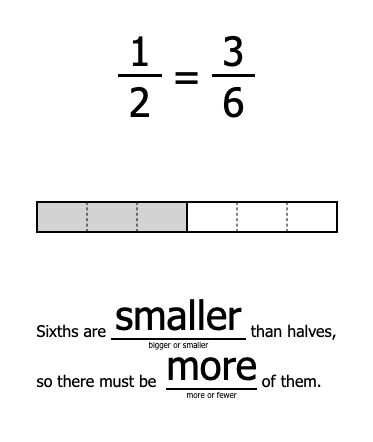
Draw bar models to find equivalent fractions on a number line. 1 half is how many sixths? Divide the distance between 0 and 1 into 2 equal parts. Shade 1 part, or 1/2. To make sixths, partition each half into 3 equal parts. Since there are now 6 equal parts in 1, each part is 1 sixth, or 1/6. 3 sixths are shaded, so 1/2 = 3/6.
Prerequisites: 3-83
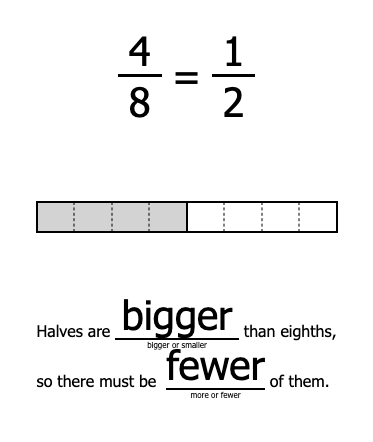
Generalize from finding more parts, to finding more challenging, equivalent fractions with fewer parts. 4 eighths is how many halves? Divide 1 – the distance between 0 and 1 – into 8 equal parts. Shade 4 parts, or 4/8. Think of the shaded 4/8 as 1 part. How many are in 1? Since there are 2, each is 1 half, and 4/8 = 1/2.
Prerequisites: 3-84
2-055: Model Proper Fractions using Rods & Bar Models
Use colored rods and draw bar models to represent proper fractions - fractions less than a whole. If the bar is divided into thirds - 1 third is a unit fraction, 2 thirds is a proper fraction, and 3 thirds is the whole. Since a unit is less than the whole, it is also a proper fraction.
Prerequisites: 2-53
3-084: Equivalent Fractions converting to More, Smaller Parts
Draw bar models to find equivalent fractions on a number line. 1 half is how many sixths? Divide the distance between 0 and 1 into 2 equal parts. Shade 1 part, or 1/2. To make sixths, partition each half into 3 equal parts. Since there are now 6 equal parts in 1, each part is 1 sixth, or 1/6. 3 sixths are shaded, so 1/2 = 3/6.
Prerequisites: 3-83
3-085: Equivalent Fractions converting to Fewer, Larger Parts
Generalize from finding more parts, to finding more challenging, equivalent fractions with fewer parts. 4 eighths is how many halves? Divide 1 – the distance between 0 and 1 – into 8 equal parts. Shade 4 parts, or 4/8. Think of the shaded 4/8 as 1 part. How many are in 1? Since there are 2, each is 1 half, and 4/8 = 1/2.
Prerequisites: 3-84
Compare the size of two fractions of a same-sized whole, to help develop number sense. Learn different strategies to compare fractions with equal numerators, equal denominators, and unambiguous cases where one fraction has more larger pieces, and the other has fewer, smaller pieces.
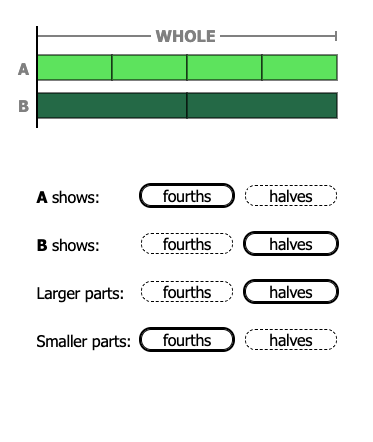
Compare the unit fractions 1 half, 1 third, and 1 fourth. When the whole is the same, more equal parts mean smaller parts. Fewer equal parts mean larger parts. There is an inverse relationship between the number of pieces and size of equal pieces. Length models – colored rods and bars – make comparing fractions, easier.
Prerequisites: 1-82
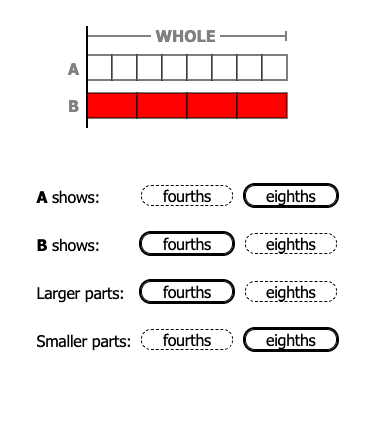
Use colored rods and bar models to compare unit fractions. Explore the relationship between the number of equal parts and their size. For the same whole, more equal parts means smaller parts, and fewer equal parts means larger parts. There is an inverse relationship between the number of parts in the whole and their size.
Prerequisites: 1-85 ○ 2-53
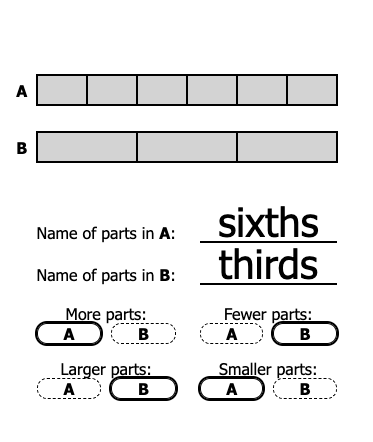
Use bar models to compare the size of unit fractions. On a number line, show larger denominators mean more equal parts so each part is smaller. Smaller denominators mean fewer equal parts so each part is larger. Large denominators have smaller parts. Small denominators have larger parts. It is called an "inverse relationship."
Prerequisites: 2-54
1-085: Compare Unit Fractions
Compare the unit fractions 1 half, 1 third, and 1 fourth. When the whole is the same, more equal parts mean smaller parts. Fewer equal parts mean larger parts. There is an inverse relationship between the number of pieces and size of equal pieces. Length models – colored rods and bars – make comparing fractions, easier.
Prerequisites: 1-82
2-054: Compare Unit Fractions using Rods & Bar Models
Use colored rods and bar models to compare unit fractions. Explore the relationship between the number of equal parts and their size. For the same whole, more equal parts means smaller parts, and fewer equal parts means larger parts. There is an inverse relationship between the number of parts in the whole and their size.
Prerequisites: 1-85 ○ 2-53
3-083: Inverse Relationship between the Number & Size of Equal Parts
Use bar models to compare the size of unit fractions. On a number line, show larger denominators mean more equal parts so each part is smaller. Smaller denominators mean fewer equal parts so each part is larger. Large denominators have smaller parts. Small denominators have larger parts. It is called an "inverse relationship."
Prerequisites: 2-54
Use one or more strategies to compare, order and put multiple fractions on a number line by knowing their value in relation to one another. Generalize to putting any number on a number line, including improper fractions that are greater than 1.
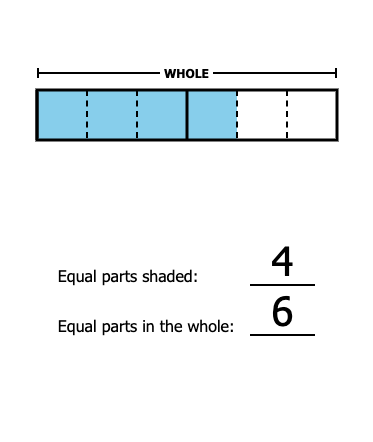
Divide bar models into halves, thirds, fourths, sixths, and eighths. Draw equal parts in smart ways. Divide halves into halves to make fourths, halves into thirds and thirds into halves to make sixths, and fourths into halves and halves into fourths to make eighths. Shade both contiguous and non-contiguous parts (gaps).
Prerequisites: 2-56 ○ 2-53
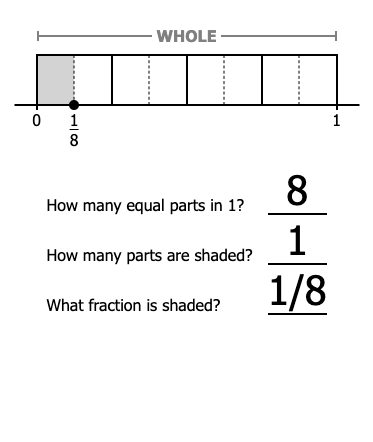
Show unit fractions on a number line. What's 1/8? It's the length of 1 part – measured as the distance from 0 – when the length 1 is divided into 8 equal parts. Draw a bar to represent the length 1 as the distance between 0 and 1. Divide the bar into 8 equal parts. Shade the first one and write 1/8 on the number line.
Prerequisites: 3-75 ○ 2-53
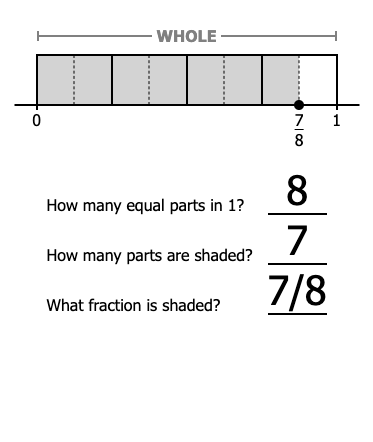
Show proper fractions on a number line. What's 7/8? It's the length of 7 parts – measured as the distance from 0 – when the length 1 is divided into 8 equal parts. Draw a bar to represent 1 as the distance between 0 and 1. Divide the bar into 8 equal parts. Shade the first seven and write 7/8 on the number line.
Prerequisites: 3-80
3-075: Model Fractions using Linear Models
Divide bar models into halves, thirds, fourths, sixths, and eighths. Draw equal parts in smart ways. Divide halves into halves to make fourths, halves into thirds and thirds into halves to make sixths, and fourths into halves and halves into fourths to make eighths. Shade both contiguous and non-contiguous parts (gaps).
Prerequisites: 2-56 ○ 2-53
3-080: Unit Fractions (1/b)
Show unit fractions on a number line. What's 1/8? It's the length of 1 part – measured as the distance from 0 – when the length 1 is divided into 8 equal parts. Draw a bar to represent the length 1 as the distance between 0 and 1. Divide the bar into 8 equal parts. Shade the first one and write 1/8 on the number line.
Prerequisites: 3-75 ○ 2-53
3-081: Proper Fractions (a/b < 1)
Show proper fractions on a number line. What's 7/8? It's the length of 7 parts – measured as the distance from 0 – when the length 1 is divided into 8 equal parts. Draw a bar to represent 1 as the distance between 0 and 1. Divide the bar into 8 equal parts. Shade the first seven and write 7/8 on the number line.
Prerequisites: 3-80
Add and subtract fractions with like denominators - with and without regrouping. Make sense of fraction notation by understanding that the denominator is the unit, and only like units can be added or subtracted. (We cannot add 2 cats plus 3 dogs and get 5 cat-dogs, but we can add 2 animals plus 3 animals and get 5 animals.) Rename addends to have common denominators to add and subtract.
Divide bar models into halves, thirds, fourths, sixths, and eighths. Draw equal parts in smart ways. Divide halves into halves to make fourths, halves into thirds and thirds into halves to make sixths, and fourths into halves and halves into fourths to make eighths. Shade both contiguous and non-contiguous parts (gaps).
Prerequisites: 2-56 ○ 2-53
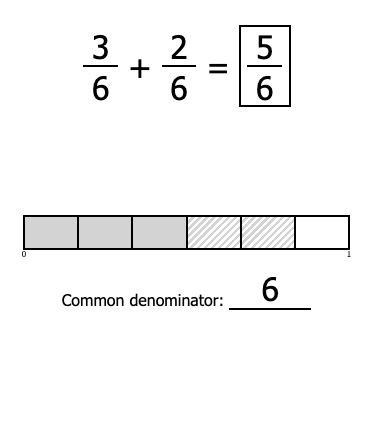
Generalize from whole numbers, to adding fractions with equal denominators. What's 3/6 + 2/6? To make sense of fraction notation, write units explicitly. 3 sixths + 2 sixths = 5 sixths, so 3/6 + 2/6 = 5/6, not 5/12. Develop modeling and drawing skills on a number line to lay the foundation for the other 3 operations.
Prerequisites: 3-75
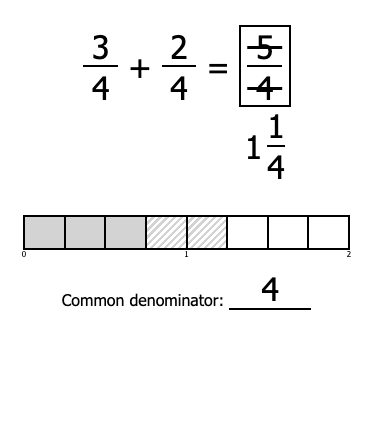
Transition to adding 2 fractions with equal denominators and sums greater than 1. What's 3/4 + 2/4? Their units are the same – they have common denominators – so add their quantities or numerators. 3 fourths + 2 fourths = 5 fourths, or 1 and 1 fourth. Using fraction notation, 3/4 + 2/4 = 5/4 = 4/4 + 1/4 = 1 1/4.
Prerequisites: 4-98
3-075: Model Fractions using Linear Models
Divide bar models into halves, thirds, fourths, sixths, and eighths. Draw equal parts in smart ways. Divide halves into halves to make fourths, halves into thirds and thirds into halves to make sixths, and fourths into halves and halves into fourths to make eighths. Shade both contiguous and non-contiguous parts (gaps).
Prerequisites: 2-56 ○ 2-53
4-098: Add Fractions with No Regrouping
Generalize from whole numbers, to adding fractions with equal denominators. What's 3/6 + 2/6? To make sense of fraction notation, write units explicitly. 3 sixths + 2 sixths = 5 sixths, so 3/6 + 2/6 = 5/6, not 5/12. Develop modeling and drawing skills on a number line to lay the foundation for the other 3 operations.
Prerequisites: 3-75
4-099: Add Fractions with Regrouping
Transition to adding 2 fractions with equal denominators and sums greater than 1. What's 3/4 + 2/4? Their units are the same – they have common denominators – so add their quantities or numerators. 3 fourths + 2 fourths = 5 fourths, or 1 and 1 fourth. Using fraction notation, 3/4 + 2/4 = 5/4 = 4/4 + 1/4 = 1 1/4.
Prerequisites: 4-98
Use modeling and reasoning to multiply a whole number times a fraction or a fraction times a whole number. Use the breaking into 1s strategy to solve problems where the whole number is a multiple of the denominator, as well as when it is not.
Transition to adding 2 fractions with equal denominators and sums greater than 1. What's 3/4 + 2/4? Their units are the same – they have common denominators – so add their quantities or numerators. 3 fourths + 2 fourths = 5 fourths, or 1 and 1 fourth. Using fraction notation, 3/4 + 2/4 = 5/4 = 4/4 + 1/4 = 1 1/4.
Prerequisites: 4-98
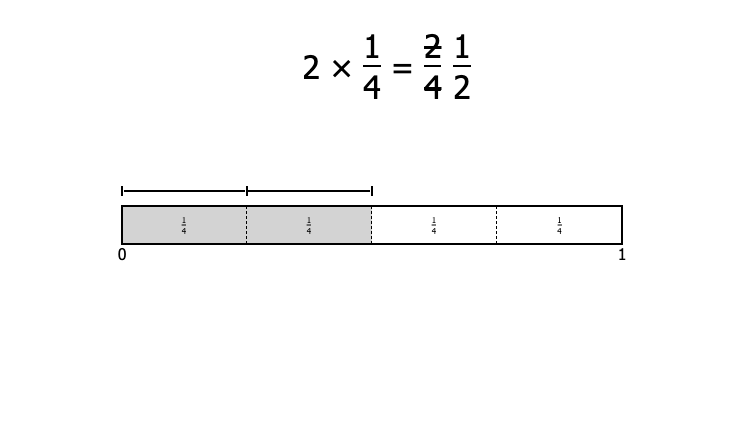
Transition from adding to multiplying fractions. What's 2 x 1/4? Draw a bar model to see 2 groups of 1 fourth is 1 fourth+1 fourth = 2 fourths. Using fraction notation, 2 x 1/4 = 1/4+1/4 = 2/4 = 1/2. Shortcut? 2 x 1/4 = (2x1)/4 = 2/4. What's 3 x 1/3? 3 x 1 third = (3x1) thirds = 3 thirds. Using fraction notation, 3 x 1/3 = (3x1)/3 = 3/3 = 1.
Prerequisites: 4-98
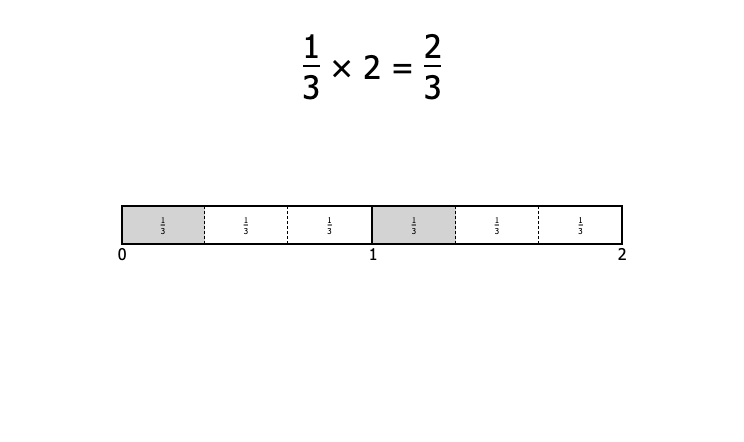
Find a fraction of a whole number by breaking numbers into 1s. What's 1/3 x 2? Think of 2 as 1+1. Draw a bar model or number bond to see 1/3 x (1+1) = (1/3 x 1)+(1/3 x 1) = 1/3+1/3 = 2/3, or 2 x 1/3. Since 1/3 x 2 = 2 x 1/3, transition to using the commutative property, when ready. What's 4/5 x 2? It's 2 x 4/5 = 8/5 = 1 3/5.
Prerequisites: 4-99
4-099: Add Fractions with Regrouping
Transition to adding 2 fractions with equal denominators and sums greater than 1. What's 3/4 + 2/4? Their units are the same – they have common denominators – so add their quantities or numerators. 3 fourths + 2 fourths = 5 fourths, or 1 and 1 fourth. Using fraction notation, 3/4 + 2/4 = 5/4 = 4/4 + 1/4 = 1 1/4.
Prerequisites: 4-98
4-107: Multiply Whole Number x Fraction - Computation
Transition from adding to multiplying fractions. What's 2 x 1/4? Draw a bar model to see 2 groups of 1 fourth is 1 fourth+1 fourth = 2 fourths. Using fraction notation, 2 x 1/4 = 1/4+1/4 = 2/4 = 1/2. Shortcut? 2 x 1/4 = (2x1)/4 = 2/4. What's 3 x 1/3? 3 x 1 third = (3x1) thirds = 3 thirds. Using fraction notation, 3 x 1/3 = (3x1)/3 = 3/3 = 1.
Prerequisites: 4-98
5-051: Fraction x Whole Number - Breaking into 1s
Find a fraction of a whole number by breaking numbers into 1s. What's 1/3 x 2? Think of 2 as 1+1. Draw a bar model or number bond to see 1/3 x (1+1) = (1/3 x 1)+(1/3 x 1) = 1/3+1/3 = 2/3, or 2 x 1/3. Since 1/3 x 2 = 2 x 1/3, transition to using the commutative property, when ready. What's 4/5 x 2? It's 2 x 4/5 = 8/5 = 1 3/5.
Prerequisites: 4-99
Use linear and area models to make sense of multiplication in cases where both factors are fractions. Begin by multiplying a unit fraction by a unit fraction to find a new unit fraction, and progress to multiplying a proper fraction by a proper fraction.
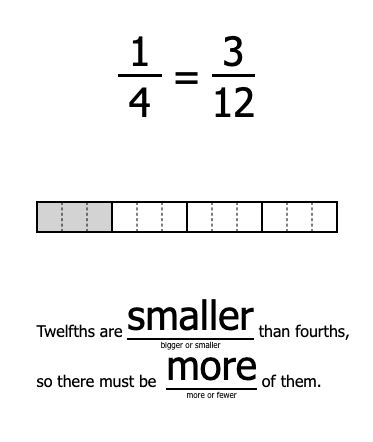
Use number lines to find equivalent fractions. 1 fourth is how many twelfths? Partition the distance from 0 to 1 into fourths. Make 12 twelfths by dividing each fourth into 3 equal parts. 1 fourth is 3 times 1 twelfth, so 1/4 = 3/12. Shortcut? Multiply numerator and denominator by 3. Get 3 times as many pieces that are 1/3 the size.
Prerequisites: 3-84
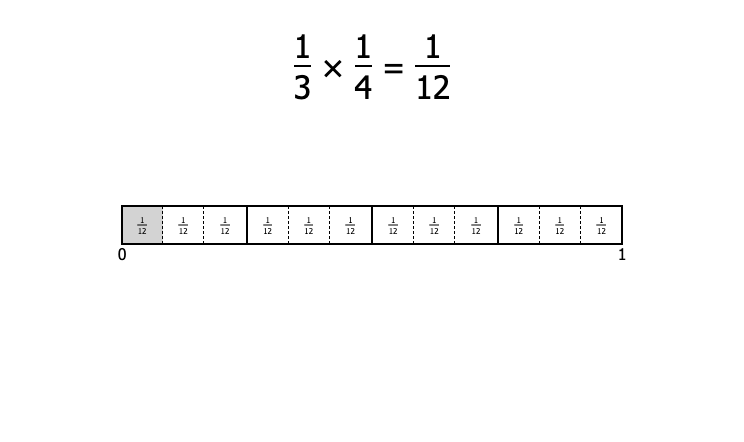
Multiply unit fractions to find a new unit fraction. What's 1/3 x 1/4? Draw 1/4 using a bar model on a number line. Divide 1/4 into 3 equal parts. What's 1 part? There are 12 parts in 1, so 1/3 x 1/4 = 1/12. Shortcut? Multiply the denominators. What's 1/2 x 1/5? 2x5 = 10, so the new denominator is 10, and the new unit fraction is 1/10.
Prerequisites: 5-53 ○ 4-107
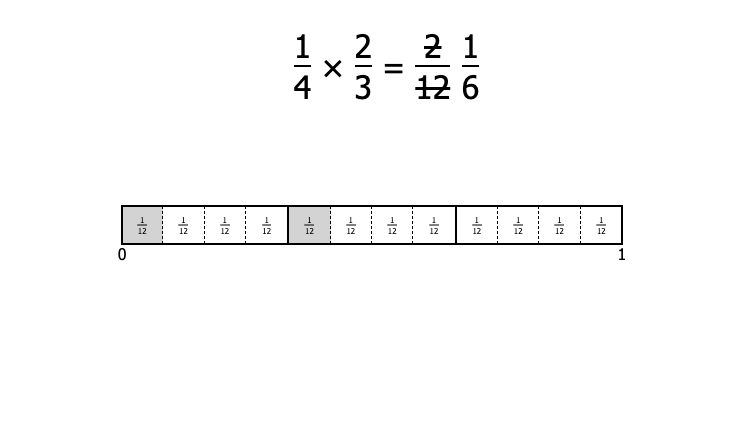
Multiply unit fractions and proper fractions by breaking proper fractions into unit fractions. What's 1/4 x 2/3? 2/3 = 1/3 + 1/3, so multiply 1/4 x (1/3 + 1/3) = 1/12 + 1/12 = 2/12 and 2/12 = 1/6. Algorithm? Multiply numerators to get the number of each part. Multiply denominators to get the size of each part. What's 3/4 x 1/2? (3x1)/(4x2) = 3/8.
Prerequisites: 5-54
4-083: Fraction Equivalence - Make More Parts
Use number lines to find equivalent fractions. 1 fourth is how many twelfths? Partition the distance from 0 to 1 into fourths. Make 12 twelfths by dividing each fourth into 3 equal parts. 1 fourth is 3 times 1 twelfth, so 1/4 = 3/12. Shortcut? Multiply numerator and denominator by 3. Get 3 times as many pieces that are 1/3 the size.
Prerequisites: 3-84
5-054: Unit Fraction x Unit Fraction
Multiply unit fractions to find a new unit fraction. What's 1/3 x 1/4? Draw 1/4 using a bar model on a number line. Divide 1/4 into 3 equal parts. What's 1 part? There are 12 parts in 1, so 1/3 x 1/4 = 1/12. Shortcut? Multiply the denominators. What's 1/2 x 1/5? 2x5 = 10, so the new denominator is 10, and the new unit fraction is 1/10.
Prerequisites: 5-53 ○ 4-107
5-055: Unit Fraction x Proper Fraction
Multiply unit fractions and proper fractions by breaking proper fractions into unit fractions. What's 1/4 x 2/3? 2/3 = 1/3 + 1/3, so multiply 1/4 x (1/3 + 1/3) = 1/12 + 1/12 = 2/12 and 2/12 = 1/6. Algorithm? Multiply numerators to get the number of each part. Multiply denominators to get the size of each part. What's 3/4 x 1/2? (3x1)/(4x2) = 3/8.
Prerequisites: 5-54
Divide when the quotient is a fraction, using bar models to build understanding. Use the breaking into 1s strategy and the partial quotients strategy. Divide unit fractions into equal groups, using the sharing model, to understand the conventional invert-and-multiply algorithm.
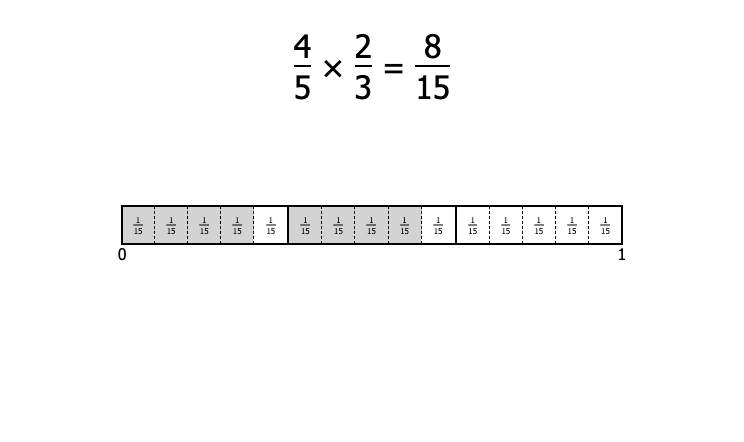
Multiply proper fractions by breaking one or both proper fractions into unit fractions. What's 4/5 x 2/3? Since 2/3 = 1/3 + 1/3, multiply 4/5 x (1/3 + 1/3) = 4/15 + 4/15 = 8/15. Algorithm? Multiply numerators to get the number of new parts. Multiply denominators to get the size of each part. What's 2/3 x 2/3? (2x2)/(3x3) = 4/9.
Prerequisites: 5-55
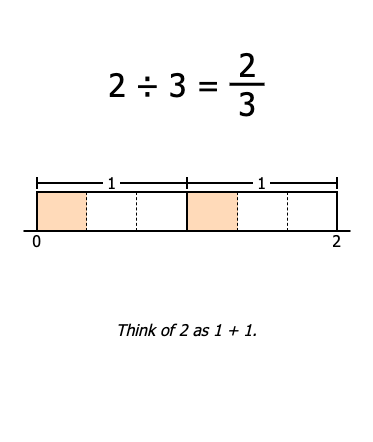
Divide whole numbers that aren't multiples of the divisor. Break the total into ones and apply the distributive property. What's 2÷3? Since 2 = 1+1, 2÷3 = (1+1)÷3 = (1÷3)+(1÷3) = 1/3 + 1/3 = 2/3. What's 3÷5? It's (1+1+1)÷5 = 1/5 + 1/5 + 1/5 = 3/5. Find and add partial quotients to get the total quotient. Algorithm? x÷y = x/y.
Prerequisites: 5-51
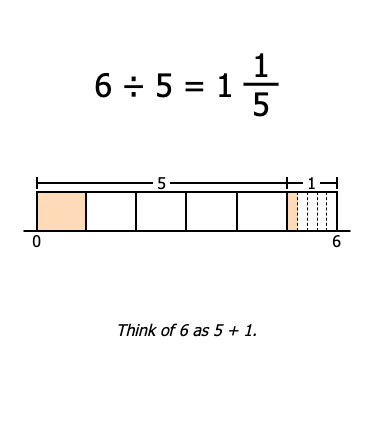
Instead of breaking the total into 1s, break the dividend into a multiple of the divisor and what's left. Find and add partial quotients to get the total quotient. What's 6÷5? Since 6 = 5+1, 6÷5 = (5+1)÷5 = (5÷5)+(1÷5) = 1 + 1/5 = 1 1/5. What's 8÷3? Since 8 = 6+2, 8÷3 = (6+2)÷3 = (6÷3)+(2÷3) = 2 + 2/3 = 2 2/3.
Prerequisites: 5-67
5-056: Proper Fraction x Proper Fraction
Multiply proper fractions by breaking one or both proper fractions into unit fractions. What's 4/5 x 2/3? Since 2/3 = 1/3 + 1/3, multiply 4/5 x (1/3 + 1/3) = 4/15 + 4/15 = 8/15. Algorithm? Multiply numerators to get the number of new parts. Multiply denominators to get the size of each part. What's 2/3 x 2/3? (2x2)/(3x3) = 4/9.
Prerequisites: 5-55
5-067: Whole Number ÷ Whole Number - Breaking into 1s
Divide whole numbers that aren't multiples of the divisor. Break the total into ones and apply the distributive property. What's 2÷3? Since 2 = 1+1, 2÷3 = (1+1)÷3 = (1÷3)+(1÷3) = 1/3 + 1/3 = 2/3. What's 3÷5? It's (1+1+1)÷5 = 1/5 + 1/5 + 1/5 = 3/5. Find and add partial quotients to get the total quotient. Algorithm? x÷y = x/y.
Prerequisites: 5-51
5-068: Whole Number ÷ Whole Number - Partial Quotients
Instead of breaking the total into 1s, break the dividend into a multiple of the divisor and what's left. Find and add partial quotients to get the total quotient. What's 6÷5? Since 6 = 5+1, 6÷5 = (5+1)÷5 = (5÷5)+(1÷5) = 1 + 1/5 = 1 1/5. What's 8÷3? Since 8 = 6+2, 8÷3 = (6+2)÷3 = (6÷3)+(2÷3) = 2 + 2/3 = 2 2/3.
Prerequisites: 5-67
Calculate with mixed numbers. Apply previous experiences with number bonds and shifting 10 to working with mixed numbers. Add and subtract mixed numbers with no regrouping, with regrouping, and with unlike denominators.
Transition to adding 2 fractions with equal denominators and sums greater than 1. What's 3/4 + 2/4? Their units are the same – they have common denominators – so add their quantities or numerators. 3 fourths + 2 fourths = 5 fourths, or 1 and 1 fourth. Using fraction notation, 3/4 + 2/4 = 5/4 = 4/4 + 1/4 = 1 1/4.
Prerequisites: 4-98
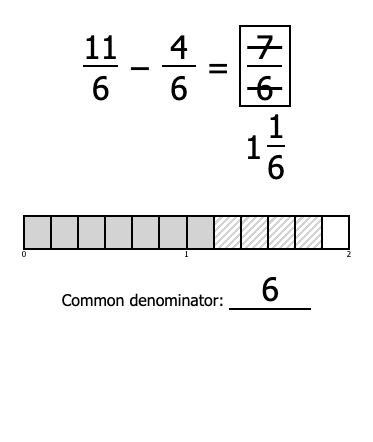
Transition to subtracting 2 fractions with equal denominators and differences greater than 1. What's 11/6 - 4/6? Their units are the same – equal denominators – so subtract their quantities or numerators. 11 sixths - 4 sixths = 7 sixths, or 1 and 1 sixth. Using fraction notation, 11/6 - 4/6 = 7/6 = 6/6 + 1/6 = 1 1/6.
Prerequisites: 4-100 ○ 4-86
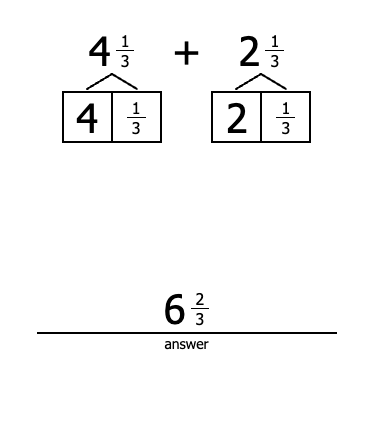
Add and subtract mixed numbers with common denominators. What's 4 1/3 + 2 1/3? Use partial sums to add. Since 4+2 = 6 and 1/3 + 1/3 = 2/3, the sum is the mixed number 6 2/3. What's 4 6/8 - 2 1/8? Use partial differences to subtract. Since 4-2 = 2 and 6/8 - 1/8 = 5/8, the difference is the mixed number 2 5/8.
Prerequisites: 4-100, 4-98
4-099: Add Fractions with Regrouping
Transition to adding 2 fractions with equal denominators and sums greater than 1. What's 3/4 + 2/4? Their units are the same – they have common denominators – so add their quantities or numerators. 3 fourths + 2 fourths = 5 fourths, or 1 and 1 fourth. Using fraction notation, 3/4 + 2/4 = 5/4 = 4/4 + 1/4 = 1 1/4.
Prerequisites: 4-98
4-101: Subtract Fractions with Regrouping
Transition to subtracting 2 fractions with equal denominators and differences greater than 1. What's 11/6 - 4/6? Their units are the same – equal denominators – so subtract their quantities or numerators. 11 sixths - 4 sixths = 7 sixths, or 1 and 1 sixth. Using fraction notation, 11/6 - 4/6 = 7/6 = 6/6 + 1/6 = 1 1/6.
Prerequisites: 4-100 ○ 4-86
4-102: Add & Subtract Mixed Numbers with No Regrouping
Add and subtract mixed numbers with common denominators. What's 4 1/3 + 2 1/3? Use partial sums to add. Since 4+2 = 6 and 1/3 + 1/3 = 2/3, the sum is the mixed number 6 2/3. What's 4 6/8 - 2 1/8? Use partial differences to subtract. Since 4-2 = 2 and 6/8 - 1/8 = 5/8, the difference is the mixed number 2 5/8.
Prerequisites: 4-100, 4-98
Use knowledge of place value and fractions to represent fractions in the Base 10 number system, as decimals. Use base 10 blocks, base 10 discs and number bonds to model ones, tenths, and hundredths. Convert ones into tenths and ones into tenths and hundredths.
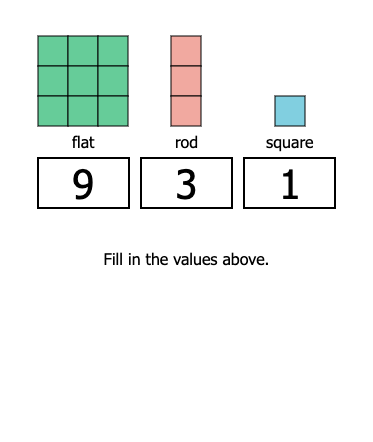
Prepare for modeling decimals by using concrete models in a flexible way. If a flat has 9 unit squares so its value is 9 instead of 100, what's the value of the rod? Here, a rod is a flat divided into 3 equal parts, so 1 rod = 9÷3 = 3. What's the value of the square? A square is a rod divided into 3 equal parts, so 1 square = 3÷3 = 1.
Prerequisites: 3-22
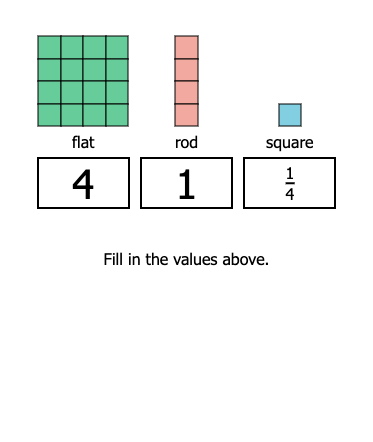
Transition from thinking proportionally about just whole numbers, to including fractions, too. If a flat has 16 squares and its total value is 4, what's the value of a rod? A rod is a flat divided into 4 equal parts, so 1 rod = 4÷4 = 1. What's the value of the square? A square is a rod divided into 4 equal parts, so 1 square = 1÷4 = 1/4.
Prerequisites: 4-110
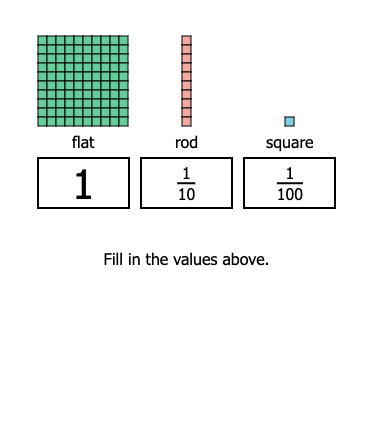
Focus on decimal fractions – tenths and hundredths. If a flat has 100 squares and a total value of 1, what is the value of 1 square? What's 1 divided into 100 equal parts? Each square is 1 hundredth, or 1/100. How many hundredths in a flat? 100, and 100 x 1/100 = 1. How many hundredths in a rod? 10, and 10 x 1/100 = 1/10.
Prerequisites: 4-111 ○ 3-22
4-110: Flats, Rods & Squares - Model Whole Numbers
Prepare for modeling decimals by using concrete models in a flexible way. If a flat has 9 unit squares so its value is 9 instead of 100, what's the value of the rod? Here, a rod is a flat divided into 3 equal parts, so 1 rod = 9÷3 = 3. What's the value of the square? A square is a rod divided into 3 equal parts, so 1 square = 3÷3 = 1.
Prerequisites: 3-22
4-111: Flats, Rods & Squares - Model Whole Numbers & Fractions
Transition from thinking proportionally about just whole numbers, to including fractions, too. If a flat has 16 squares and its total value is 4, what's the value of a rod? A rod is a flat divided into 4 equal parts, so 1 rod = 4÷4 = 1. What's the value of the square? A square is a rod divided into 4 equal parts, so 1 square = 1÷4 = 1/4.
Prerequisites: 4-110
4-112: Flats, Rods & Squares - Model Decimal Fractions
Focus on decimal fractions – tenths and hundredths. If a flat has 100 squares and a total value of 1, what is the value of 1 square? What's 1 divided into 100 equal parts? Each square is 1 hundredth, or 1/100. How many hundredths in a flat? 100, and 100 x 1/100 = 1. How many hundredths in a rod? 10, and 10 x 1/100 = 1/10.
Prerequisites: 4-111 ○ 3-22
Extend understanding of decimals by one more place value. One hundredth has a value of 10 thousandths. Use decimal notation to write decimal fractions as decimal numbers to the thousandths. Also, use base 10 discs to model expanded form, and use benchmark numbers to compare and order decimals on a number line.
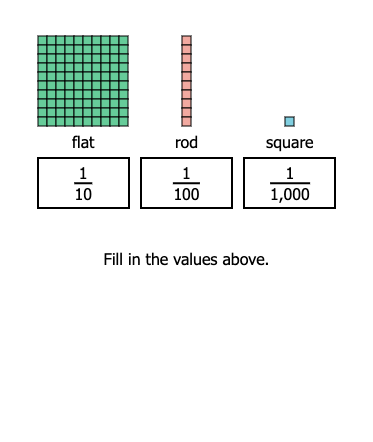
Model decimal fractions. If a flat is 1/10, what's a rod? 10 rods = 1 flat, so 1 rod = 1/10 flat and a rod is 1/10 x 1/10 = 1/100. A square? 10 squares = 1 rod, so 1 square = 1/10 rod and a square is 1/10 x 1/100 = 1/1,000. What's 2 flats, 3 rods, and 5 squares? The total value is (2 x 1/10) + (3 x 1/100) + (5 x 1,000) = 235/1,000.
Prerequisites: 5-89 ○ 4-112, 4-46
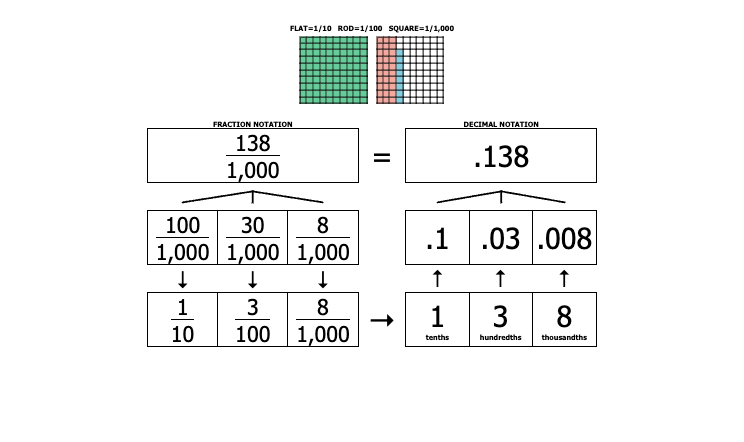
Use Base 10 notation to write decimal fractions - tenths, hundredths and thousandths. What's 138/1,000 written as a decimal number? 138/1,000 = 100/1,000 + 30/1,000 + 8/1,000 = 1/10 + 3/100 + 8/1,000, so write 1 in the tenths place, 3 in the hundredths places, and 8 in the thousandths place. 138/1,000 = .138 = 0.138.
Prerequisites: 5-90 ○ 4-119
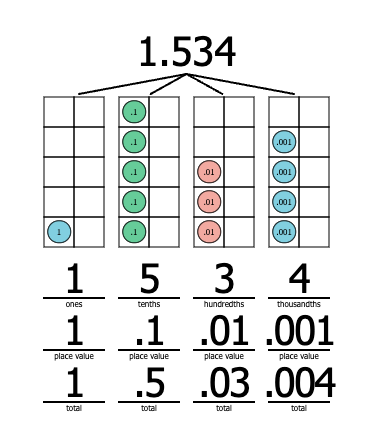
Use non-proportional, Base 10 discs to model expanded form. What's 1.534? Identify each digit's quantity and place value. Multiply to get its total value. 1.534 = (1 x 1)+(5 x .1)+(3 x .01)+(4 x .001) = 1 + .5 + .03 + .04. Transition from discs to number bonds. Emphasize the difference between a digit's quantity and value.
Prerequisites: 5-91 ○ 4-117
5-090: Model Decimal Fractions with Flats, Rods & Squares
Model decimal fractions. If a flat is 1/10, what's a rod? 10 rods = 1 flat, so 1 rod = 1/10 flat and a rod is 1/10 x 1/10 = 1/100. A square? 10 squares = 1 rod, so 1 square = 1/10 rod and a square is 1/10 x 1/100 = 1/1,000. What's 2 flats, 3 rods, and 5 squares? The total value is (2 x 1/10) + (3 x 1/100) + (5 x 1,000) = 235/1,000.
Prerequisites: 5-89 ○ 4-112, 4-46
5-091: Fraction Notation to Decimal Notation
Use Base 10 notation to write decimal fractions - tenths, hundredths and thousandths. What's 138/1,000 written as a decimal number? 138/1,000 = 100/1,000 + 30/1,000 + 8/1,000 = 1/10 + 3/100 + 8/1,000, so write 1 in the tenths place, 3 in the hundredths places, and 8 in the thousandths place. 138/1,000 = .138 = 0.138.
Prerequisites: 5-90 ○ 4-119
5-093: Model Decimal Numbers in Expanded Form
Use non-proportional, Base 10 discs to model expanded form. What's 1.534? Identify each digit's quantity and place value. Multiply to get its total value. 1.534 = (1 x 1)+(5 x .1)+(3 x .01)+(4 x .001) = 1 + .5 + .03 + .04. Transition from discs to number bonds. Emphasize the difference between a digit's quantity and value.
Prerequisites: 5-91 ○ 4-117
Round decimal numbers to the nearest one, tenth, or hundredth, using open number lines. Find the closest round number lower than a number, and higher than the number, then use the midpoint as a benchmark to decide whether to round up or down.
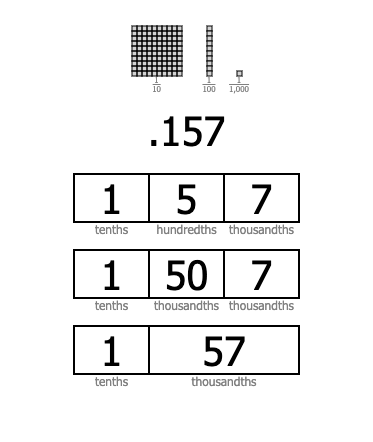
Think flexibly about place value. How many thousandths in .057? There's a 7 in the thousandths place, but 5/100 = 50/1,000, so .057 = 50/1,000 + 7/1,000 = 57/1,000. How many thousandths in .157? Since 1/10 = 100/1,000, .157 = 100/1,000 + 57/1,000 = 157/1,000. Practice grouping more than 1 place value at a time.
Prerequisites: 5-91
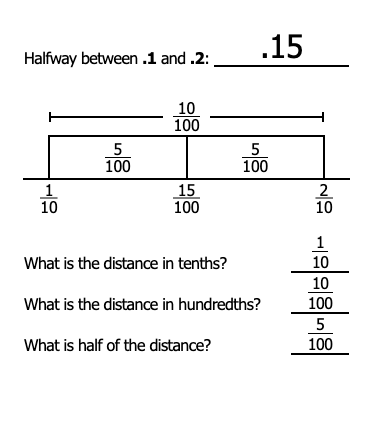
Find the midpoint between 2 adjacent tenths or hundredths. What number is halfway between .1 and .2? The distance between .1 and .2 is .2-.1 = .1. 1 tenth doesn't divide easily by 2, but 1 tenth is 10 hundredths and half is 5 hundredths or .05. The midpoint between .1 and .2 is .1 + .05 = .15. It's also .2 – .05 = .15.
Prerequisites: 5-93 ○ 4-27
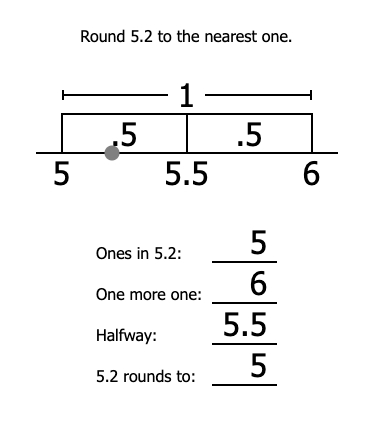
On an open number line, round tenths to the nearest whole number. Is 5.2 closer to 5 or to 6 – the number of ones it has or to 1 more – the next largest whole number? Compare 5.2 to the benchmark number 5.5, halfway in-between 5 and 6. Since 5.2 < 5.5, it's closer to 5. Round down to the nearest whole number, 5.
Prerequisites: 5-94 ○ 4-27, 4-89
5-092: Renaming Decimal Numbers
Think flexibly about place value. How many thousandths in .057? There's a 7 in the thousandths place, but 5/100 = 50/1,000, so .057 = 50/1,000 + 7/1,000 = 57/1,000. How many thousandths in .157? Since 1/10 = 100/1,000, .157 = 100/1,000 + 57/1,000 = 157/1,000. Practice grouping more than 1 place value at a time.
Prerequisites: 5-91
5-094: Rounding Decimal Numbers: Learn the Halfway Benchmark
Find the midpoint between 2 adjacent tenths or hundredths. What number is halfway between .1 and .2? The distance between .1 and .2 is .2-.1 = .1. 1 tenth doesn't divide easily by 2, but 1 tenth is 10 hundredths and half is 5 hundredths or .05. The midpoint between .1 and .2 is .1 + .05 = .15. It's also .2 – .05 = .15.
Prerequisites: 5-93 ○ 4-27
5-095: Rounding Decimal Numbers to the Nearest One
On an open number line, round tenths to the nearest whole number. Is 5.2 closer to 5 or to 6 – the number of ones it has or to 1 more – the next largest whole number? Compare 5.2 to the benchmark number 5.5, halfway in-between 5 and 6. Since 5.2 < 5.5, it's closer to 5. Round down to the nearest whole number, 5.
Prerequisites: 5-94 ○ 4-27, 4-89
Add decimals by joining addends by place value. Rename tenths as hundredths or hundredths as thousandths, when necessary to find a sum. Start modeling with base 10 blocks, and move to modeling numbers with base 10 discs and then number bonds, laying the foundation for vertical algorithms.
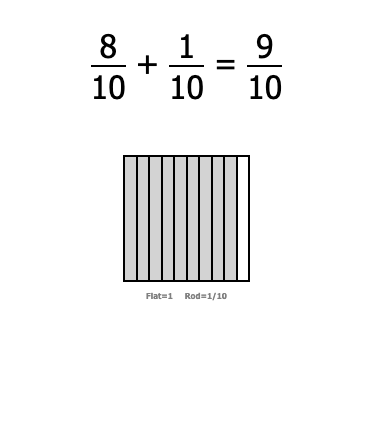
Use Base 10 blocks to add tenths and hundredths. What's 8/10 + 1/10? If a flat is 1, a rod is 1/10. 8 rods + 1 rod = 9 rods, so 8/10 + 1/10 = 9/10. What's 29/100 + 11/100? Since a square is 1/100, 29 squares + 11 squares = 40 squares, and 29/100 + 11/100 = 40/100. Add fractions by thinking in units of tenths and hundredths.
Prerequisites: 4-98
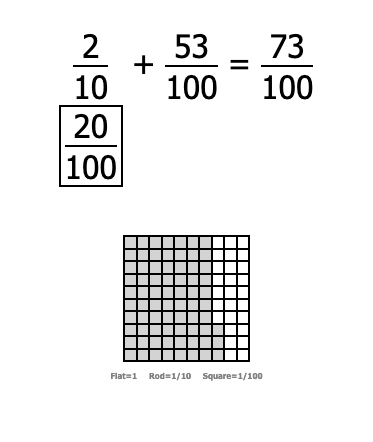
Use Base 10 blocks to rename and add tenths to hundredths. What's 2/10 + 53/100? The denominators are not the same, so make hundredths – a common unit. If a flat is 1, each vertical column or rod is 1/10, and each square is 1/100. Since 2/10 is 2 columns, 20 squares, and 20/100, 2/10 + 53/100 = 20/100 + 53/100 = 73/100.
Prerequisites: 4-112 ○ 3-22
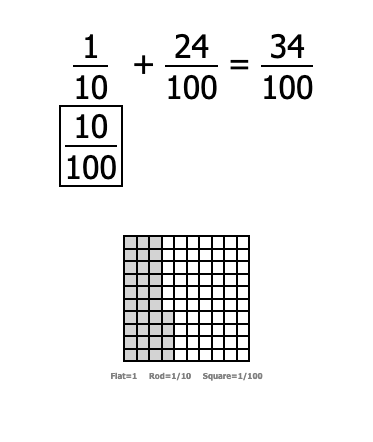
Add tenths and hundredths concretely using Base 10 blocks. What's a common unit? Hundredths. If a flat is 1, each rod or column is 1/10 = 10/100. What's 1/10 + 24/100? 1/10 is 1 rod or 10/100. 10/100 + 24/100 = 34/100. Use Base 10 blocks to visualize equivalent fractions and add hundredths.
Prerequisites: 4-114
4-113: Add Tenths & Add Hundredths using Base 10 Blocks
Use Base 10 blocks to add tenths and hundredths. What's 8/10 + 1/10? If a flat is 1, a rod is 1/10. 8 rods + 1 rod = 9 rods, so 8/10 + 1/10 = 9/10. What's 29/100 + 11/100? Since a square is 1/100, 29 squares + 11 squares = 40 squares, and 29/100 + 11/100 = 40/100. Add fractions by thinking in units of tenths and hundredths.
Prerequisites: 4-98
4-114: Add Tenths & Hundredths by Renaming, using Base 10 Blocks
Use Base 10 blocks to rename and add tenths to hundredths. What's 2/10 + 53/100? The denominators are not the same, so make hundredths – a common unit. If a flat is 1, each vertical column or rod is 1/10, and each square is 1/100. Since 2/10 is 2 columns, 20 squares, and 20/100, 2/10 + 53/100 = 20/100 + 53/100 = 73/100.
Prerequisites: 4-112 ○ 3-22
5-042: Add Decimal Fractions with Tenths & Hundredths
Add tenths and hundredths concretely using Base 10 blocks. What's a common unit? Hundredths. If a flat is 1, each rod or column is 1/10 = 10/100. What's 1/10 + 24/100? 1/10 is 1 rod or 10/100. 10/100 + 24/100 = 34/100. Use Base 10 blocks to visualize equivalent fractions and add hundredths.
Prerequisites: 4-114
Find the difference between two decimal numbers. Shift ones or tenths as needed, use partial differences and then the standard algorithm. Compare digits in decimal numbers additively.
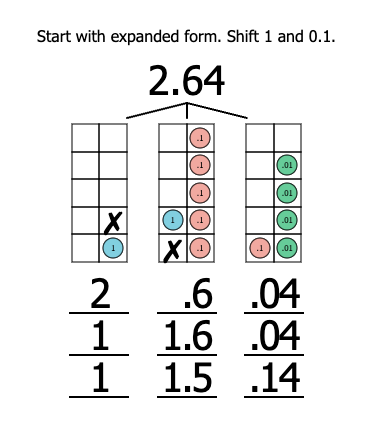
Prepare for regrouping by shifting ones and tenths. What's 2.64 if 1 one and 1 tenth are shifted? Shift 1 one. 2 ones become 1 one, and 6 tenths become 16 tenths. Shift 1 tenth. 16 tenths become 15 tenths, and 4 hundredths become 14 hundredths. 2.64 = (1 x 1)+(15 x .1)+(14 x .01) = 1 + 1.5 + .14
Prerequisites: 4-119
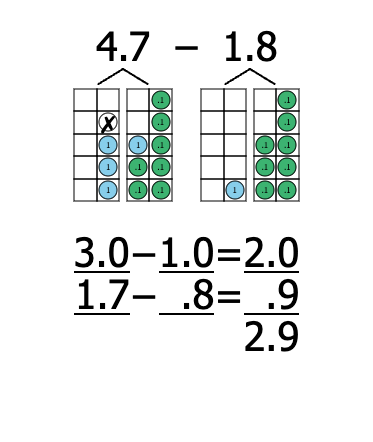
Model and subtract ones, tenths, and hundredths using Base 10 discs and number bonds. What's 4.7 - 1.8? To get more tenths, shift 1 to get 3 ones and 17 tenths. Since 3 - 1 = 2 and 1.7 - .8 = .9, 4.7 - 1.8 = 2 + .9 = 2.9. Lay the foundation for vertical algorithms by regrouping and subtracting units that are the same.
Prerequisites: 5-100
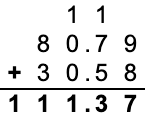
Add and subtract using vertical, standard algorithms that focus on each digit's quantity and place value. What's .09 + .08? 9 hundredths + 8 hundredths = 17 hundredths = 1 tenth + 7 hundredths. Write a "7" in the hundredths place and a "1" in the tenths place. Write digits in the correct column with the correct place value.
Prerequisites: 5-101, 5-99 ○ 4-32
5-100: Shift Ones and Tenths
Prepare for regrouping by shifting ones and tenths. What's 2.64 if 1 one and 1 tenth are shifted? Shift 1 one. 2 ones become 1 one, and 6 tenths become 16 tenths. Shift 1 tenth. 16 tenths become 15 tenths, and 4 hundredths become 14 hundredths. 2.64 = (1 x 1)+(15 x .1)+(14 x .01) = 1 + 1.5 + .14
Prerequisites: 4-119
5-101: Subtract Decimal Numbers using Partial Differences
Model and subtract ones, tenths, and hundredths using Base 10 discs and number bonds. What's 4.7 - 1.8? To get more tenths, shift 1 to get 3 ones and 17 tenths. Since 3 - 1 = 2 and 1.7 - .8 = .9, 4.7 - 1.8 = 2 + .9 = 2.9. Lay the foundation for vertical algorithms by regrouping and subtracting units that are the same.
Prerequisites: 5-100
5-102: Add & Subtract Decimal Numbers using the Standard Algorithm
Add and subtract using vertical, standard algorithms that focus on each digit's quantity and place value. What's .09 + .08? 9 hundredths + 8 hundredths = 17 hundredths = 1 tenth + 7 hundredths. Write a "7" in the hundredths place and a "1" in the tenths place. Write digits in the correct column with the correct place value.
Prerequisites: 5-101, 5-99 ○ 4-32
Multiply decimals. Starty by using the partial products algorithm and the area model to multiply. Use fraction notation to keep track of quantities, units, and where to write the decimal point. Some may progress to using the standard algorithm.
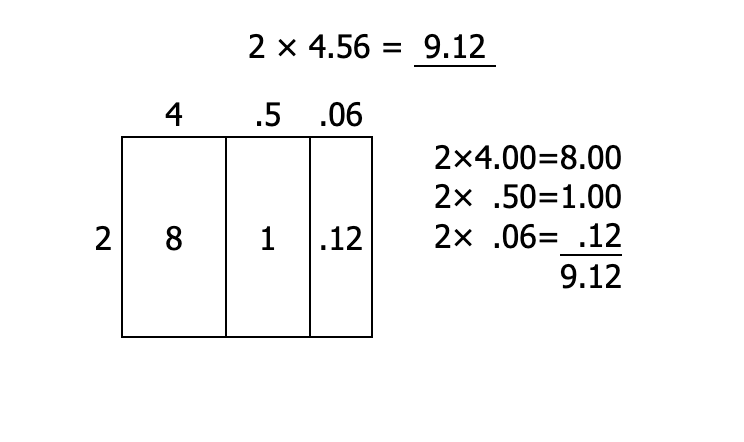
Use the area model to multiply by applying the distributive property. Find and add partial areas to get the total area. What's 2 x .06? Since 2 x 6/100 = 12/100, 2 x .06 = .12. What's 2 x .5? Since 2 x 5/10 = 10/10 = 1. Using fraction notation helps keep track of quantities, units, and where to write the decimal point.
Prerequisites: 5-93 ○ 4-35
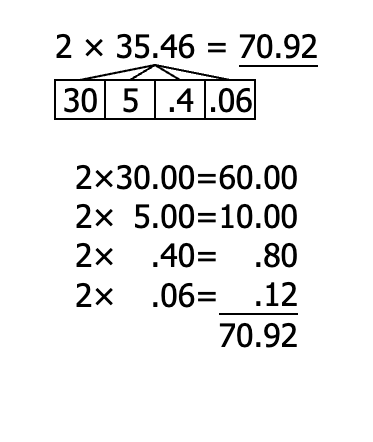
Use number bonds to multiply by applying the distributive property. Find and add partial products to get the total products. What's 2 x 35.46? Since 2 x 30 = 60, 2 x 5 = 10, 2 x .40 = .80, 2 x.06 = .12, and 60 + 10 + .80 + .12 = 70.92. Leverage understanding of fractions and the area model to multiply and make sense of decimals.
Prerequisites: 5-104
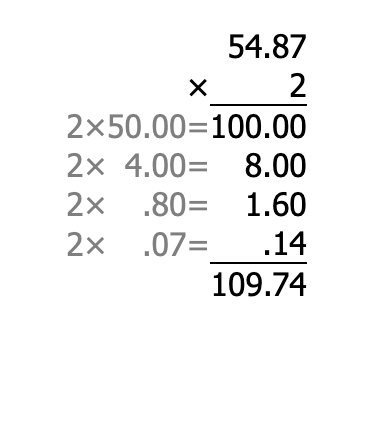
Multiply left-to-right, using the partial products algorithm. Keep track of place values by aligning the decimal points and emphasizing each digit's correct place value. What's 2 x .8? Since 2 x 8/10 = 16/10 = 1 6/10 = 1.6, write 6 in the tenths place and 1 in the ones place. Add partial products vertically to get the total product.
Prerequisites: 5-105
5-104: Multiply Decimal Numbers using an Area Model
Use the area model to multiply by applying the distributive property. Find and add partial areas to get the total area. What's 2 x .06? Since 2 x 6/100 = 12/100, 2 x .06 = .12. What's 2 x .5? Since 2 x 5/10 = 10/10 = 1. Using fraction notation helps keep track of quantities, units, and where to write the decimal point.
Prerequisites: 5-93 ○ 4-35
5-105: Multiply Decimal Numbers using Number Bonds
Use number bonds to multiply by applying the distributive property. Find and add partial products to get the total products. What's 2 x 35.46? Since 2 x 30 = 60, 2 x 5 = 10, 2 x .40 = .80, 2 x.06 = .12, and 60 + 10 + .80 + .12 = 70.92. Leverage understanding of fractions and the area model to multiply and make sense of decimals.
Prerequisites: 5-104
5-106: Multiply Decimal Numbers using the Partial Products Algorithm
Multiply left-to-right, using the partial products algorithm. Keep track of place values by aligning the decimal points and emphasizing each digit's correct place value. What's 2 x .8? Since 2 x 8/10 = 16/10 = 1 6/10 = 1.6, write 6 in the tenths place and 1 in the ones place. Add partial products vertically to get the total product.
Prerequisites: 5-105
Divide decimal numbers by whole-number divisors. Solve equivalent whole-number division problems when the divisor is a decimal.
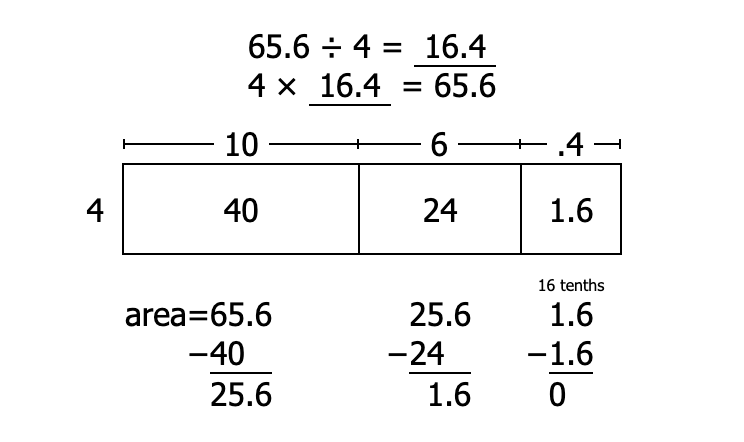
Use the area model to divide by thinking of division as multiplication with an unknown factor or side length. What's 65.6 ÷ 4? 4 x __ = 65.6? Apply the distributive property by breaking the total area into partial areas. Find and add partial side lengths to get the total side length. 65.6 ÷ 4 = (40+24+1.6) ÷ 4 = 10+6+.4 = 16.4.
Prerequisites: 5-107 ○ 5-104, 4-47
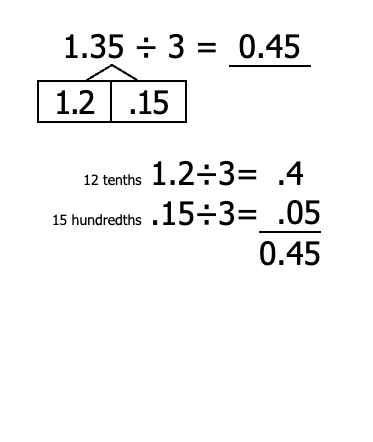
Use number bonds to divide by breaking decimals into familiar multiples from the basic times tables. What's 1.35 ÷ 3? Since 1.35 = 1.2 + .15 = 12 tenths + 15 hundredths, 1.35 ÷ 3 = (1.2 + .15) ÷ 3 = (12 tenths + 15 hundredths) ÷ 3 = 4 tenths + 5 hundredths = .45. Find and add partial quotients to get the total quotient.
Prerequisites: 5-108 ○ 5-8
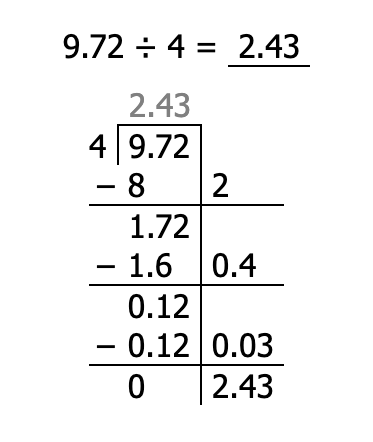
Transition from number bonds to the vertical, partial quotients algorithm. Continue to apply the distributive property by breaking dividends into known multiples of the divisor. What's 9.72 ÷ 4? Since 9.72 = 8 + 1.6 + .12, 9.72 ÷ 4 = (8 + 1.6 + .12) ÷ 4 = (8 ones + 16 tenths + 12 hundredths) ÷ 4 = 2 + .4 + .03 = 2.43.
Prerequisites: 5-109 ○ 5-9
5-108: Divide Decimal Numbers using the Area Model
Use the area model to divide by thinking of division as multiplication with an unknown factor or side length. What's 65.6 ÷ 4? 4 x __ = 65.6? Apply the distributive property by breaking the total area into partial areas. Find and add partial side lengths to get the total side length. 65.6 ÷ 4 = (40+24+1.6) ÷ 4 = 10+6+.4 = 16.4.
Prerequisites: 5-107 ○ 5-104, 4-47
5-109: Divide Decimal Numbers using Number Bonds
Use number bonds to divide by breaking decimals into familiar multiples from the basic times tables. What's 1.35 ÷ 3? Since 1.35 = 1.2 + .15 = 12 tenths + 15 hundredths, 1.35 ÷ 3 = (1.2 + .15) ÷ 3 = (12 tenths + 15 hundredths) ÷ 3 = 4 tenths + 5 hundredths = .45. Find and add partial quotients to get the total quotient.
Prerequisites: 5-108 ○ 5-8
5-110: Divide Decimal Numbers using the Partial Quotients Algorithm
Transition from number bonds to the vertical, partial quotients algorithm. Continue to apply the distributive property by breaking dividends into known multiples of the divisor. What's 9.72 ÷ 4? Since 9.72 = 8 + 1.6 + .12, 9.72 ÷ 4 = (8 + 1.6 + .12) ÷ 4 = (8 ones + 16 tenths + 12 hundredths) ÷ 4 = 2 + .4 + .03 = 2.43.
Prerequisites: 5-109 ○ 5-9
Find length, the shortest distance between two points, to measure colored bars. Start with informal, concrete units, such as paper clips, before being introduced to the abstract idea of inches or centimeters. Paper clips are easy to count and compare, as long as the units are placed end-to-end, with no gaps.
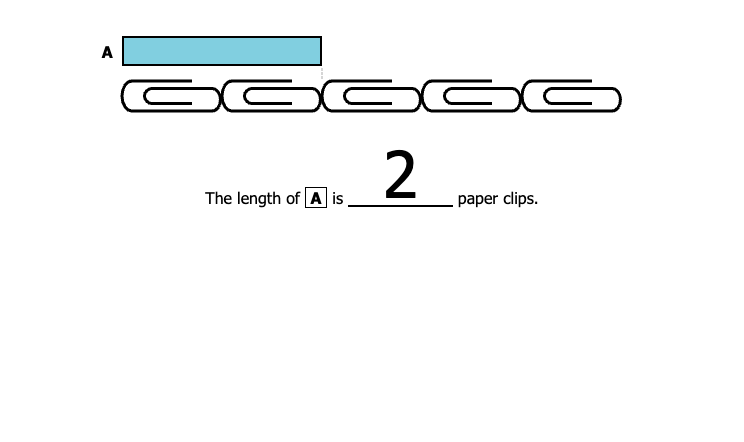
To develop counting and grouping skills in a practical and visual way, measure the length of colored bars using informal units – big or small paper clips placed end-to-end with no gaps or overlaps. Count, add, and compare to measure length in paper clips, an informal unit of measure.
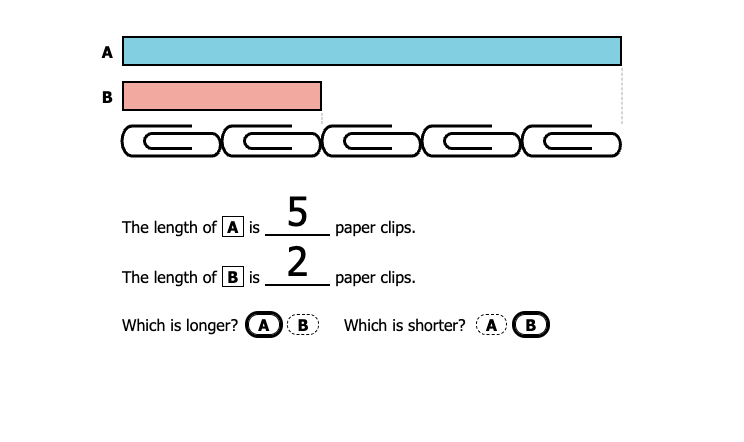
Transition from 1 bar to 2 bars to count, add, compare, and introduce the concept of "difference" – how much longer or shorter one bar is than the other. Encourage students to think strategically by figuring out the length of the shorter bar first, then counting on or adding on to find the length of the longer bar.
Prerequisites: K-69
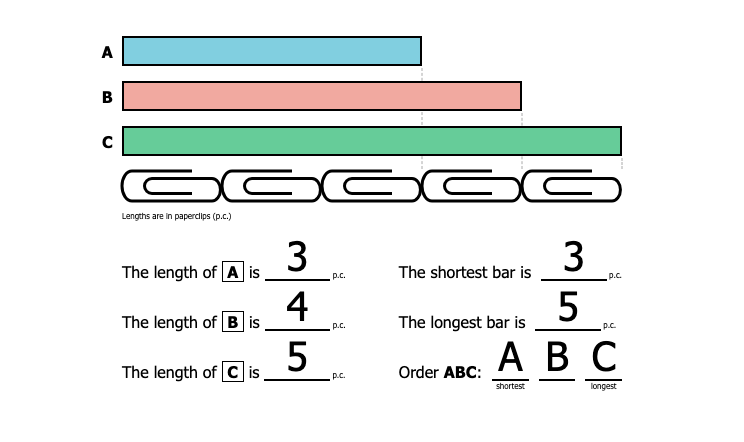
Enrich by generalizing from 2 bars to 3 bars. How long are they? Think strategically by measuring the shortest bar first. How many more paper clips are the longer bars? Use their differences to figure out their lengths. Put the bars in order from shortest to longest. Supplement part-total with comparative thinking.
Prerequisites: K-70
K-069: Measure the Length of 1 Bar
To develop counting and grouping skills in a practical and visual way, measure the length of colored bars using informal units – big or small paper clips placed end-to-end with no gaps or overlaps. Count, add, and compare to measure length in paper clips, an informal unit of measure.
K-070: Measure and Compare the Lengths of 2 Bars
Transition from 1 bar to 2 bars to count, add, compare, and introduce the concept of "difference" – how much longer or shorter one bar is than the other. Encourage students to think strategically by figuring out the length of the shorter bar first, then counting on or adding on to find the length of the longer bar.
Prerequisites: K-69
K-071: Measure and Compare the Lengths of 3 Bars
Enrich by generalizing from 2 bars to 3 bars. How long are they? Think strategically by measuring the shortest bar first. How many more paper clips are the longer bars? Use their differences to figure out their lengths. Put the bars in order from shortest to longest. Supplement part-total with comparative thinking.
Prerequisites: K-70
Address misconceptions about length. Use paper clips to model how gaps and overlap create inaccurate measurement, and the importance of measuring from the beginning of an object. Explore the relationship between the size and number of units -- we need more, smaller paper clips, and fewer, large paper clips.
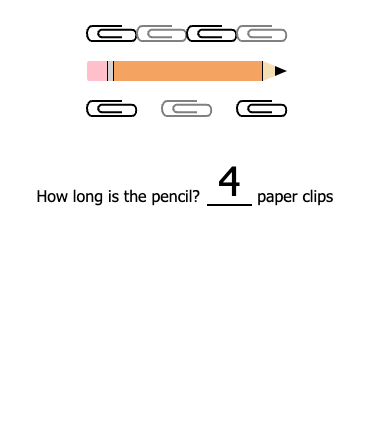
Analyze measuring mistakes to deepen understanding about length. If the units have gaps between them, is the true length longer or shorter than the observed number of units? Longer. What if the units overlap? The true length is shorter. To measure correctly, the units must be aligned end-to-end with no gaps or overlaps.
Prerequisites: 1-123
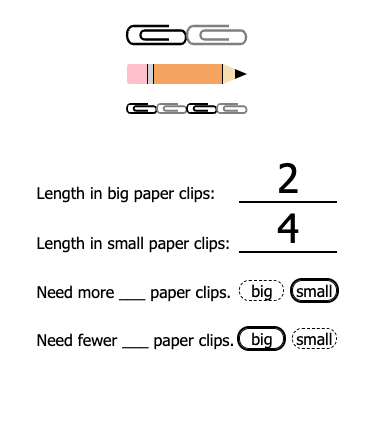
Explore the relationship between the size and number of units by measuring objects twice. Measure first with large paper clips, then measure with small paper clips. Which requires more paper clips? Need more, smaller paper clips, and fewer, large paper clips. There's an inverse relationship between the size and number of units.
Prerequisites: 1-124 ○ 1-85
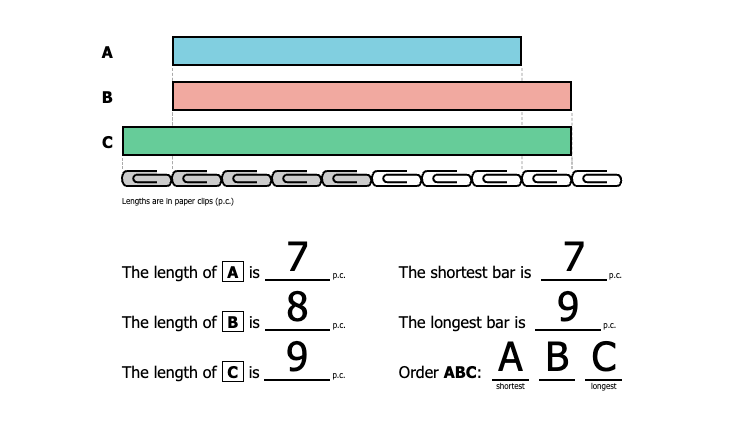
Measure length in non-standard units as the number of paper clips placed end-to-end with no gaps or overlaps. Reason, calculate, subitize, and compare to figure out how many without counting. To emphasize length as the distance between 2 points, measure from any paper clip instead of from the first paper clip.
Prerequisites: 1-121
1-124: Analyze Measurement with Gaps & Overlaps
Analyze measuring mistakes to deepen understanding about length. If the units have gaps between them, is the true length longer or shorter than the observed number of units? Longer. What if the units overlap? The true length is shorter. To measure correctly, the units must be aligned end-to-end with no gaps or overlaps.
Prerequisites: 1-123
1-125: Big Units vs Small Units - Inverse Relationship
Explore the relationship between the size and number of units by measuring objects twice. Measure first with large paper clips, then measure with small paper clips. Which requires more paper clips? Need more, smaller paper clips, and fewer, large paper clips. There's an inverse relationship between the size and number of units.
Prerequisites: 1-124 ○ 1-85
2-110: Reason About Length - Non-Standard Units
Measure length in non-standard units as the number of paper clips placed end-to-end with no gaps or overlaps. Reason, calculate, subitize, and compare to figure out how many without counting. To emphasize length as the distance between 2 points, measure from any paper clip instead of from the first paper clip.
Prerequisites: 1-121
Measure length with formal units, using metric centimeters and customary inches, to the nearest quarter inch. Learn the convention of measuring from zero. Transition to measuring from any number by calculating the distance between the starting and ending points. Move on to breaking units into halfs and fourths to measure more precisely.
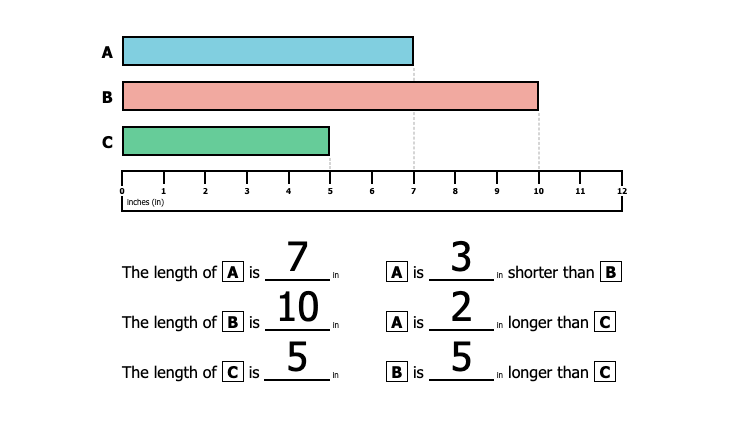
Use a ruler to measure the length of a colored bar. Start by measuring from zero. Transition to measuring from any number by calculating the distance between the starting and ending points on the ruler. Use reasoning and arithmetic to compare and calculate how much longer or shorter one bar is than another.
Prerequisites: 2-110 ○ 1-125
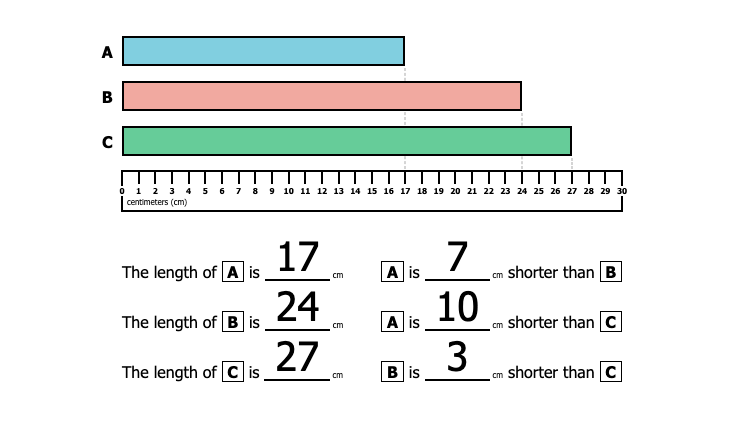
Generalize from measuring in inches to measuring in smaller, centimeters. "Cent" means 100, and 100 centimeters makes 1 meter. Measure from zero or any point on the ruler by calculating the distance between the starting and ending points. Compare and calculate how much longer or shorter one bar is than another.
Prerequisites: 2-113
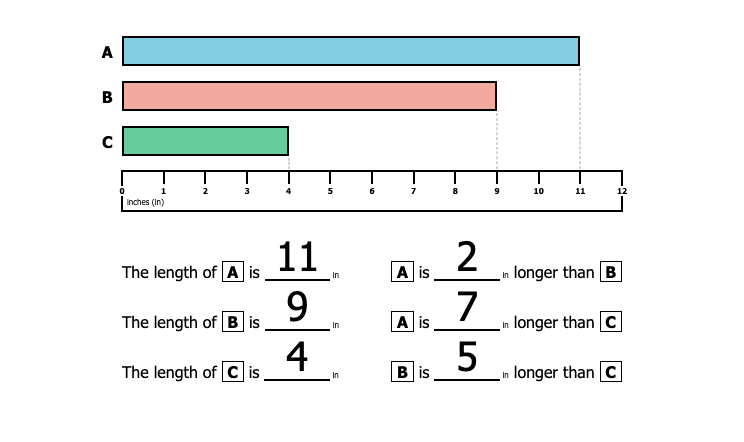
Use rulers to measure and compare colored bars. Find the difference between 2 bars by adding and subtracting in inches or centimeters. Align bars with zero, then transition to calculating length as the distance between any 2 points. Use rulers like a number line.
Prerequisites: 2-114
2-113: Measure and Compare Lengths in Inches
Use a ruler to measure the length of a colored bar. Start by measuring from zero. Transition to measuring from any number by calculating the distance between the starting and ending points on the ruler. Use reasoning and arithmetic to compare and calculate how much longer or shorter one bar is than another.
Prerequisites: 2-110 ○ 1-125
2-114: Measure and Compare Lengths in Centimeters
Generalize from measuring in inches to measuring in smaller, centimeters. "Cent" means 100, and 100 centimeters makes 1 meter. Measure from zero or any point on the ruler by calculating the distance between the starting and ending points. Compare and calculate how much longer or shorter one bar is than another.
Prerequisites: 2-113
3-118: Measure & Compare Length to the nearest Whole Unit
Use rulers to measure and compare colored bars. Find the difference between 2 bars by adding and subtracting in inches or centimeters. Align bars with zero, then transition to calculating length as the distance between any 2 points. Use rulers like a number line.
Prerequisites: 2-114
Find personal benchmarks of similar length to formal units. Build mental benchmarks by knowing, for example, that from elbow to wrist is 12 inches - the length of a ruler. Choose the best tool to measure each object (a ruler, a yardstick, or a measuring tape), and build number sense by estimating lengths with non-standard and standard units.
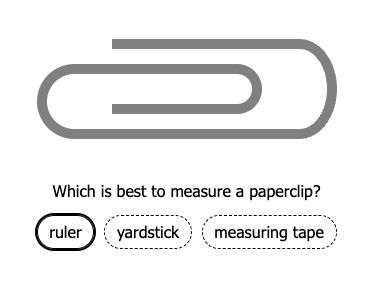
Use benchmarks to develop a sense of length. Measure your arm to know which part is 12 inches – the length of a ruler. Measure your height to know which part of your body is 3 feet tall – the length of a yardstick. Which tool do you use to measure a pencil? It's shorter than your forearm, so a ruler. An umbrella? It's longer than your forearm so a yardstick.
Prerequisites: 2-114, 2-113
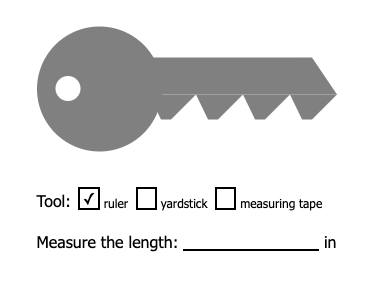
To develop "measurement sense," measure many different objects, both at school and at home. For small objects, use a ruler to measure in inches or centimeters. For medium objects, use a yard or meter stick. For large objects, use a measuring tape to measure in feet or meters.
Prerequisites: 2-115 ○ 2-114, 2-113
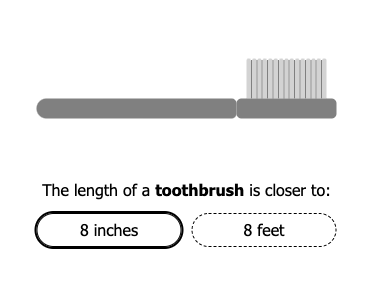
Build number sense with U.S. standard units – inches and feet. What has a length of about 1 inch? The width of a quarter. What has a length of 1 foot? A standard ruler. Is the length of a toothbrush 8 inches or 8 feet? Is the length of a bed 6 feet or 60 feet? Use the known lengths of common objects as benchmarks.
Prerequisites: 2-116 ○ 2-113
2-115: Choosing the Best Measuring Tool for Length
Use benchmarks to develop a sense of length. Measure your arm to know which part is 12 inches – the length of a ruler. Measure your height to know which part of your body is 3 feet tall – the length of a yardstick. Which tool do you use to measure a pencil? It's shorter than your forearm, so a ruler. An umbrella? It's longer than your forearm so a yardstick.
Prerequisites: 2-114, 2-113
2-116: Measure the Lengths of Real Objects
To develop "measurement sense," measure many different objects, both at school and at home. For small objects, use a ruler to measure in inches or centimeters. For medium objects, use a yard or meter stick. For large objects, use a measuring tape to measure in feet or meters.
Prerequisites: 2-115 ○ 2-114, 2-113
2-117: Estimate Length in Standard Units
Build number sense with U.S. standard units – inches and feet. What has a length of about 1 inch? The width of a quarter. What has a length of 1 foot? A standard ruler. Is the length of a toothbrush 8 inches or 8 feet? Is the length of a bed 6 feet or 60 feet? Use the known lengths of common objects as benchmarks.
Prerequisites: 2-116 ○ 2-113
Identify the name and value of U.S. coins and dollar bills. Use color and size to distinguish coins and learn comparison words such as "larger", "smaller", "largest", and "smallest". Calculate the value of groups of coins, and compare using the greater than (>), less than (<), or equal (=) symbol.
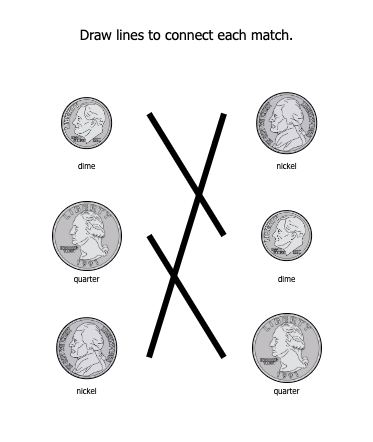
Introduce coins using real or plastic coins, and pictures of coins. Focus on color and size. Which coins are silver in color? Which coin is not silver? Which coin is the largest? Which coin is the smallest? Which is larger, a nickel or a penny? Which is smaller, a penny or a dime? Introduce and use comparison words.
Prerequisites: K-1
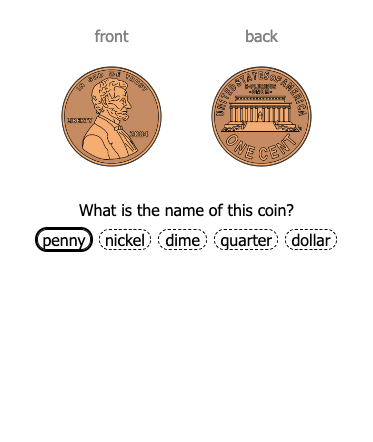
Enrich by introducing money. Identify pennies, nickels, dimes, quarters, and $1 bills. Group coins by color, and order coins by size. Identify the U.S Presidents – Abraham Lincoln, Thomas Jefferson, Franklin Roosevelt, and George Washington. Explore using real and plastic coins, as well as online, digital coins.
Prerequisites: K-4
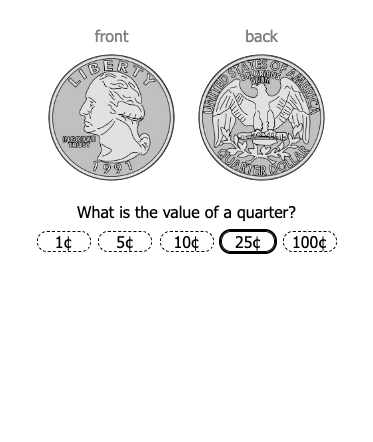
Enrich by learning the value of a penny, nickel, dime, quarter, and 1-dollar bill, in cents (¢). Discover the pattern with pennies, nickels, and quarters. As their size increases, their value increases. Dimes are tricky because they do not follow the pattern. They are smaller than pennies and nickels, but have a larger value.
Prerequisites: K-119
K-004: Match Coins
Introduce coins using real or plastic coins, and pictures of coins. Focus on color and size. Which coins are silver in color? Which coin is not silver? Which coin is the largest? Which coin is the smallest? Which is larger, a nickel or a penny? Which is smaller, a penny or a dime? Introduce and use comparison words.
Prerequisites: K-1
K-119: U.S. Money - Names of Coins*
Enrich by introducing money. Identify pennies, nickels, dimes, quarters, and $1 bills. Group coins by color, and order coins by size. Identify the U.S Presidents – Abraham Lincoln, Thomas Jefferson, Franklin Roosevelt, and George Washington. Explore using real and plastic coins, as well as online, digital coins.
Prerequisites: K-4
K-120: U.S. Money - Values of Coins*
Enrich by learning the value of a penny, nickel, dime, quarter, and 1-dollar bill, in cents (¢). Discover the pattern with pennies, nickels, and quarters. As their size increases, their value increases. Dimes are tricky because they do not follow the pattern. They are smaller than pennies and nickels, but have a larger value.
Prerequisites: K-119
Read time on an analog clock. Write time with digital notation and by drawing hands on an analog clock face. Start with just the hour hand. Progress to learning the minute hand and telling time to the nearest hour, half-hour, 15 minutes and the nearest minute. Match common activities and events to specific times of the day to better understand time.
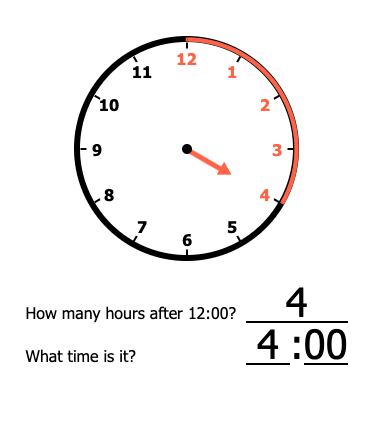
Learn to read time on an analog clock. Learn to write time using digital notation. Start with a clock that has only the shorter, hour hand. The hour hand shows the number of hours after 12 o'clock – written as 12:00. What time is it when the hour hand points directly at 4? It is 4 hours after 12:00, so the time is 4:00.
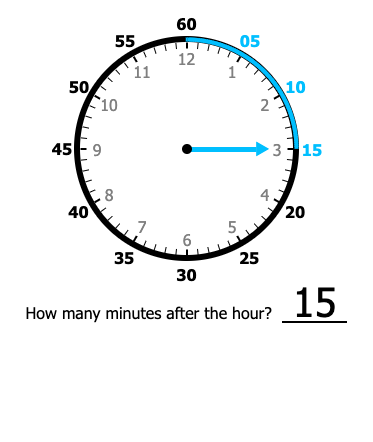
Read a clock with just the longer, minute hand. The digits 1 to 12 still represent hours, so connect each hour with minutes. 12 is 0 min, 3 is 15 min, 6 is 30 min, and 9 is 45 min. If the minute hand points at 12, it's 0 min after the hour. If it points at 6, it's 30 min after the hour – 1 half hour. If it points at 2, it's 10 min after the hour.
Prerequisites: 1-130
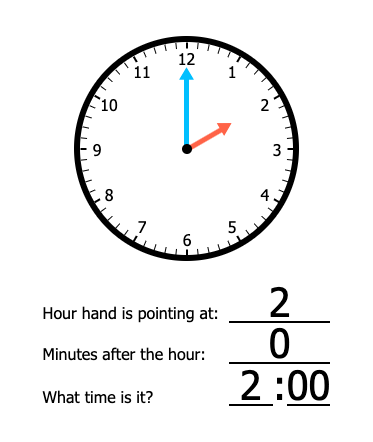
Put hours and minutes together by reading a clock that has both hands. What time is it if the hour hand points at 2 and the minute hand points at 12? It's 2:00 – 2 hours and 0 minutes after 12:00. What time is it if the hour hand points at 1 and the minute hand points at 6? It's 1:30 – 1 hour and 30 minutes after 12:00, – or "half past 1."
Prerequisites: 1-131, 1-130
1-130: Tell Time - Learn the Hour Hand
Learn to read time on an analog clock. Learn to write time using digital notation. Start with a clock that has only the shorter, hour hand. The hour hand shows the number of hours after 12 o'clock – written as 12:00. What time is it when the hour hand points directly at 4? It is 4 hours after 12:00, so the time is 4:00.
1-131: Tell Time - Learn the Minute Hand
Read a clock with just the longer, minute hand. The digits 1 to 12 still represent hours, so connect each hour with minutes. 12 is 0 min, 3 is 15 min, 6 is 30 min, and 9 is 45 min. If the minute hand points at 12, it's 0 min after the hour. If it points at 6, it's 30 min after the hour – 1 half hour. If it points at 2, it's 10 min after the hour.
Prerequisites: 1-130
1-132: Tell Time - Whole Hours & Half-Hours
Put hours and minutes together by reading a clock that has both hands. What time is it if the hour hand points at 2 and the minute hand points at 12? It's 2:00 – 2 hours and 0 minutes after 12:00. What time is it if the hour hand points at 1 and the minute hand points at 6? It's 1:30 – 1 hour and 30 minutes after 12:00, – or "half past 1."
Prerequisites: 1-131, 1-130
Use number lines, number bonds, and shifting 60 when necessary, to solve problems where a start time, end time, or elapsed time is unknown. Understand that the whole unit in time, is 60 minutes, not 100, as in our base 10 system, and that the numbers on a clock face have 2 meanings -- 6 means 6:00 and 30 minutes after the hour. Use benchmark numbers, on an open number line, to make small jumps to calculate elapsed time.
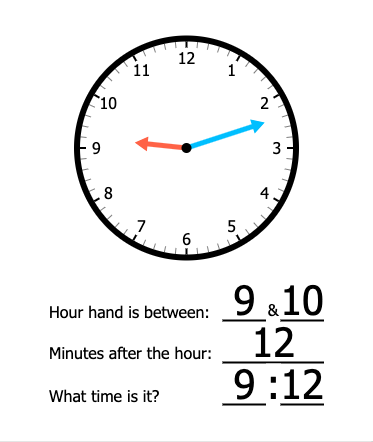
Start by reading time on an analog clock to the nearest 1 minute. What time is it when the hour hand is between 9 and 10 and the minute hand shows 12 minutes after the hour? 9 hours and 12 minutes have elapsed since 12:00, so it's "nine twelve" or "12 minutes after 9." Progress to drawing hour and minute hands.
Prerequisites: 2-126
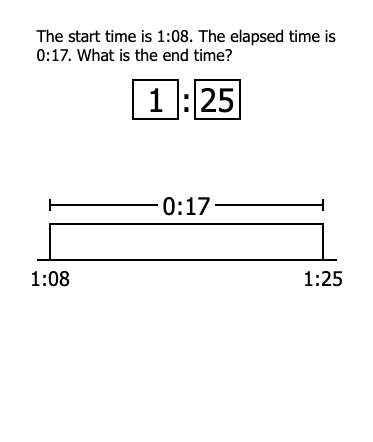
Use a timeline to solve elapsed time problems by visualizing the start time, elapsed time, and end time. Start by finding the end time – result unknown problems – when the end time and start time are within the same hour. If the start time is 1:08 and elapsed time is :17, what is the end time? It's 1:08 + :17 = 1:25.
Prerequisites: 3-125 ○ 2-40, 2-36
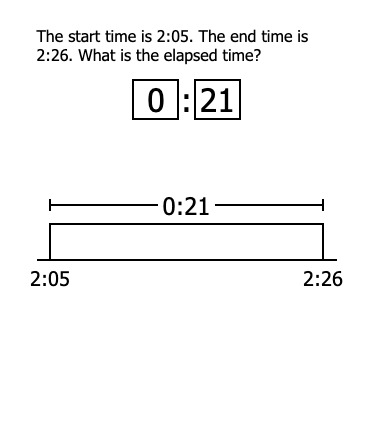
Find the elapsed time – change unknown problems – when the end time and start time are within the same hour. If the start time is 2:05 and the end time is 2:26, what is the elapsed time? Solve 2:05 + ? = 2:26, or 2:26 - ? = 2:05. Add or subtract in 1 or more steps to find the difference. The elapsed time is :21.
Prerequisites: 3-126 ○ 2-41, 2-37
3-125: Read & Write Time to the Nearest Minute
Start by reading time on an analog clock to the nearest 1 minute. What time is it when the hour hand is between 9 and 10 and the minute hand shows 12 minutes after the hour? 9 hours and 12 minutes have elapsed since 12:00, so it's "nine twelve" or "12 minutes after 9." Progress to drawing hour and minute hands.
Prerequisites: 2-126
3-126: Elapsed Time Within the Hour: End-Time-Unknown
Use a timeline to solve elapsed time problems by visualizing the start time, elapsed time, and end time. Start by finding the end time – result unknown problems – when the end time and start time are within the same hour. If the start time is 1:08 and elapsed time is :17, what is the end time? It's 1:08 + :17 = 1:25.
Prerequisites: 3-125 ○ 2-40, 2-36
3-127: Elapsed Time Within the Hour: Elapsed-Time-Unknown
Find the elapsed time – change unknown problems – when the end time and start time are within the same hour. If the start time is 2:05 and the end time is 2:26, what is the elapsed time? Solve 2:05 + ? = 2:26, or 2:26 - ? = 2:05. Add or subtract in 1 or more steps to find the difference. The elapsed time is :21.
Prerequisites: 3-126 ○ 2-41, 2-37
Calculate perimeter and area of different shapes. Find the length of a side when area and one side of a rectangle is known. Use multiplication and division, rather than repeated addition and subtraction. Find the composite area of 2 contiguous rectangles by finding the partial areas and adding to find the total area.
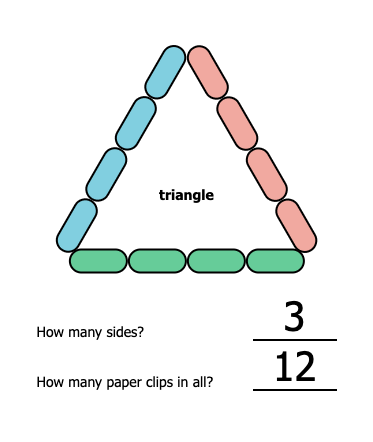
Use shapes to provide context for counting, skip counting, and adding, and also build a foundation for both multiplication and measurement. If each side of an equilateral triangle has length 4, what's the total length of all 3 sides? What's 4+4+4? Since 4+4 = 8 and 8+4 = 12, the total length of all 3 sides – 3 groups of 4 – is 12.
Prerequisites: K-73 ○ K-72
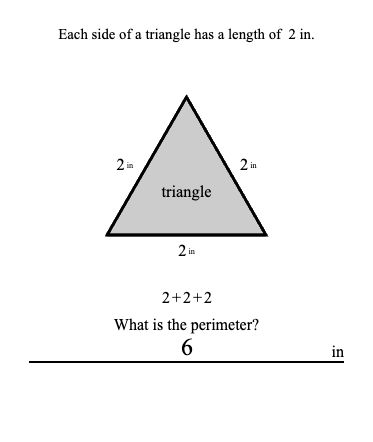
Provide context for multiplication by finding the perimeter of equilateral triangles, squares, and regular pentagons. If the sides of a triangle all measure 2 inches, what's the perimeter? Since the total length of all 3 sides is 3x2 = 2x2 + 1x2 = 6, the perimeter is 6 inches. Find and add partial lengths to get the total length.
Prerequisites: 2-90
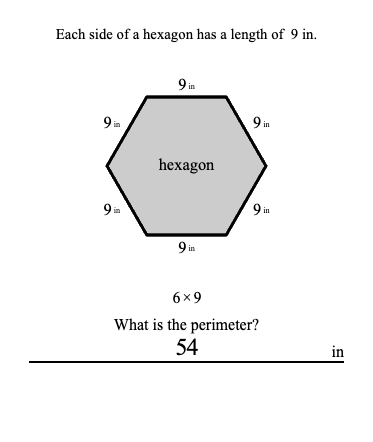
Reinforce multiplication facts by finding the perimeter of regular hexagons, heptagons, octagons, and nonagons. If a hexagon's sides all measure 9 inches, what's its perimeter? Since the total length of 6 sides is 6x9 = 3x9 + 3x9 = 27+27 = 54, the perimeter is 54 inches. Find and add partial lengths to get the total length.
Prerequisites: 3-35
1-126: Geometric Measurement - Add Equal Groups
Use shapes to provide context for counting, skip counting, and adding, and also build a foundation for both multiplication and measurement. If each side of an equilateral triangle has length 4, what's the total length of all 3 sides? What's 4+4+4? Since 4+4 = 8 and 8+4 = 12, the total length of all 3 sides – 3 groups of 4 – is 12.
Prerequisites: K-73 ○ K-72
3-035: Multiply 2-5 Groups: Geometric Measurement
Provide context for multiplication by finding the perimeter of equilateral triangles, squares, and regular pentagons. If the sides of a triangle all measure 2 inches, what's the perimeter? Since the total length of all 3 sides is 3x2 = 2x2 + 1x2 = 6, the perimeter is 6 inches. Find and add partial lengths to get the total length.
Prerequisites: 2-90
3-050: Multiply 6-10 Groups in Perimeter Problems Part I
Reinforce multiplication facts by finding the perimeter of regular hexagons, heptagons, octagons, and nonagons. If a hexagon's sides all measure 9 inches, what's its perimeter? Since the total length of 6 sides is 6x9 = 3x9 + 3x9 = 27+27 = 54, the perimeter is 54 inches. Find and add partial lengths to get the total length.
Prerequisites: 3-35
Calculate the volume of rectangular prisms, or find a missing length when provided with the volume and area of one face. Start with calculating the number of unit cubes that fit inside a rectangular prism, and progress to deriving the formula for volume, V=Area of Base x H = (L x W) x H.
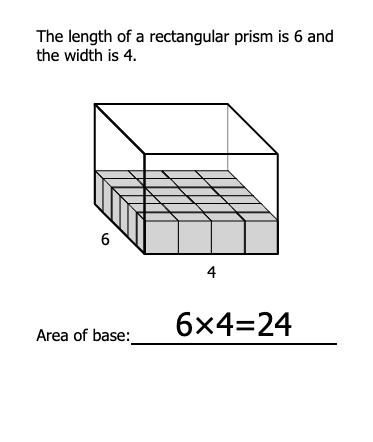
Generalize from the area of a rectangle to the area of the base of a rectangular prism. How many unit cubes can fit in the bottom layer? Multiply the number of rows by the number of unit cubes in each row. Master multiplication facts, develop spatial reasoning, and lay the groundwork for calculating volume.
Prerequisites: 2-21
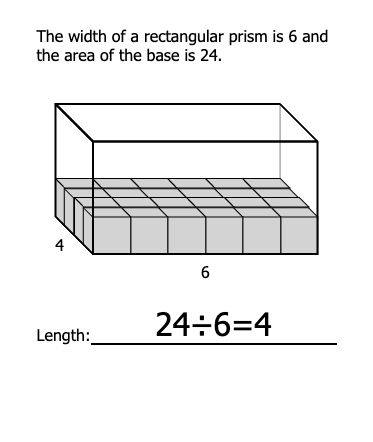
Generalize from finding the side length of a rectangle, to finding the number of rows of unit cubes in a rectangular prism's base. If 24 cubes fit in the bottom layer of a rectangular prism and there are 6 cubes in each row, how many rows are there? Divide by grouping or use multiplication to find the number of rows.
Prerequisites: 3-100
Generalize from length and area, to measuring volume – the number of unit cubes that fit inside a rectangular prism. Multiply length times width to get the area of the prism's base. Then scale the area of the base by the prism's height to get the prism's volume. Derive the formula for volume, V = Area of Base x H = (L x W) x H.
Prerequisites: 3-100
3-100: Base Area of Rectangular Prisms
Generalize from the area of a rectangle to the area of the base of a rectangular prism. How many unit cubes can fit in the bottom layer? Multiply the number of rows by the number of unit cubes in each row. Master multiplication facts, develop spatial reasoning, and lay the groundwork for calculating volume.
Prerequisites: 2-21
3-102: Divide using Area Models to find the Side Length of a Rectangular Prism's Base
Generalize from finding the side length of a rectangle, to finding the number of rows of unit cubes in a rectangular prism's base. If 24 cubes fit in the bottom layer of a rectangular prism and there are 6 cubes in each row, how many rows are there? Divide by grouping or use multiplication to find the number of rows.
Prerequisites: 3-100
5-022: Volume of Rectangular Prisms
Generalize from length and area, to measuring volume – the number of unit cubes that fit inside a rectangular prism. Multiply length times width to get the area of the prism's base. Then scale the area of the base by the prism's height to get the prism's volume. Derive the formula for volume, V = Area of Base x H = (L x W) x H.
Prerequisites: 3-100
Convert length, mass (weight), liquid volume, or time, from larger-sized units to an equivalent using smaller-sized units. Use bar models to represent the relationship between larger and smaller units of measurement, as an introduction to rates, ratios and proportions.
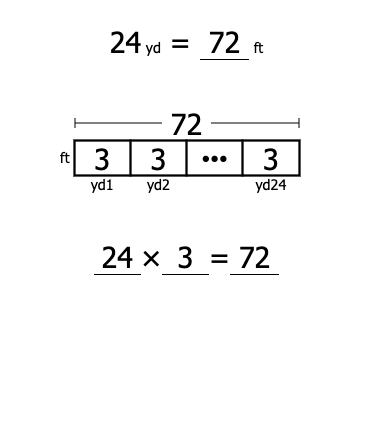
Draw bar models to visualize the relationship between larger and smaller units of length. 24 yards is how many feet? Start with the unit rate. Since 1 yd = 3 ft, 24 yd = 24 x 3 ft = 72 ft. Alternatively, 1 yd = 3 ft, so 4 yd = 12 ft, and 24 yd = 6 x 12 ft = 72 ft. Think proportionally and use partial products to multiply.
Prerequisites: 4-10
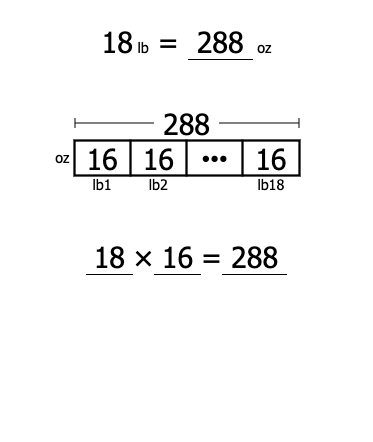
Generalize from converting units of length, to converting units of weight and mass. 18 pounds is how many ounces? Start with the unit rate. Since 1 lb = 16 oz, 18 lb = 18 x 16 oz = 288 oz. Alternatively, 1 lb = 16 oz, so 6 lb = 96 oz, and 18 lb = 3 x 96 oz = 288 oz. Think proportionally and use partial products to multiply.
Prerequisites: 4-122
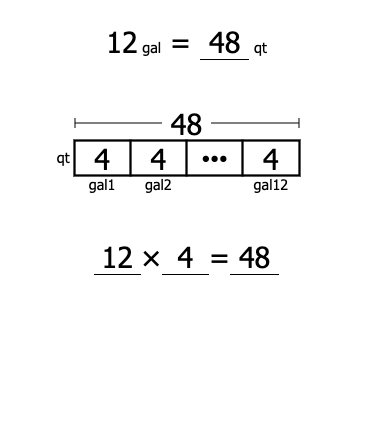
Use unit rates to convert measurements of liquid volume from larger units to smaller units. Convert gallons to quarts, quarts to pints, pints to cups, and cups to fluid ounces. With metric units, convert liters to milliliters. Multiply by thinking proportionally and using partial products. Work to commit unit rates to memory.
Prerequisites: 4-123
4-122: Convert Units of Length
Draw bar models to visualize the relationship between larger and smaller units of length. 24 yards is how many feet? Start with the unit rate. Since 1 yd = 3 ft, 24 yd = 24 x 3 ft = 72 ft. Alternatively, 1 yd = 3 ft, so 4 yd = 12 ft, and 24 yd = 6 x 12 ft = 72 ft. Think proportionally and use partial products to multiply.
Prerequisites: 4-10
4-123: Convert Units of Weight & Mass
Generalize from converting units of length, to converting units of weight and mass. 18 pounds is how many ounces? Start with the unit rate. Since 1 lb = 16 oz, 18 lb = 18 x 16 oz = 288 oz. Alternatively, 1 lb = 16 oz, so 6 lb = 96 oz, and 18 lb = 3 x 96 oz = 288 oz. Think proportionally and use partial products to multiply.
Prerequisites: 4-122
4-124: Convert Units of Liquid Volume
Use unit rates to convert measurements of liquid volume from larger units to smaller units. Convert gallons to quarts, quarts to pints, pints to cups, and cups to fluid ounces. With metric units, convert liters to milliliters. Multiply by thinking proportionally and using partial products. Work to commit unit rates to memory.
Prerequisites: 4-123
Convert length, mass (weight), liquid volume, or time from smaller-sized units to an equivalent using larger-sized units. Use bar models to represent the relationship between smaller and larger-sized units of measurement. Derive unit rates and commit to memory common conversion rates.
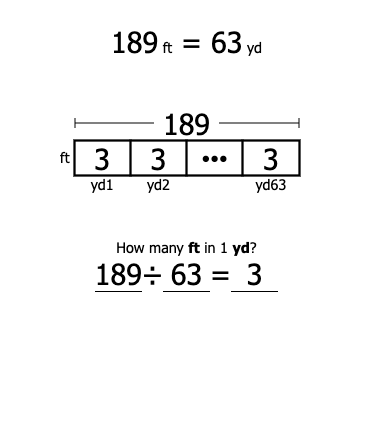
Derive unit rates – the number of smaller units in 1 larger unit – for units of length, weight, and liquid volume. If 189 feet = 63 yards, how many feet is 1 yard? Draw a bar model to visualize the relationship between feet and yards. 189 ÷ 63 = 3, so 3 feet = 1 yard. Thinking proportionally, 189 ft = 63 yd, 21 ft = 7 yd, 3 ft = 1 yd.
Prerequisites: 4-52 ○ 5-27, 4-16
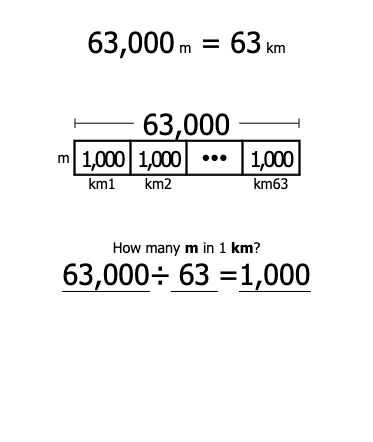
Derive unit rates for length, mass (weight), and liquid volume. Use prefixes (kilo=thousand, milli=thousandth, centi=hundredth) to make unit rates easier to remember. If 63,000 m = 63 km, how many meters is 1 kilometer? Use a bar model to see 1,000 m = 1 km. 63,000 m = 63 km, so 7,000 m = 7 km and 1,000 m = 1 km.
Prerequisites: 5-118 ○ 4-46
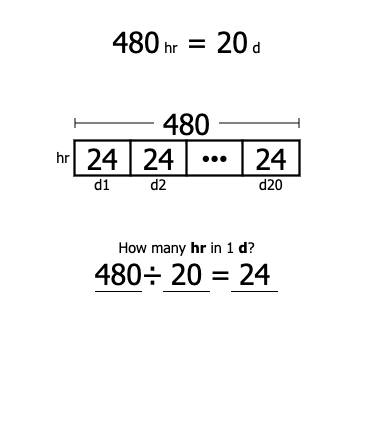
Derive unit rates for clock and calendar time. If 480 hours = 20 days, how many hours is 1 day? Draw a bar model to see 24 hr = 1 d. Thinking proportionally, 480 hr = 20 d, so 240 hr = 10 d, and 24 hr = 1 d. Learn and memorize – commit to memory – common conversion rates for units of time.
Prerequisites: 5-118 ○ 5-27
5-118: Derive Unit Rates with Standard Units
Derive unit rates – the number of smaller units in 1 larger unit – for units of length, weight, and liquid volume. If 189 feet = 63 yards, how many feet is 1 yard? Draw a bar model to visualize the relationship between feet and yards. 189 ÷ 63 = 3, so 3 feet = 1 yard. Thinking proportionally, 189 ft = 63 yd, 21 ft = 7 yd, 3 ft = 1 yd.
Prerequisites: 4-52 ○ 5-27, 4-16
5-119: Derive Unit Rates with Metric Units
Derive unit rates for length, mass (weight), and liquid volume. Use prefixes (kilo=thousand, milli=thousandth, centi=hundredth) to make unit rates easier to remember. If 63,000 m = 63 km, how many meters is 1 kilometer? Use a bar model to see 1,000 m = 1 km. 63,000 m = 63 km, so 7,000 m = 7 km and 1,000 m = 1 km.
Prerequisites: 5-118 ○ 4-46
5-120: Derive Unit Rates with Clock & Calendar Time
Derive unit rates for clock and calendar time. If 480 hours = 20 days, how many hours is 1 day? Draw a bar model to see 24 hr = 1 d. Thinking proportionally, 480 hr = 20 d, so 240 hr = 10 d, and 24 hr = 1 d. Learn and memorize – commit to memory – common conversion rates for units of time.
Prerequisites: 5-118 ○ 5-27
Scale numbers up or down using a double-sided number line to keep track of the multiplicative relationship between two amounts. Use whole numbers and unit fractions, and convert larger to smaller units, and smaller to larger units.
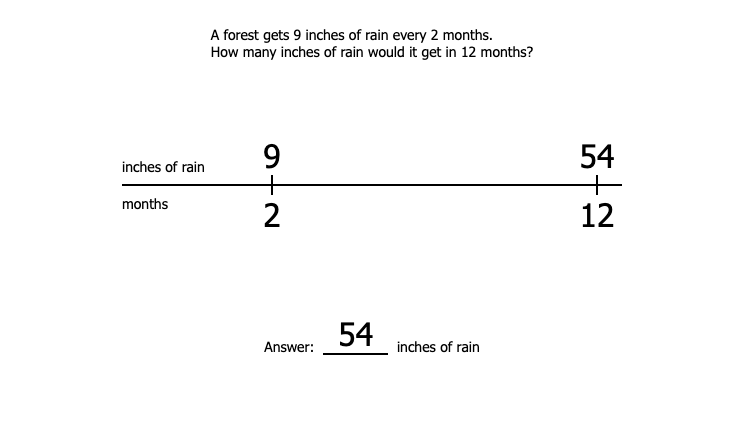
Use double-sided number lines to visualize and scale whole numbers proportionally. If it rains 9 inches in 2 months, how much will it rain in 12 months? Multiply or divide to find the scale factor. Since 6 x 2 months = 12 months, it will rain 6 times as much. It will rain 6 x 9 inches = 54 inches in 12 months.
Prerequisites: 4-17, 4-16
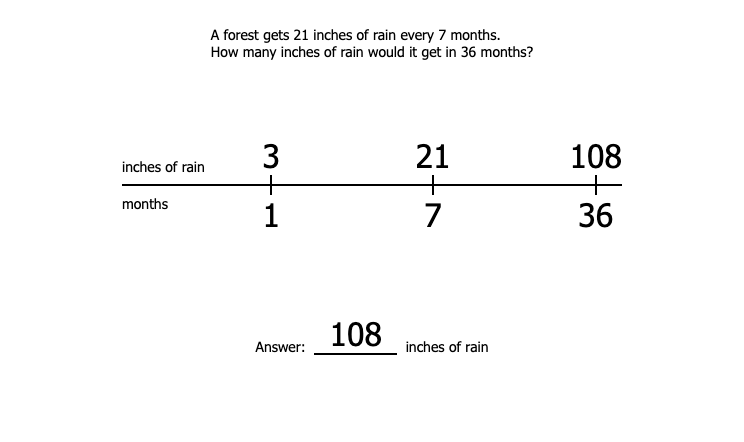
Lay the foundation for ratio and slope by applying the unit rate. If it rains 21 inches in 7 months, how much will it rain in 36 months? 36 is not a multiple of 7, but 21 is. Since 21 inches in 7 months is a rate of 3 inches in 1 month, it will rain 36 x 3 inches = 108 inches in 36 months. Use the unit rate to scale quantities proportionally.
Prerequisites: 5-84
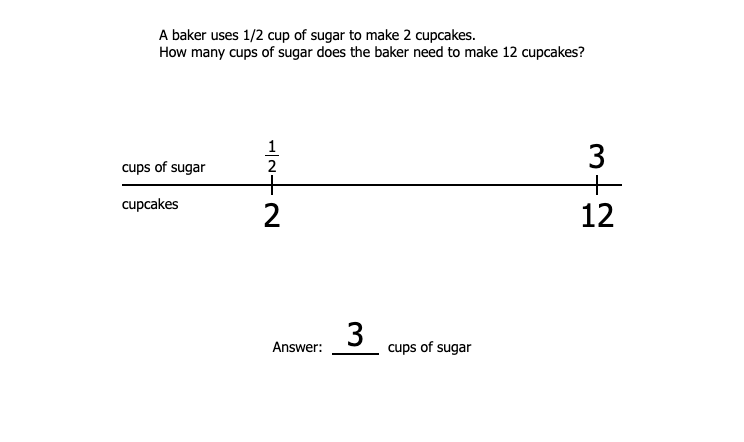
Use double-sided number lines to visualize and scale unit-fractions proportionally. If 2 pies need 1/2 of a cup of sugar, how much sugar do 12 pies need? Multiply or divide to find the scale factor. Since 12 pies ÷ 2 pies = 6, the scale factor is 6, and 12 pies need 6 x 1/2 cup = 3 cups of sugar.
Prerequisites: 5-85 ○ 5-72, 5-54, 5-53
5-084: Scale Whole Numbers on a Double-Sided Number Line: Part I
Use double-sided number lines to visualize and scale whole numbers proportionally. If it rains 9 inches in 2 months, how much will it rain in 12 months? Multiply or divide to find the scale factor. Since 6 x 2 months = 12 months, it will rain 6 times as much. It will rain 6 x 9 inches = 54 inches in 12 months.
Prerequisites: 4-17, 4-16
5-085: Scale Whole Numbers on a Double-Sided Number Line: Part II
Lay the foundation for ratio and slope by applying the unit rate. If it rains 21 inches in 7 months, how much will it rain in 36 months? 36 is not a multiple of 7, but 21 is. Since 21 inches in 7 months is a rate of 3 inches in 1 month, it will rain 36 x 3 inches = 108 inches in 36 months. Use the unit rate to scale quantities proportionally.
Prerequisites: 5-84
5-086: Scale Unit Fractions on a Double-Sided Number Line: Part I
Use double-sided number lines to visualize and scale unit-fractions proportionally. If 2 pies need 1/2 of a cup of sugar, how much sugar do 12 pies need? Multiply or divide to find the scale factor. Since 12 pies ÷ 2 pies = 6, the scale factor is 6, and 12 pies need 6 x 1/2 cup = 3 cups of sugar.
Prerequisites: 5-85 ○ 5-72, 5-54, 5-53
Use picture graphs to represent numbers visually and build number sense. Learn strategies to compare rows or columns, count on, and solve problems by grouping in smart ways. Horizontal and vertical picture graphs provide context for addition and subtraction.
Use picture graphs to represent numbers visually. Find how many in each row by counting. Build number sense by comparing. Is there a pattern? Does the next group or category have the same number of objects, or 1 more? Practice writing digits by tracing. When ready, practice writing digits from memory.
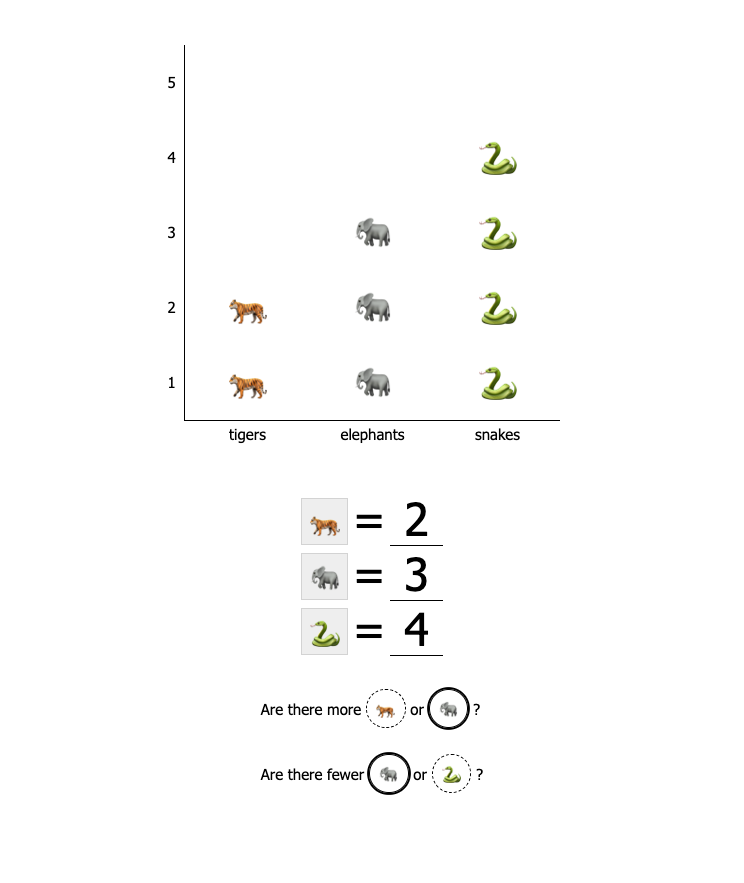
Think flexibly by using vertical picture graphs to model and compare numbers. Find how many in each column by counting. Build number sense by comparing. Is there a pattern? Does the next group or category have the same number of objects, or 1 fewer? Practice writing digits, first by tracing and then from memory.
Prerequisites: K-20
Use picture graphs to count backward and build number sense. Visually compare the number of items in each category to the number of items in the next category. Since it has 1 fewer item, the number is 1 less. Count backward to learn the number that comes before each number – a foundational skill for subtraction.
Prerequisites: K-21 ○ K-23
K-020: Horizontal Picture Graphs to 5
Use picture graphs to represent numbers visually. Find how many in each row by counting. Build number sense by comparing. Is there a pattern? Does the next group or category have the same number of objects, or 1 more? Practice writing digits by tracing. When ready, practice writing digits from memory.
K-021: Vertical Picture Graphs to 5
Think flexibly by using vertical picture graphs to model and compare numbers. Find how many in each column by counting. Build number sense by comparing. Is there a pattern? Does the next group or category have the same number of objects, or 1 fewer? Practice writing digits, first by tracing and then from memory.
Prerequisites: K-20
K-039: Picture Graphs to Count Backward
Use picture graphs to count backward and build number sense. Visually compare the number of items in each category to the number of items in the next category. Since it has 1 fewer item, the number is 1 less. Count backward to learn the number that comes before each number – a foundational skill for subtraction.
Prerequisites: K-21 ○ K-23
Make sense of data when the scale of a picture or bar graph is greater than 1. Connect quantity and length by transitioning from picture graphs to bar graphs. Use scaled graphs to master multiplication facts, visuallize data with larger values, and provide context for operations.
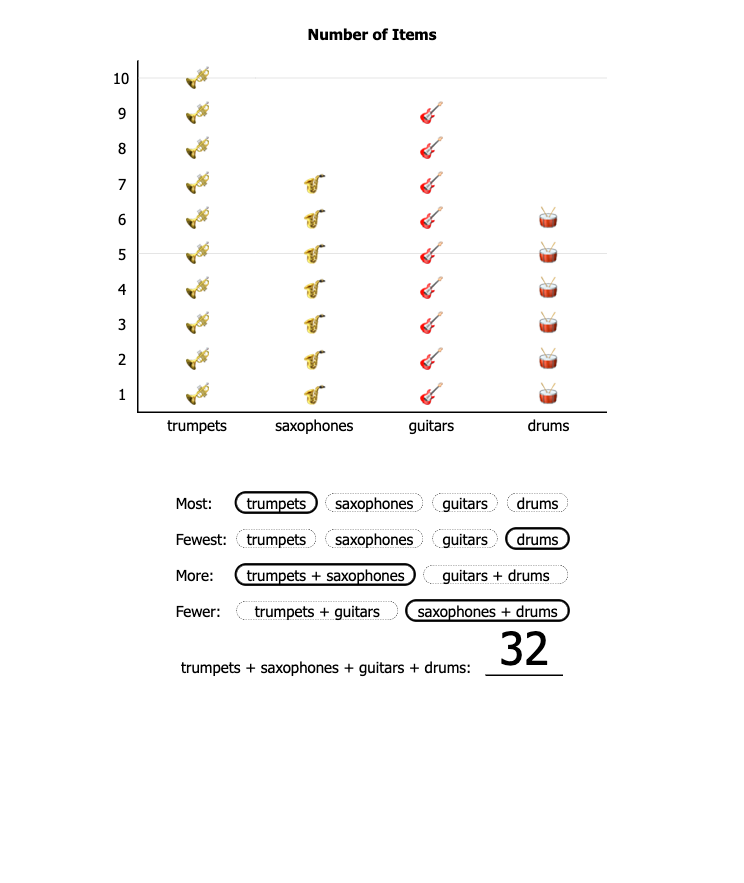
Use vertical picture graphs to make sense of data and provide context for operations. Which category has the greatest number of objects – the most? Which has the least number of objects – the fewest? Find the sum of any 2 categories. Compare and quantify their differences. How many objects in all – the sum of 4 addends?
Prerequisites: 1-5
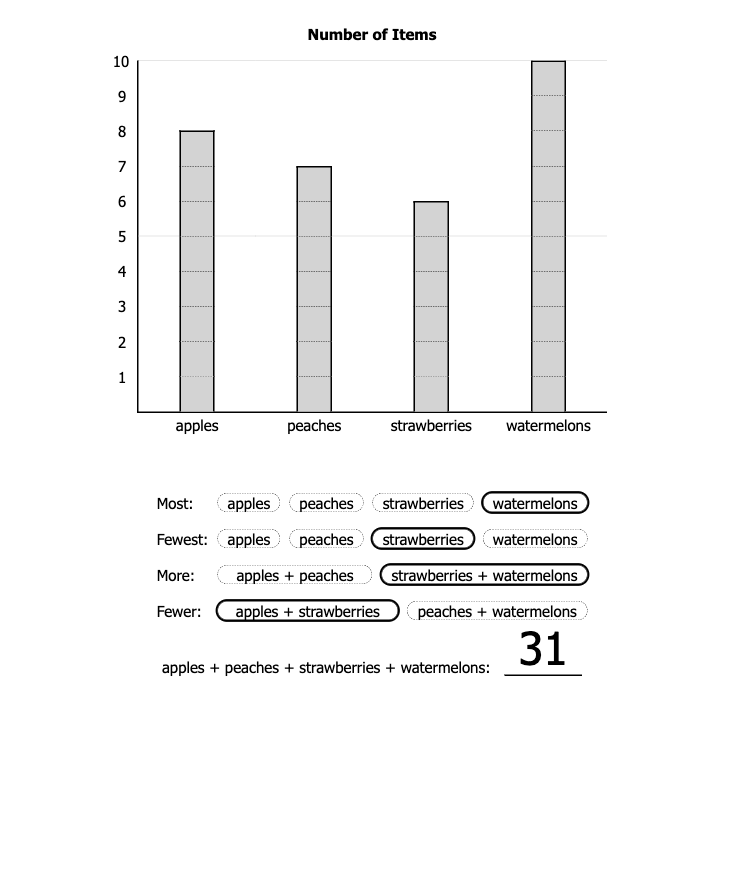
Begin to connect quantity and length by transitioning from picture graphs to bar graphs. Represent 1 object with 1 unit square or unit bar. Since there are no gaps, the number of objects in each category is represented by the length of each bar and given by the graph's vertical axis. Compare and calculate sums and differences.
Prerequisites: 2-128
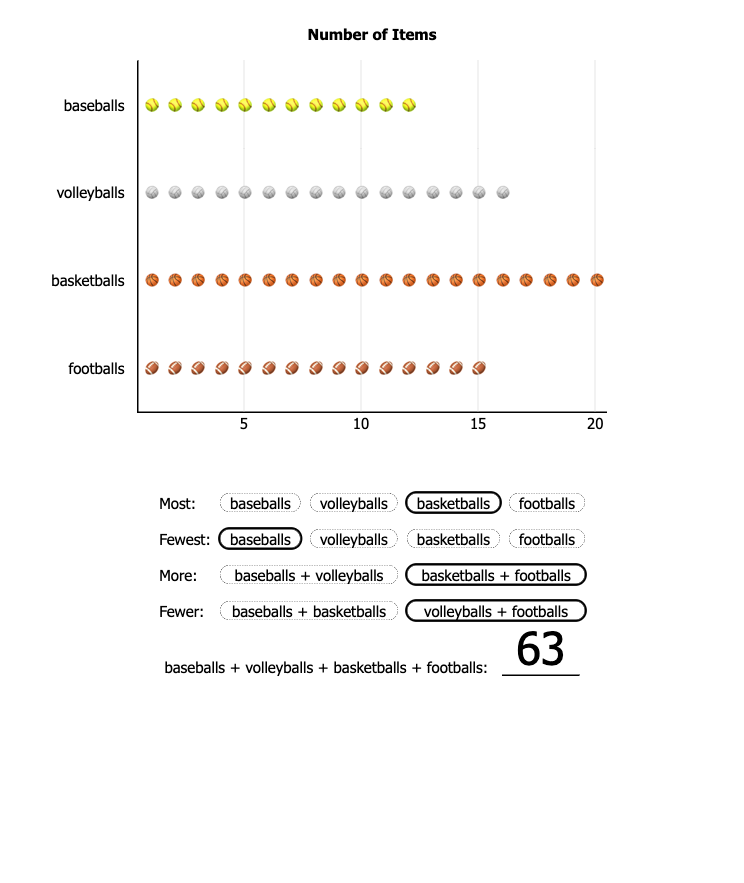
Generalize from vertical to horizontal picture graphs. Use data to provide context for operations, and graphs to represent numbers visually and build number sense. Use grouping strategies based on multiples of 5 and 10 to calculate and compare 1 category, 2 categories, and calculate how many in all.
Prerequisites: 2-128 ○ 1-4
2-128: Vertical Picture Graphs within 10
Use vertical picture graphs to make sense of data and provide context for operations. Which category has the greatest number of objects – the most? Which has the least number of objects – the fewest? Find the sum of any 2 categories. Compare and quantify their differences. How many objects in all – the sum of 4 addends?
Prerequisites: 1-5
2-129: Vertical Bar Graphs within 10
Begin to connect quantity and length by transitioning from picture graphs to bar graphs. Represent 1 object with 1 unit square or unit bar. Since there are no gaps, the number of objects in each category is represented by the length of each bar and given by the graph's vertical axis. Compare and calculate sums and differences.
Prerequisites: 2-128
2-130: Horizontal Picture Graphs within 20
Generalize from vertical to horizontal picture graphs. Use data to provide context for operations, and graphs to represent numbers visually and build number sense. Use grouping strategies based on multiples of 5 and 10 to calculate and compare 1 category, 2 categories, and calculate how many in all.
Prerequisites: 2-128 ○ 1-4
Visualize data by plotting frequency on an open number line. Use line plots to answer statistical questions about the data. Use fractional measurements of data measured to the nearest half and quarter unit, and progress to data measaured to the nearest tenth or hundredth of a unit.
Use vertical picture graphs to make sense of data and provide context for operations. Which category has the greatest number of objects – the most? Which has the least number of objects – the fewest? Find the sum of any 2 categories. Compare and quantify their differences. How many objects in all – the sum of 4 addends?
Prerequisites: 1-5
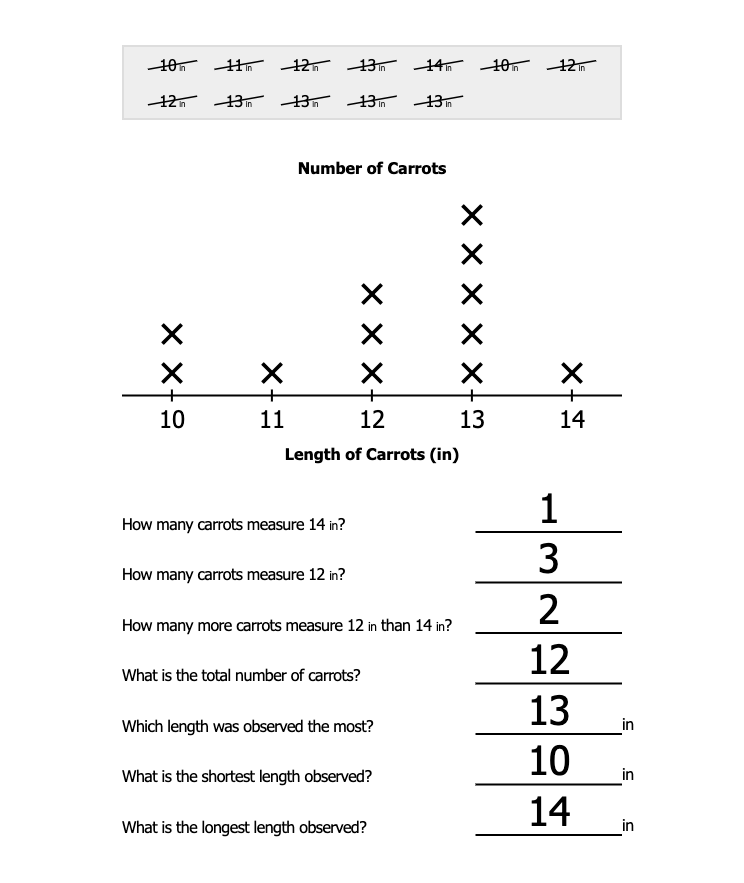
Introduce line plots as a visual way to make sense of data and provide context for measuring length and weight. Plot the frequency of lengths measured to the nearest inch or foot, and the measurement of weight measured to the nearest ounce or pound. What's the minimum length or weight? What's the maximum length or weight? Which length or weight is observed most? Explore data both as individual observations and also as a group.
Prerequisites: 2-128
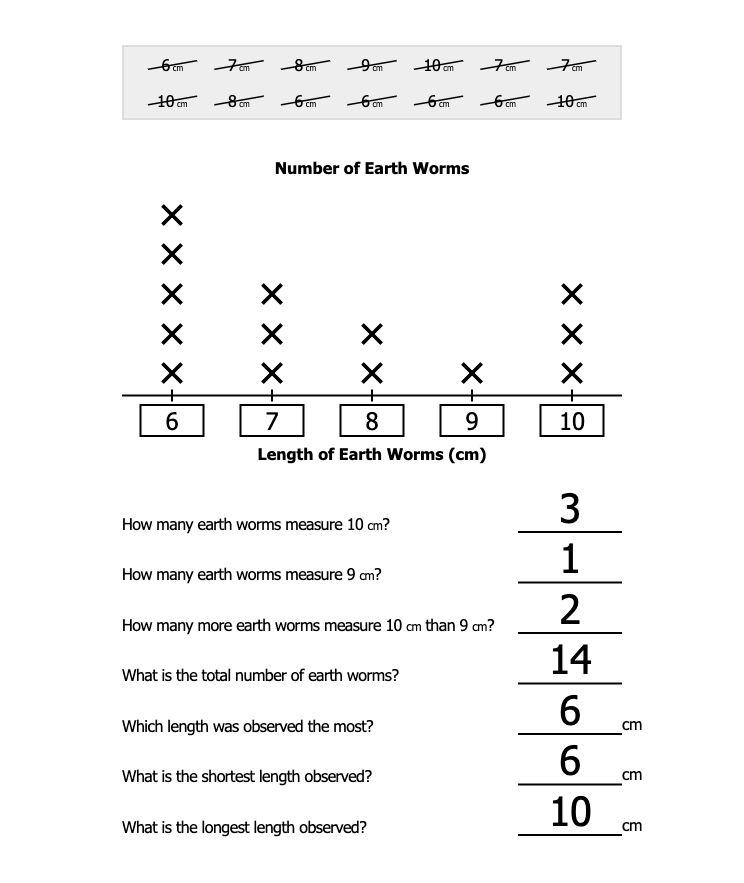
Draw line plots to make sense of data measured in centimeters, meters, grams and kilograms. Start by drawing a number line that includes all the values in the sample. Write the smallest and largest values first, followed by all the numbers in-between. Plot the frequency of each length or weight to better understand the sample's data as a group.
Prerequisites: 2-132
2-128: Vertical Picture Graphs within 10
Use vertical picture graphs to make sense of data and provide context for operations. Which category has the greatest number of objects – the most? Which has the least number of objects – the fewest? Find the sum of any 2 categories. Compare and quantify their differences. How many objects in all – the sum of 4 addends?
Prerequisites: 1-5
2-132: Line Plots with Standard Units
Introduce line plots as a visual way to make sense of data and provide context for measuring length and weight. Plot the frequency of lengths measured to the nearest inch or foot, and the measurement of weight measured to the nearest ounce or pound. What's the minimum length or weight? What's the maximum length or weight? Which length or weight is observed most? Explore data both as individual observations and also as a group.
Prerequisites: 2-128
2-133: Line Plots with Metric Units
Draw line plots to make sense of data measured in centimeters, meters, grams and kilograms. Start by drawing a number line that includes all the values in the sample. Write the smallest and largest values first, followed by all the numbers in-between. Plot the frequency of each length or weight to better understand the sample's data as a group.
Prerequisites: 2-132
Match shapes, solids, and common objects. Practice part-whole thinking by breaking larger shapes into smaller shapes and joining smaller shapes to make larger shapes. Learn the difference between defining and non-defining attributes and explore what makes shapes the same or different.
Comparing is a key aspect of learning. Given 2 columns of pictures, match each picture on the left with the same picture on the right. Explore what makes 2 pictures the same and what makes other pictures different. Matching activities introduce the concept of 1-to-1 correspondence. They help prepare students for counting.
Introduce 2D shapes. Which shape on the left matches the same shape on the right? Matching sides and corners helps with one-to-one correspondence. Does a shape have an extra side or corner? Does it have more? If one shape has more, does the other shape have fewer? Match shapes to objects in the room.
Prerequisites: K-1
Introduce 3D solids. When possible, use real solids as well as pictures of solids. Recognize and learn their geometric names by making connections to common and familiar objects. Which solid looks like a can of soup? Which solid looks like an ice cream cone? Which looks like an ice cube? A box? A ball?
Prerequisites: K-2
K-001: Match Objects
Comparing is a key aspect of learning. Given 2 columns of pictures, match each picture on the left with the same picture on the right. Explore what makes 2 pictures the same and what makes other pictures different. Matching activities introduce the concept of 1-to-1 correspondence. They help prepare students for counting.
K-002: Match Shapes
Introduce 2D shapes. Which shape on the left matches the same shape on the right? Matching sides and corners helps with one-to-one correspondence. Does a shape have an extra side or corner? Does it have more? If one shape has more, does the other shape have fewer? Match shapes to objects in the room.
Prerequisites: K-1
K-003: Match Solids
Introduce 3D solids. When possible, use real solids as well as pictures of solids. Recognize and learn their geometric names by making connections to common and familiar objects. Which solid looks like a can of soup? Which solid looks like an ice cream cone? Which looks like an ice cube? A box? A ball?
Prerequisites: K-2
Compare the size, length, height, width, and area of circles and polygons, and identify shapes and solids by name. Use correct vocabulary to describe relative position of objects on a grid, to build spatial awareness, and to compare an objects' position relative to others.
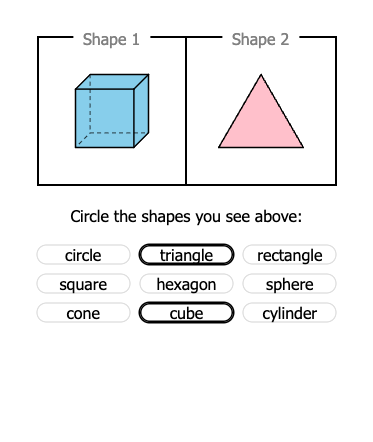
Compare flat shapes or solids that may be rotated or scaled. Which defining attributes are the same? Which are different? If both are flat, how many straight sides do they each have? Are their sides all equal? How many corners or vertices do they have? If both are solids, how many faces do they each have?
Prerequisites: K-123
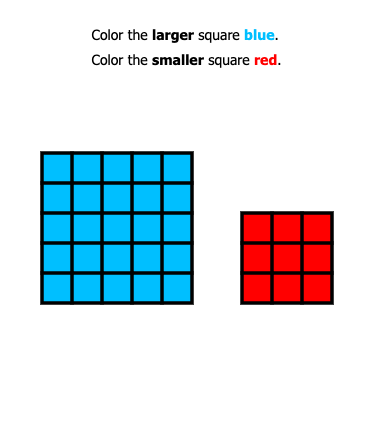
Lay the foundation for geometric measurement by comparing the size, length, height, and width of squares and rectangles. Use vocabulary including "larger," "longer," "taller," and "wider," as well as "smaller," "shorter," and "narrower." Does one shape fit inside the other? Use part-whole thinking when comparing.
Prerequisites: K-73
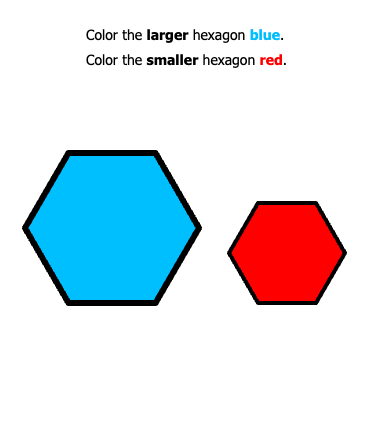
Generalize from comparing rectangles to comparing circles, triangles, squares, pentagons, and hexagons. Compare size and height by visualizing if one shape can fit inside the other. If it can, then that shape is smaller, shorter, and a part of the larger, taller shape. Build the conceptual foundation for part-whole thinking.
Prerequisites: K-125 ○ K-7
K-124: Compare Defining Attributes of 2D & 3D Shapes
Compare flat shapes or solids that may be rotated or scaled. Which defining attributes are the same? Which are different? If both are flat, how many straight sides do they each have? Are their sides all equal? How many corners or vertices do they have? If both are solids, how many faces do they each have?
Prerequisites: K-123
K-125: Compare Area, Length, Height, and Width of Rectangles
Lay the foundation for geometric measurement by comparing the size, length, height, and width of squares and rectangles. Use vocabulary including "larger," "longer," "taller," and "wider," as well as "smaller," "shorter," and "narrower." Does one shape fit inside the other? Use part-whole thinking when comparing.
Prerequisites: K-73
K-126: Compare Area and Height of Circles & Polygons
Generalize from comparing rectangles to comparing circles, triangles, squares, pentagons, and hexagons. Compare size and height by visualizing if one shape can fit inside the other. If it can, then that shape is smaller, shorter, and a part of the larger, taller shape. Build the conceptual foundation for part-whole thinking.
Prerequisites: K-125 ○ K-7
Observe attributes of objects and reason about which categories an object fits, or does not fit. Classify and compare shapes by defining attributes and learn to identify lines of symmetry. Develop reasoning skills and fluency with 4-sided shapes by exploring the heirarchy of quadrilaterals.
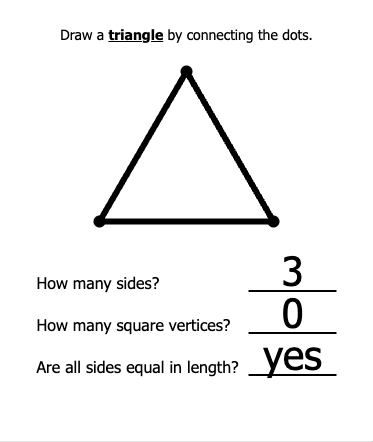
Explore the defining attributes – number of sides, equal sides, vertices, and square corners – that determine if a shape is a triangle, quadrilateral, rectangle, square, pentagon, or hexagon. In contrast, non-defining attributes – color, rotation, and size – describe a shape, but don't define or determine what kind of shape it is.
Prerequisites: 1-134
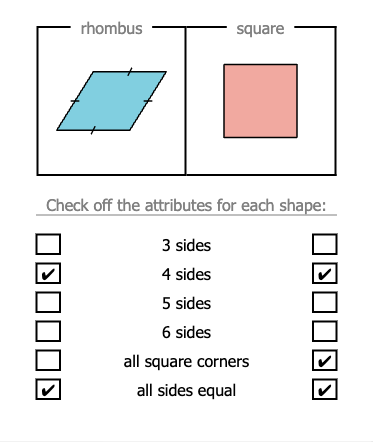
Categorize shapes by identifying their defining attributes. If a shape has 4 equal sides, 2 pairs of parallel sides, and 4 square corners, what kind of shape is it? Can a shape have more than one name or category? It's a quadrilateral, rhombus, rectangle, and square. Goal is to commit names and attributes to memory.
Prerequisites: 2-134
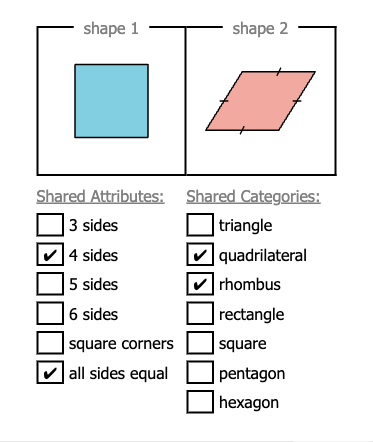
Explore how categories are related by identifying shared attributes. Which defining attributes do a square and rhombus have in common? They both have 4 equal sides, so both are quadrilaterals and rhombuses. Since squares also have 4 square corners, they're a special kind of rhombus and called a subcategory.
Prerequisites: 3-134
2-134: Defining Attributes of 2D Shapes
Explore the defining attributes – number of sides, equal sides, vertices, and square corners – that determine if a shape is a triangle, quadrilateral, rectangle, square, pentagon, or hexagon. In contrast, non-defining attributes – color, rotation, and size – describe a shape, but don't define or determine what kind of shape it is.
Prerequisites: 1-134
3-134: Classify & Compare Shapes by Defining Attributes
Categorize shapes by identifying their defining attributes. If a shape has 4 equal sides, 2 pairs of parallel sides, and 4 square corners, what kind of shape is it? Can a shape have more than one name or category? It's a quadrilateral, rhombus, rectangle, and square. Goal is to commit names and attributes to memory.
Prerequisites: 2-134
3-135: Classify & Compare Shapes by Category
Explore how categories are related by identifying shared attributes. Which defining attributes do a square and rhombus have in common? They both have 4 equal sides, so both are quadrilaterals and rhombuses. Since squares also have 4 square corners, they're a special kind of rhombus and called a subcategory.
Prerequisites: 3-134
Label and draw points, line segments, rays, and lines. Draw, describe, and classify angles. Use a protractor to measure angles and identify right angles, straight angles, acute angles, obtuse angles, and reflex angles.
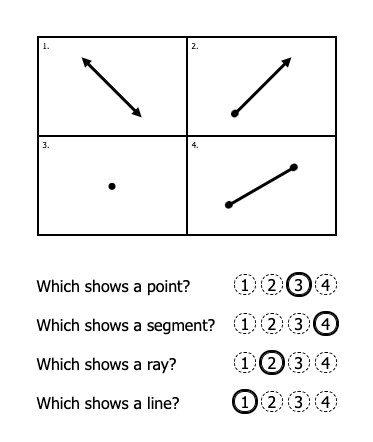
Identify and draw points, line segments, rays, and lines. A point is the smallest part of a line. A line segment connects 2 points. Its length is the distance between the points. A ray starts at a point and extends forever in 1 direction. A line extends forever in opposite directions. The length of a point, ray, or line can't be measured.
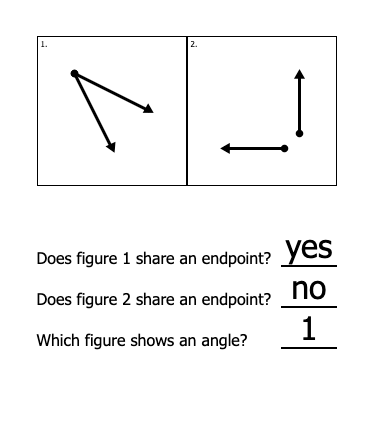
Form angles using 2 rays that share a common endpoint. Describe and classify angles informally as "sharp" (acute), "wide" (obtuse), and "square" (right). Transition to formal names when students can measure angles in degrees with a protractor. Draw sharp, wide, and square angles, as well as figures that are not angles.
Prerequisites: 4-128
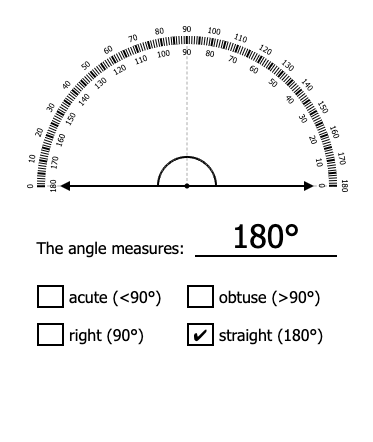
Measure angles using a protractor. Classify by comparing angles to 90° right angles formed by perpendicular rays, and 180° straight angles formed by rays pointing in opposite directions. An angle less than 90° is an acute angle. An angle between 90° and 180° is an obtuse angle. A reflex angle is between 180° and 360°.
Prerequisites: 4-129
4-128: Points, Line Segments, Rays & Lines
Identify and draw points, line segments, rays, and lines. A point is the smallest part of a line. A line segment connects 2 points. Its length is the distance between the points. A ray starts at a point and extends forever in 1 direction. A line extends forever in opposite directions. The length of a point, ray, or line can't be measured.
4-129: Draw, Describe & Classify Angles
Form angles using 2 rays that share a common endpoint. Describe and classify angles informally as "sharp" (acute), "wide" (obtuse), and "square" (right). Transition to formal names when students can measure angles in degrees with a protractor. Draw sharp, wide, and square angles, as well as figures that are not angles.
Prerequisites: 4-128
4-130: Measure & Classify Angles using a Protractor
Measure angles using a protractor. Classify by comparing angles to 90° right angles formed by perpendicular rays, and 180° straight angles formed by rays pointing in opposite directions. An angle less than 90° is an acute angle. An angle between 90° and 180° is an obtuse angle. A reflex angle is between 180° and 360°.
Prerequisites: 4-129
Coordinate geometry is introduced. Locate or plot points on a coordinate plane, and generate tables of coordinate pairs. Learn to move on a plane using relative and cardinal directions, and analyze patterns and relationships, using coordinate pairs.
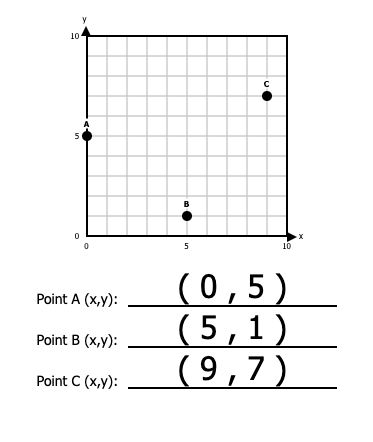
Introduce coordinate geometry. Given a point in Quadrant I, find its coordinate pair. Given a coordinate pair, plot the point. The first number in a coordinate pair gives the number of units moving from (0,0) to the right (east) along the x-axis. The second number gives the number of units moving up (north) along the y-axis.
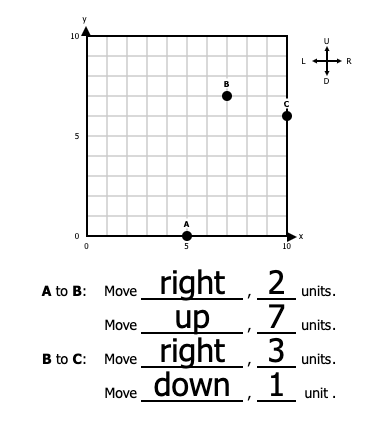
Apply understanding of coordinate pairs by moving on a coordinate plane. Given the starting point and 2 subsequent points, determine the distance and relative direction to move (right, left, up, down). Given the starting point and the distance and cardinal direction to move (east, west, north, south), find the ending point.
Prerequisites: 5-129
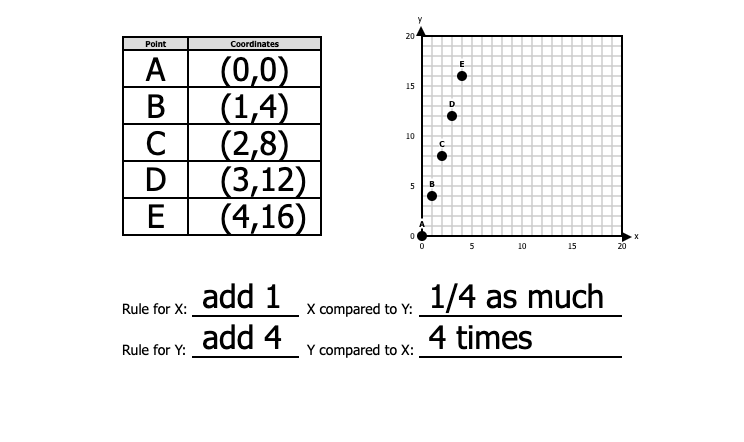
Analyze patterns and relationships using coordinate pairs. Starting at (0,0), use the rules for the x and y coordinates to make a table and plot the next 4 coordinate pairs. For every point, is the y coordinate the same multiple or fraction of the x coordinate? Since it's the same, the relationship between x and y is proportional.
Prerequisites: 5-130
5-129: Introduction to Coordinate Geometry
Introduce coordinate geometry. Given a point in Quadrant I, find its coordinate pair. Given a coordinate pair, plot the point. The first number in a coordinate pair gives the number of units moving from (0,0) to the right (east) along the x-axis. The second number gives the number of units moving up (north) along the y-axis.
5-130: Relative & Cardinal Directions
Apply understanding of coordinate pairs by moving on a coordinate plane. Given the starting point and 2 subsequent points, determine the distance and relative direction to move (right, left, up, down). Given the starting point and the distance and cardinal direction to move (east, west, north, south), find the ending point.
Prerequisites: 5-129
5-131: Analyze Proportional Linear Relationships using Coordinate Pairs
Analyze patterns and relationships using coordinate pairs. Starting at (0,0), use the rules for the x and y coordinates to make a table and plot the next 4 coordinate pairs. For every point, is the y coordinate the same multiple or fraction of the x coordinate? Since it's the same, the relationship between x and y is proportional.
Prerequisites: 5-130
